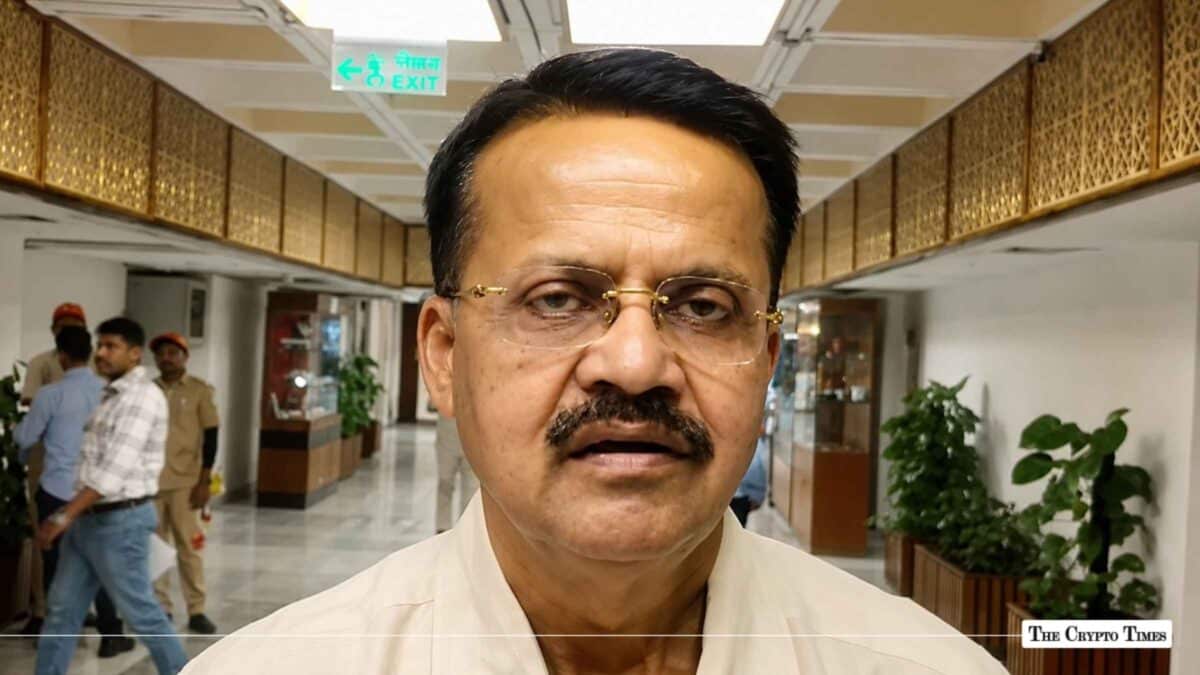
India’s Parliamentary Standing Committee on Finance Chairman Bhartruhari Mahtab dropped a significant statement today while addressing the media after the committee’s 7th sitting on Virtual Digital Assets (VDAs), commonly known as cryptocurrency.
Speaking to Press Trust of India (PTI), Mahtab said that a large number of people in India are investing in crypto, and thousands of crores are flowing out of the country through VDA investments, something he described as “very alarming.”
This is the first time a sitting chairman of India’s Parliamentary Standing Committee on Finance has publicly acknowledged the scale of capital flight linked to crypto in such direct terms.
What happened in today’s meeting
Mahtab confirmed that today’s sitting, which was the committee’s 7th on the VDA subject, focused specifically on the crypto and VDA topic.
“We called 3 stakeholders, operating in India and are registered in India,” Mahtab told PTI. He added that “there are certain organizations which are stationed outside India, in Singapore.”
As The Crypto Times reported on May 13, the three exchanges called were ZebPay, Binance, and WazirX.
Mahtab also pointed out that there are certain organizations stationed outside India, in Singapore, which was a clear reference to the offshore entities and structures that have been a recurring concern in India’s crypto policy discussions. WazirX’s parent entity, for instance, went through restructuring via the Singapore High Court after the $234.9 million hack in July 2024.
“We also called the Revenue Secretary, and the Income Tax Department, and also the Corporate Affairs Secretary, because all these 3 are involved in it, related to taxation,” Mahtab said. “It was necessary to understand their viewpoint.”
He confirmed that “we will be having further meetings on this subject” and noted that “this is the 7th sitting that we had today.”
Apart from the exchange representatives, the committee also heard from the Revenue Secretary, the Income Tax Department, and the Secretary of Corporate Affairs. Mahtab explained that all three government departments were called because they are directly involved in the taxation side of VDAs, and it was necessary to understand their viewpoint.
He confirmed that more meetings will follow on this subject.
Three categories in the world; India falls in none
When PTI asked Mahtab about the regulation angle and the Reserve Bank of India’s known stance on VDAs, he gave a very detailed breakdown of how different countries are approaching crypto globally.
Mahtab acknowledged the RBI’s position directly: “RBI is opposed to any regulation or any permission for VDA being operated in our country.” This is consistent with the central bank’s long-standing position. The RBI first warned the public about virtual currencies back in December 2013 and went as far as issuing a banking ban on crypto businesses in April 2018, which was later struck down by the Supreme Court in 2020.
But here is where it gets interesting.
Mahtab outlined three distinct categories of countries when it comes to crypto:
The first category includes countries like the United States, the United Kingdom, and the European Union, along with certain other nations, that have chosen to regulate VDAs. The US recently moved forward with the GENIUS Act on stablecoins and is actively working on the CLARITY Act for broader crypto market structure. The EU has already implemented its Markets in Crypto-Assets (MiCA) framework.
The second category includes countries like China that have outright banned cryptocurrency.
The third category, Mahtab said, includes countries like Japan and Brazil that do not have a full-fledged regulatory mechanism but are trying to contain crypto through their existing legal frameworks.
India, as of today, does not fall neatly into any of these three categories. The country has no dedicated crypto law, no unified regulatory framework, but it does tax VDA transactions at a flat 30% under Section 115BBH of the Income Tax Act with an additional 1% TDS under Section 194S. And the RBI does not recognise it.
Mahtab said the committee is studying all three approaches to determine which one works best for India.
Capital flight is very alarming
Perhaps the most striking part of Mahtab’s statement was when he said that a lot of people in India are investing in cryptocurrency, and the money that is being accrued from these investments should be taxed within the country.
He went further and said that the committee has found that thousands of crores are being invested in VDAs, and what is alarming is that all of it is going out of the country.
This aligns with what industry data has been showing for a while now. According to estimates, approximately 90% of VDA trading volume involving Indian users occurs on offshore platforms that sit outside India’s regulatory jurisdiction.
MP Raghav Chadha noted during the Union Budget 2026-27 debates that nearly 73% of VDA trading now takes place on foreign exchanges, over 180 Indian crypto startups have moved abroad, and around 12 crore investors use offshore platforms, leading to a significant loss of potential tax revenue.
The CBDT, during the committee’s earlier January 7, 2026 sitting, had informed the panel that approximately Rs 888.82 crore in undisclosed income related to VDA transactions had been identified and notices had been sent to over 44,000 taxpayers.
What the committee has NOT said
It is important to note what Mahtab did not say.
He did not confirm that the committee is recommending regulation. He did not say India is planning to regulate crypto. He did not announce any upcoming legislation or framework. What he said is that the committee is studying all three global approaches and is still in the discovery phase.
The committee’s study, titled “A Study on Virtual Digital Assets (VDAs) and Way Forward,” was taken up as a subject for detailed examination during the 2024-25 period. Today was the 7th sitting. More sittings will follow.
So while the direction of the conversation is encouraging for the Indian crypto industry, there is no concrete outcome yet. The committee is still gathering evidence, still hearing from stakeholders, and still studying what other countries have done.
The backstory
For context, India’s approach to crypto has been one of the most complex and contradictory in the world. The country taxes crypto aggressively: a flat 30% tax on all gains with no deductions allowed other than the cost of acquisition, no loss set-offs between VDAs or against any other income, and a 1% TDS on every qualifying transaction. India has also brought crypto exchanges under the Prevention of Money Laundering Act since March 2023, with 49 exchanges registered with FIU-IND as reporting entities.
But there is no comprehensive law governing VDAs. No clarity on which regulator oversees crypto. No legal definition of whether crypto is a commodity, a security, or a currency. The RBI remains firmly opposed. A discussion paper on crypto regulation that was reportedly in its “final drafting stages” as of May 2025 was shelved again by April 2026 after the RBI reportedly blocked it.
The Supreme Court of India itself questioned the absence of comprehensive crypto regulation in May 2025.
Meanwhile, India continues to lead the Chainalysis Global Crypto Adoption Index for the third consecutive year, with an estimated 119 million crypto users as of 2025.
The gap between how aggressively India taxes crypto and how little it has done to regulate the sector is something that today’s meeting, and Mahtab’s public comments, have only made more visible.
More sittings will follow. Whether they lead to actual regulation remains an open question.
Also Read: Gujarat Deputy CM Uncovers Dark Web Crypto Network in India Linked to Terror