- BG Wealth Sharing and its sister platform DSJ Exchange ran for roughly twelve months before collapsing in early May 2026, with reported losses above $150 million.
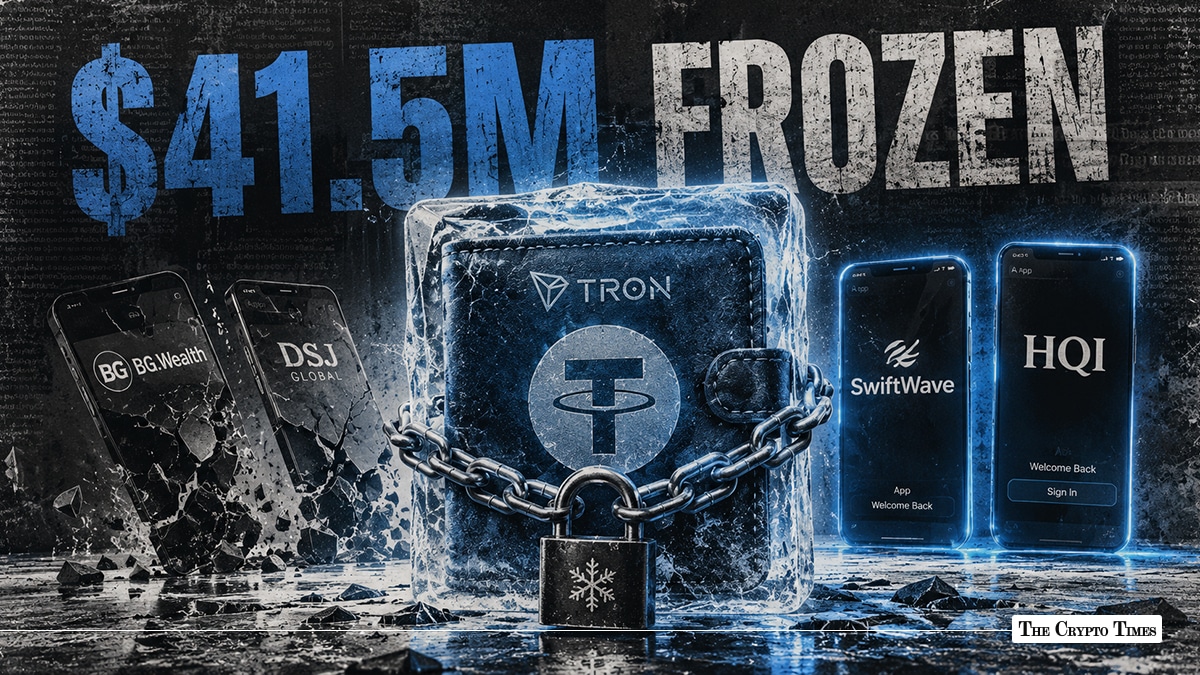
- Tether blacklisted $38.4 million in USDT on TRON, and exchange partners froze another $3.1 million, bringing total recovered funds to around $41.5 million.
- On-chain investigator ZachXBT documented more than $92 million laundered through cross-chain bridges and token swaps in the days before withdrawals froze.
- Thirteen regulators across five continents had already issued public warnings before the collapse. None of them stopped it.
- Promoters who recruited for BG Wealth and DSJ are now appearing in chat groups pushing Swift Wave Capital and HQI Exchange, platforms with near-identical mechanics.
- Direct wallet-level links between the collapsed network and the new platforms have not been publicly confirmed. The operational overlap, however, is hard to ignore.
The message came through Bonchat at 2 a.m. for some users. For others, it was a frozen withdrawal screen and a sudden demand for a 12 percent tax. By the time most BG Wealth Sharing users understood what was happening, the money was already gone.
More than $150 million, according to the on-chain trail. Tens of thousands of users across at least a dozen countries. Twelve months of operation, thirteen regulatory warnings ignored, and one of the most aggressive USDT freezes Tether has ever executed.
That should have been the end of the story. It is not.
In the days after BG Wealth and its trading front-end DSJ Exchange went dark, something strange started happening inside the Telegram and Bonchat groups where victims were trying to make sense of their losses. New platform names began circulating. Swift Wave Capital. HQI Exchange. Recovery pitches. Fresh signal groups. Familiar mentors with a new opportunity that, this time, would be different.
The dashboards on these new platforms look almost identical to the one that just collapsed. The recruitment scripts read the same. The promised returns sit in the same suspicious 1 to 3 percent daily range. And in many cases, the people promoting them are the same people who sold users on BG Wealth six months ago.
Whether these platforms are run by the same operators is a separate question, and one this article will treat carefully. What is clear is that the playbook has changed. In 2026, large crypto Ponzi networks are no longer disappearing after the exit. They are rebranding, redirecting, and putting their own burned users back into the next funnel.
This is what investigators are starting to call the scam pipeline. Here is how it works.
The pipeline model
Older crypto scams followed a simple arc. Launch a platform, take the deposits, vanish. The 2026 model is more durable, and more cynical. Click through each stage to see how it operates.
A polished exchange-style platform is deployed across multiple temporary domains, with a professional dashboard, fake audit reports, and AI-generated spokespeople.
That handoff between stages five and six is the part that has changed. The victim list is now an asset. The community chat groups that were used to recruit people into BG Wealth are the same groups now being used to redirect them into Swift Wave.
How the 2026 crypto scam playbook has changed
The most striking thing about networks like BG Wealth is how professional they look. The dashboards are not crude. The marketing materials use AI-generated spokespeople and slick video content. Customer support responds quickly. Some platforms even publish fake audit reports and fabricated regulatory filings.
The trading layer is theatre
Users are not really trading. They paste a signal code provided by their mentor, click a button, and watch a fake profit appear on the screen. This is what victims and researchers have been calling “click-a-button” trading. The core mechanic is the same across DSJ, Swift Wave, and similar platforms.
The infrastructure is multi-domain
When regulators in Washington State, Alberta, or New Zealand named DSJ-linked sites, the operators simply rotated to new domains. The related TXEX umbrella, operated by League of Whalefall Ltd and running in parallel to DSJ, was linked by New Zealand’s FMA to 813 lookalike sites and 30 corporate entities at various points.
The recruitment layer is human
Many of the “mentors” running these chats are not the operators. Recent reporting suggests a significant share are themselves trafficking victims working out of scam compounds in Southeast Asia, following scripts handed down by a much smaller core team.
The settlement layer is stablecoins
USDT on TRON dominates because it settles in seconds and avoids traditional banking compliance entirely. The irony is that the same speed that makes USDT attractive to scammers is also what lets Tether freeze funds when it acts quickly enough.
THE SHIFT

The platform name is the least useful thing to evaluate. The mechanics, the recruitment style, the withdrawal traps, and the chat-group migration patterns are what actually identify the scam.
A note on TXEX, DSJ, and how they relate
Because the names blur together, one clarification matters. TXEX (TX Exchange) and DSJ Exchange are not the same operation, and DSJ did not launch “under” TXEX. Per the Washington State DFI and New Zealand FMA:
- TX Exchange (TXEX) is operated by League of Whalefall LTD, which marketed itself to Pacific Islander communities.
- DSJ Exchange is operated alongside BG Wealth Sharing LTD, which styled itself as “the world’s largest hedge fund” and marketed globally.
- These are two intertwined-but-distinct syndicates that regulators describe as running “in parallel” with “significant operational overlap” — shared tactics, shared infrastructure patterns, and overlapping timelines, but not a formal parent-subsidiary structure.
This distinction matters precisely because this article is careful about not overstating links. The 813-website figure belongs to the TXEX/League of Whalefall network specifically.
BG Wealth, DSJ, Swift Wave, and HQI side by side
Whether Swift Wave and HQI are operated by the same people who ran BG Wealth and DSJ is unresolved. What can be compared, side by side, is the structure of each platform.
| Pattern | BG Wealth / DSJ | Swift Wave / HQI |
|---|---|---|
| Trading mechanic | Paste signal, click button, fake daily yield of 1.3 to 2.6 percent | Same mechanic, similar yield promises |
| Recruitment | MLM referral tiers, Telegram and Bonchat mentors | MLM referral tiers, same chat ecosystems |
| Withdrawal block | 12 percent “IPO tax” demanded before release | “VIP upgrade” or KYC deposit demanded before release |
| Corporate presence | Virtual mailbox in Colorado, meaningless Form D filing | No verifiable HQ, generic offshore registration |
| Domains | Rapid rotation across hundreds of mirrors | Recently registered domains, lookalike branding |
The template is identical. Whether the people behind it are identical is a separate question, and one that has not been answered with on-chain evidence yet.
One important distinction between the two new platforms: HQI Exchange’s role as a migration target is regulator-documented. The Washington State DFI updated its official BG Wealth alert on May 15, 2026 to state that “BG Wealth investors are reportedly being directed away from the DSJ Exchange to a new platform called the HQI Exchange (‘HQIEX’)” and that “investors are being told to deposit more funds to ‘move’ to the new platform.”
HQI and HQIEX were formally added to the DFI’s named-entity list. Swift Wave Capital (also branded VCEX or Value Chain) has not been named in the same regulatory alerts, but independent scam researchers, including BehindMLM and Danny de Hek of dehek.com, documented it as a BG Wealth Sharing “clone” using identical cut-and-paste signal trading as early as March 2026, tied to a promoter named Faiana Brown operating in Hawaii. In BehindMLM’s framing, Swift Wave is a “breakaway scheme,” an early promoter pivot that began before the DSJ collapse, not only after it.
Timeline of the collapse
BG Wealth Sharing and DSJ Exchange launch under the broader TXEX umbrella.
Thirteen regulators across five continents issue warnings, including the Alberta Securities Commission, New Zealand’s FMA, and Washington State DFI.
U.S. agencies escalate, including an FBI domain seizure tied to the network. The law enforcement action seizes the bgwealthsharing.com domain under Operation Level Up and the Scam Center Strike Force.
More than $92 million moved cross-chain through bridges and swaps.
DSJ halts withdrawals and demands a 12 percent tax to release funds.
Swift Wave Capital (VCEX / Value Chain) is documented by independent scam researchers as a BG Wealth “breakaway scheme,” with promoters pivoting before the main collapse.
Tether freezes $38.4 million in USDT on TRON.
Promoter activity begins shifting toward Swift Wave Capital and HQI Exchange. Washington State DFI updates its alert to formally name HQI Exchange as the platform BG Wealth victims are being migrated towards.
The money trail
Most of the money came in as USDT on TRON. Most of it left the same way, at least at first. ZachXBT’s findings on DSJ traced more than $92 million moving through a familiar mix of obfuscation tools in the week before the collapse.
Some of that movement was caught in time. Tether froze $38 million in USDT. Exchange partners locked another $3.1 million. That leaves roughly $100 million unaccounted for. Some of it has likely been off-ramped through OTC desks. Some of it, investigators suspect, is funding the next platform.
For broader enforcement context: the April 2026 Operation Level Up — the U.S.-led action under which bgwealthsharing.com was seized — restrained more than $701 million in connected cryptocurrency and produced 276 arrests across nine scam compounds, per regulatory and law enforcement disclosures.
This article does not publish specific wallet addresses, both to avoid interfering with ongoing investigations and to avoid giving operators a heads-up on which clusters are being watched.
Why victims walk into the next one
It is easy to ask why someone who just lost their savings would deposit again. The answer is mostly psychological.
Sunk cost
Victims have already lost real money and are looking for any path back. When the same mentor who guided them into DSJ now says a new platform will recover their losses in thirty days, the desperation is doing the listening.
Parasocial trust
Mentors in these groups spend months building one-on-one relationships. When the platform collapses, the mentor positions themselves as a victim too, then privately offers a “way out” through the next platform. Many victims report that this conversation feels like being rescued.
Manufactured momentum
Shill accounts inside the chats post fake withdrawal screenshots from the new platform within hours of the old one going dark. The fear of missing the “recovery window” pushes hesitant users to deposit again.
This is not a bug in the model. It is the model.
The regulatory gap
A network this large should not have been able to run for 12 months. It did, despite thirteen separate regulator warnings.
The reason is jurisdictional. A scam group can target users in Canada, register a shell in Colorado, host its domains through a privacy service, and run its chat centers from compounds in Southeast Asia. By the time any one regulator issues a cease-and-desist, the operators have already pointed users at a new domain. There is no real-time global database that lets enforcement agencies move at the speed these networks operate.
The takedowns that have worked, like the Tether freeze and the FBI domain seizure, only happened because private companies and on-chain investigators acted faster than the traditional regulatory pipeline. That model is effective but unsustainable, and it is not a substitute for actual cross-border enforcement.
Red flag checklist
The warning signs across BG Wealth, DSJ, Swift Wave, HQI, and similar platforms are consistent enough to function as a checklist. Tick the boxes that apply to a platform you’re considering, or one you’re already using.
If you used BG Wealth, DSJ, TXEX, Swift Wave, or HQI
Stop depositing
Do not pay any tax, IPO fee, KYC deposit, or VIP upgrade asked of you to release funds. That money is gone the moment it leaves your wallet.
Be careful with anyone offering recovery
The single most consistent piece of feedback from victims is that "recovery experts" who reach out unsolicited, especially in DMs or in the comments of scam coverage, are themselves the second wave of fraud. Real recovery does not work that way.
Preserve everything
Transaction hashes, deposit addresses, screenshots of your dashboard balances, every message from your mentor, every group chat link, every promotional video. This is the evidence that law enforcement and blockchain investigators actually use.
Report to the right places
In the U.S., that means IC3 with the FBI. In other jurisdictions, the national cybercrime unit and financial regulator are the starting points. Sending your transaction details to Tether and to exchanges named in the laundering chain gives compliance teams something concrete to act on.
What still needs to be verified
Several questions remain genuinely open, and any honest reporting on this story should say so.
Whether the wallets receiving deposits at Swift Wave and HQI feed back into the unfrozen DSJ-linked clusters has not been publicly confirmed. Whether the same regional referral leaders are formally on the payroll of the new platforms, rather than just informally migrating, is not established. Whether the new platforms share backend infrastructure, hosting clusters, or developer fingerprints with the TXEX site network is a question for blockchain forensics teams and threat intelligence firms, not for speculation.
The operational pattern is clear. The single-operator theory is not yet proven.
Conclusion
The DSJ Exchange Ponzi collapse looked, at first, like a familiar story. Big scam, big losses, big freeze, end of chapter. What is happening underneath is more troubling. The infrastructure that ran BG Wealth and DSJ did not really go away. It shed a name, swapped a logo, and started running the same machinery under Swift Wave and HQI.
For users, the lesson is that the platform name is the least useful thing to evaluate. The mechanics, the recruitment style, the withdrawal traps, and the chat-group migration patterns are what actually identify the scam. For regulators, the lesson is harsher. Taking down one site no longer takes down the network, and the network is what needs to be dismantled.
The pipeline is still running. The next platform is probably already live.
Frequently Asked Questions (FAQs)
01 What was BG Wealth Sharing?
BG Wealth Sharing was the investment-group front for DSJ Exchange, a fraudulent crypto platform that ran for roughly twelve months and collapsed in May 2026 after allegedly defrauding users of more than $150 million.
02 Is Swift Wave Capital the same operation as BG Wealth and DSJ?
There is documented overlap between the promoters recruiting for both, and the operational templates are nearly identical. Direct wallet-level or corporate links have not been publicly confirmed.
03 How much money was recovered after the DSJ collapse?
Approximately $41.5 million has been frozen, including $38.4 million in USDT that Tether blacklisted on the TRON network. Around $100 million remains unaccounted for.
04 Why are these scams built on USDT and TRON?
USDT on TRON offers near-instant settlement, very low fees, and bypasses traditional banking compliance. The same properties also allow Tether to freeze specific addresses when it cooperates with investigators.
05 What is "click-a-button" trading?
It is a fake trading interface where users paste signal codes from a mentor and click to "execute" a trade. The dashboard shows fabricated profits. No real trading occurs.
06 What should I do if I have funds stuck on one of these platforms?
Do not pay any tax or fee to release them. Preserve all evidence, report to your local cybercrime authority and to the FBI's IC3 if applicable, and avoid anyone who contacts you offering paid recovery services.