Key takeaways
- Kevin Warsh took office today as the 17th Federal Reserve Chair, succeeding Jerome Powell after a 54–45 Senate vote. He is the first Fed chair to take office with disclosed crypto holdings exceeding $100 million.
- The Senate Banking Committee advanced the CLARITY Act 15–9 on Thursday, clearing the most ambitious U.S. crypto legislation in history out of committee but leaving an ethics-provision standoff between Elizabeth Warren’s Democrats and the White House.
- Bitcoin opened Friday at $81,069 and remains pinned inside a $78,000–$82,000 range that has held for five months. The 200-day moving average sits at $82,200.
- Three resolution dates determine the summer: June 16–17 (Warsh’s first FOMC), summer 2026 (CLARITY Senate floor vote), and the next clean weekly close above $82,200.
The week three storylines collided
Bitcoin opened Friday, May 16, at $81,069 as three of the largest open questions in crypto converged within a 72-hour window. Jerome Powell’s eight-year tenure as Federal Reserve Chair ended Thursday. The Senate Banking Committee advanced the Digital Asset Market CLARITY Act in a contentious 15–9 vote. And Kevin Warsh — the first incoming Fed chair with disclosed cryptocurrency holdings — officially took the wheel today.
Each event matters on its own. Together, they have set up a six-week window between now and early July that will decide whether Bitcoin breaks out of the five-month range that has defined 2026, or whether the range hardens into the floor of a deeper correction. The three forces are not operating in isolation. They feed each other through transmission channels institutional traders are already pricing.
This is the playbook for the summer.
The triple catalyst at a glance
| Force | Nature | Critical date | Impact channel |
|---|---|---|---|
| Kevin Warsh (Fed) | Macro / monetary | June 16–17 FOMC | Real yields, dollar, risk appetite |
| Elizabeth Warren | Legislative | Senate floor vote, summer 2026 | Institutional capital readiness |
| $80K technical wall | Market structure | Daily close above $82,200 | Trend reclamation, ETF flows |
Force One: Kevin Warsh takes the Fed’s wheel
The Senate confirmed Warsh as the 17th Chair of the Federal Reserve on Wednesday, May 13, in a 54–45 vote — the most divisive Fed chair confirmation in the institution’s modern history. Senator John Fetterman of Pennsylvania was the only Democrat to cross the aisle. Powell’s tenure, marked by the pandemic emergency, historic rate hikes, and repeated clashes with the White House over central bank independence, ends today.
Warsh inherits a central bank navigating an environment that looks nothing like the one Powell faced for most of his term. U.S. inflation accelerated to 3.8% in April 2026 — the highest annual rate since May 2023 — driven largely by energy costs as the U.S.–Iran conflict continues to constrain Strait of Hormuz supply routes. Gasoline prices are up 28.4% year over year. Core CPI sits at 2.8%. The April Producer Price Index came in at 6.0% year over year, the highest reading since December 2022.
Markets now price in virtually no chance of a rate cut in 2026. The probability of a rate hike by December has climbed to about 30%, according to CME FedWatch data following the April CPI report. Bank of America has pushed its forecast for the first rate cut to the second half of 2027. For Bitcoin, which has often traded as a high-beta liquidity proxy, that backdrop remains a significant headwind.
What makes Warsh different
What distinguishes Warsh from every previous Fed Chair is his personal exposure to digital assets. His 69-page financial disclosure filed with the Office of Government Ethics in April 2026 listed holdings across more than 20 blockchain entities, with estimated crypto-related exposure exceeding $100 million.
The portfolio includes DeFi protocols such as dYdX, Layer 1 networks including Solana, prediction markets such as Polymarket, and Bitcoin infrastructure through Flashnet, a Lightning Network payments company. He also previously invested in Bitwise Asset Management, one of the spot Bitcoin ETF issuers.
His public statements on Bitcoin have been consistently constructive. At a Hoover Institution event, Warsh described Bitcoin as “an important asset” and “a very good policeman for policy,” framing its price as a signal of confidence in the Fed’s inflation management. During his April 21 confirmation hearing, he stated that digital assets are “already part of the fabric of our financial services industry.” He opposes a central bank digital currency and favors private-sector stablecoins — positions that align directly with the framework being debated in the CLARITY Act.
Warsh has signed an ethics agreement requiring divestiture of most private holdings. He is, in other words, a monetary hawk who once opposed rate cuts during the 2008 financial crisis — but who also happens to be the most crypto-literate central banker the United States has ever had. That combination creates a genuinely novel dynamic: the macro policy may be hostile to risk assets, but the institutional posture toward crypto itself could shift meaningfully.
What to watch on June 16–17
Warsh’s first FOMC meeting is scheduled for June 16–17. During his confirmation hearing, he signaled he wants “messier” rate-setting meetings where a “good family fight” among policymakers produces better decisions. He has also proposed reducing the number of annual policy meetings from eight to as few as four, hosting fewer press conferences, and accelerating the rundown of the Fed’s $6.7 trillion balance sheet.
Two scenarios are now in play:
- Dovish surprise. If Warsh acknowledges in June that productivity gains could offset inflation risk, or signals the balance-sheet runoff could slow, the dollar weakens, real yields compress, and Bitcoin catches a macro tailwind at precisely the moment institutional sentiment around the CLARITY Act is firming.
- Hawkish surprise. If the new dot-plot projections show a rate hike before any cut, the $80,000 level calcifies as a ceiling rather than a floor. Altcoins de-risk first; Bitcoin follows.
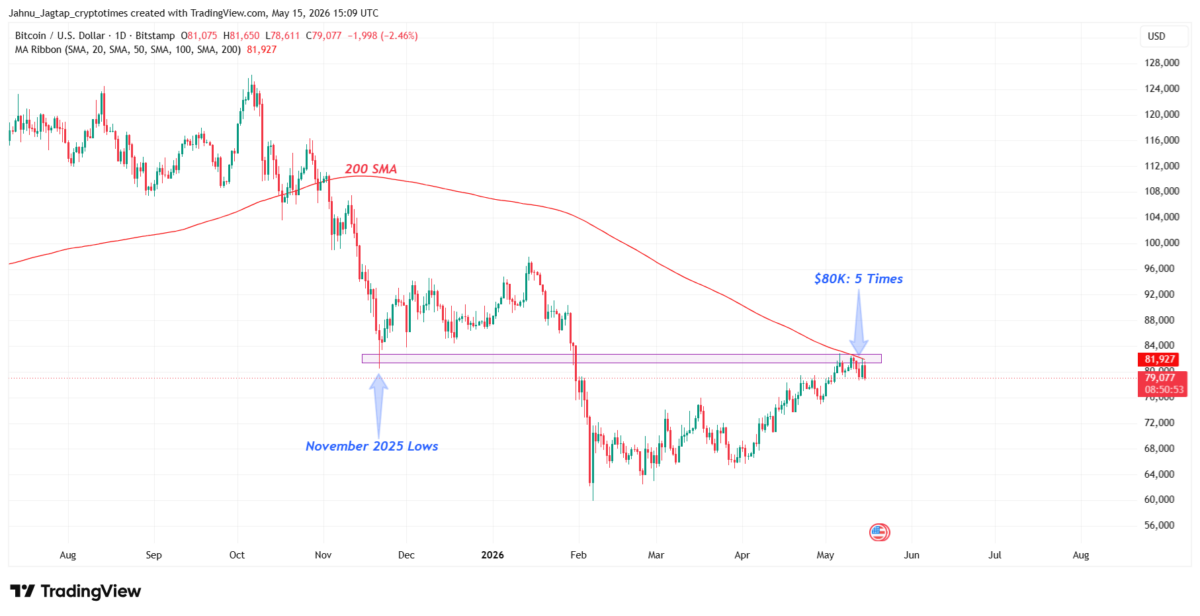
Bitcoin’s five-month range with the 200-day SMA at $82,200. Source: TradingView. Chart: The Crypto Times.
Also Read: Powell’s Exit, Warsh’s Arrival, and the CLARITY Act: Your 2026 Crypto Portfolio Roadmap
Force Two: Warren’s amendments and the ethics standoff
If Warsh is the macro wildcard, Senator Elizabeth Warren is the legislative force of opposition — and she arrived at Thursday’s Senate Banking Committee markup of the CLARITY Act fully loaded.
The Digital Asset Market Clarity Act is the most significant piece of crypto legislation the United States has ever attempted. Its 309 pages create a federal regulatory framework covering token classification, trading platform oversight, stablecoin issuance rules, DeFi protocol accountability, and law enforcement authority. The bill draws a jurisdictional boundary between the SEC (for investment-type digital assets) and the CFTC (for blockchain commodities and decentralized assets). The House passed its version 294–134 in July 2025 — the largest bipartisan margin ever recorded on a crypto bill in Congress. The White House has publicly targeted July 4 for signing.
The markup battle
More than 130 amendments were filed ahead of Thursday’s markup. Warren submitted more than any other senator, targeting anti-money laundering requirements, bank digital asset activities, and provisions she argued would “blow a hole in securities laws protecting investors since 1929.” She called the bill “just not ready for prime time” and said it “declares open season on defrauding American consumers who use crypto.”
But Warren’s most potent ammunition was not investor protection. It was a specific omission: the 309-page draft contains zero conflict-of-interest provisions restricting government officials from profiting from crypto.
Warren pointed to an estimated $1.4 billion in crypto-related gains by President Trump and his family, calling the absence of ethics provisions “stunning.” In a statement released through the Senate Banking Committee minority newsroom, she urged that no committee member should support legislation that fails to address what she described as massive conflicts of interest.
She also raised the name of Jeffrey Epstein during the markup, introducing an amendment calling for federal bank regulators to release supervisory information about Epstein’s banking relationships. “Epstein was an early backer of crypto. He poured millions of dollars into Coinbase,” Warren alleged, drawing a line between the disgraced financier and one of the bill’s primary beneficiaries. Senator Cynthia Lummis responded that “confidential supervisory information is not germane to digital asset market structure.”
The 15–9 vote and what comes next
The markup ended in a 15–9 bipartisan committee vote, with Democratic Senators Ruben Gallego of Arizona and Angela Alsobrooks of Maryland providing the decisive crossover votes. But the path from committee to law remains steep. Chairman Tim Scott executed a last-minute maneuver, introducing several amendments behind the scenes to pull additional Democrats into bipartisan support on individual provisions — a move Warren publicly objected to, saying “the deal you like, it’s not the deal I like.”
Critically, Alsobrooks stated explicitly that her committee vote “does not guarantee a vote on the floor” until outstanding issues are addressed. Senator Kirsten Gillibrand has said the bill cannot advance without an ethics provision barring senior government officials from profiting in the space. At least eight Democratic votes will be needed on the Senate floor, where 60 votes are required for passage in a chamber where Republicans hold 53 seats. TD Cowen’s Washington Research Group puts the bill’s chance of clearing the full Senate this year at roughly 30%.
The White House’s negotiating posture adds another layer of complexity. Crypto adviser Patrick Witt told the Consensus 2026 audience in Miami that the administration would accept rules applying “across the board, from the president all the way down to the brand new intern on Capitol Hill,” but would reject anything that singles out a specific officeholder. The gap between what Democrats demand and what the White House will accept is where the bill could die.
The stablecoin compromise brokered by Senators Tim Scott and Alsobrooks — permitting activity-based rewards while prohibiting passive yield on idle stablecoin balances — survived the markup, but the American Bankers Association mobilized more than 8,000 letters opposing even this limited concession, warning stablecoin products could drain insured bank deposits.
Force Three: The $80,000 wall that will not move
Bitcoin opened Friday, May 16, at $79,064 before slipping to around $77,614 in early trading. The price sits squarely in the range it has occupied for months: a $78,000–$82,000 band that has contained virtually every rally and selloff since February. Bitcoin is approximately 36% below its all-time high of $126,198, set on October 6, 2025.
The technical picture is dense with confluence. The $80,000–$82,000 zone aligns with the November 2025 lows, the upper boundary of the parallel recovery channel from February, and the 100% Fibonacci extension of the channel’s measured move. The 200-day simple moving average sits near $82,200 — a level Bitcoin has touched five times this month without sustaining a close above it. BTC has also been trading below its “bull market support band” (the 21-week exponential moving average and 20-week simple moving average) since October 2025.
The on-chain picture
On-chain data paints a more nuanced picture than the price chart alone. Glassnode analysts noted that Bitcoin has moved above both the True Market Mean and the short-term holder cost basis, and argued that if price sustains at these levels, the deep-value regime that persisted from early February will rank among the shortest episodes of its kind in Bitcoin market history. Their attention now shifts to the Active Realized Price near $85,200 — the cost basis of all non-dormant supply — as the next structural threshold.
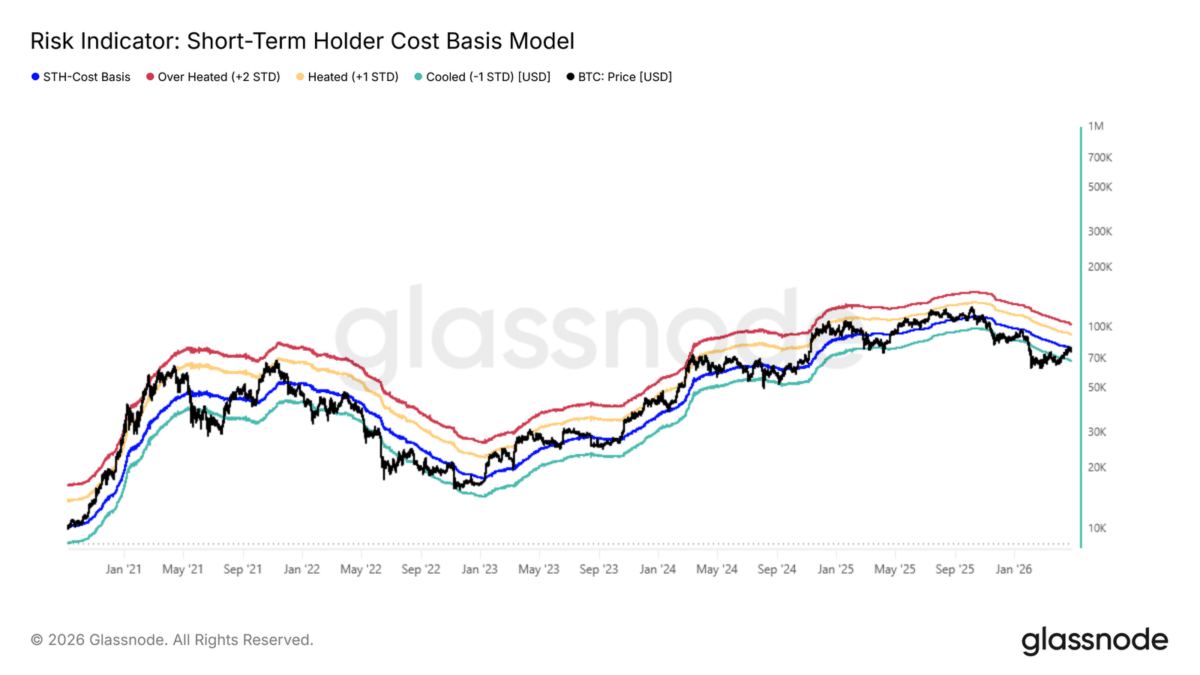
Glassnode Risk Indicator showing Bitcoin’s market structure shift in May 2026. Source: Glassnode Insights, Week 17/2026.
ETF flows: The structural bid
Spot Bitcoin ETF demand has been the most compelling bullish driver in 2026. Through early May, ETFs posted a nine-day consecutive inflow streak totaling approximately $2.7 billion, led by BlackRock’s IBIT and Fidelity’s FBTC. April closed at +$1.97 billion net positive — the strongest monthly total of 2026 and a sharp reversal from the Q1 period, when outflows dominated. Total cumulative inflows since the January 2024 launch now sit above $58 billion, though still below the $61.19 billion peak reached in October 2025 when BTC hit its all-time high.
The 30-day moving average of net flows turned firmly positive after an extended period of sustained outflows. Glassnode analysts note this shift marks a clear inflection in institutional appetite, following heavy distribution through the late-2025 to early-2026 drawdown.
However, Thursday saw the sharpest single-day outflow in nearly four months: $635 million exited spot Bitcoin ETFs, led by BlackRock’s IBIT (-$285 million) and Ark’s ARKB (-$177 million). The reversal coincided with the hot CPI print and Fed transition uncertainty, showing that the structural bid from ETFs is real but not immune to macro shocks.
USDC reserves on Binance have surged from $4.5 billion in early March to approximately $7.5 billion, a sign of sidelined capital positioned to enter the market if conviction grows. Derivatives funding rates have flipped from negative to neutral, easing the sustained short pressure that characterized futures markets through Q1.
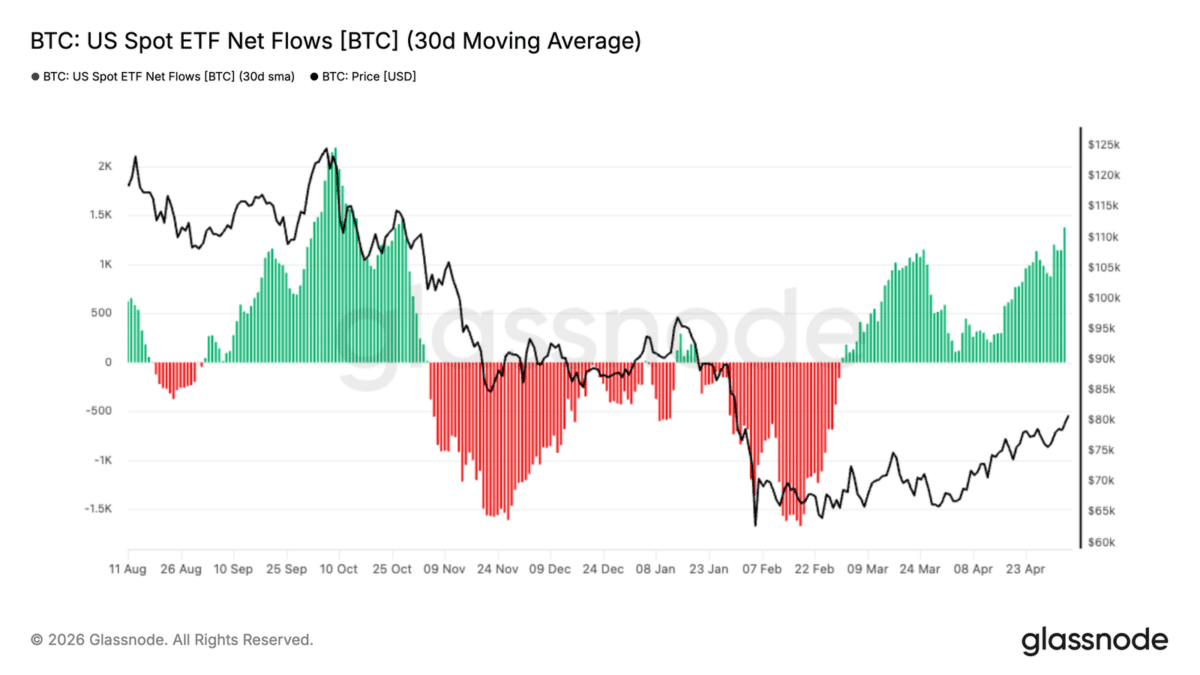
Daily net flows into U.S. spot Bitcoin ETFs, including the $635M outflow on May 14. Source: Glassnode
Key levels for the next six weeks
- Downside trigger: daily close below $78,000 breaks the range floor and increases drawdown risk toward $73,000–$71,000, with deeper support at $67,000 and $60,000.
- Upside trigger: daily close above $82,200 (the 200-day SMA) opens a push toward $84,000–$85,000. A sustained move above $85,200 (the Active Realized Price) would signal a structural regime shift.
How the three forces interact
The reason this six-week window matters more than a typical summer lull: the three forces feed each other through clearly identifiable transmission channels.
- Regulatory clarity feeds institutional positioning. The CLARITY Act’s progress directly affects whether sovereign wealth funds, pension allocators, and large bank custody desks can enter the digital asset class at scale. Every week the bill stalls, capital waits. The bill’s passage through committee is broadly bullish — it reduces institutional uncertainty and creates a legal framework for regulated participation. But the ethics fight introduces idiosyncratic risk: if the Trump family’s crypto involvement becomes the political third rail that kills the bill on the Senate floor, the market will have spent months pricing in a regulatory tailwind that never arrives.
- The ethics fight is also a macro story. If the White House is forced to make concessions that weaken CLARITY’s provisions, or if Warren’s opposition fractures the fragile Democratic coalition needed for 60 votes, the bill that emerges will be a smaller catalyst than markets have priced. Conversely, if a clean deal is struck and the bill advances with meaningful bipartisan support, it could be the regulatory clarity event that finally gives institutional buyers the confidence to push through $82,000.
- Warsh’s first FOMC lands in the middle. The June 16–17 meeting arrives after the committee vote but before any Senate floor vote. If Warsh surprises with modest dovish language, the dollar weakens, real yields compress, and Bitcoin catches a macro tailwind at exactly the moment institutional sentiment around CLARITY is firming. If he delivers a hawkish surprise, the $80,000 level calcifies as a ceiling.
Also Read: How ETFs Are Driving Bitcoin in 2026: Big Players Shaping the Trend
Three scenarios for summer 2026
Scenario 1: Breakout
Warsh delivers a neutral-to-dovish signal at the June FOMC, perhaps acknowledging that productivity gains could offset inflation risk or hinting that balance-sheet runoff may slow. The CLARITY Act’s ethics provisions are resolved in a form both parties can accept. The bill clears the full Senate with at least eight Democratic votes. BTC closes above $84,000 on strong volume and sustained ETF inflows. Institutional FOMO kicks in. Bitcoin tests $100,000 by late summer.
Scenario 2: Grind
Warsh holds rates and signals hawkish patience. The CLARITY Act advances out of committee but stalls before a floor vote as the ethics impasse drags on. The Senate runs out of legislative calendar before the August recess. Bitcoin oscillates between $78,000 and $84,000 through the summer, frustrating both bulls and bears. Altcoins underperform. Retail interest remains tepid. The market waits for a resolution that does not arrive until Q4 at the earliest.
Scenario 3: Breakdown
Warsh signals an October rate hike, or the dot plot shifts decisively hawkish. The CLARITY Act fractures on the Senate floor — either the ethics fight or the banking lobby’s resistance to stablecoin provisions kills the 60-vote math. A macro shock — escalation in the Middle East, a U.S. credit event, or a further spike in energy prices — triggers risk-off across all markets. Bitcoin loses $78,000, retests $67,000–$60,000 support, and the summer 2026 bear case plays out.
Bottom line
The $80,000 wall is not merely a chart level. It is the physical manifestation of every unresolved macro, legislative, and monetary question hanging over the crypto market. Until Warsh speaks, Warren’s ethics fight is settled, and Bitcoin prints a decisive close above $82,200 on volume, the wall stands.
The good news for bulls: all three catalysts have resolution dates. June 16–17 for the Fed. Summer for the CLARITY Senate floor vote. And the chart itself is coiled — the longer the range holds, the more violent the eventual breakout or breakdown tends to be.
For the first time in years, Fed leadership and Congress appear simultaneously engaged with crypto — one through personal investment and stated policy views, the other through the most comprehensive regulatory framework ever attempted. The question is whether that engagement produces clarity or chaos.
This is a summer that will be remembered. One way or another.
Also Read: What Does Bitcoin Become in a World Questioning the Dollar?
When is Kevin Warsh’s first FOMC meeting?
Kevin Warsh’s first FOMC meeting as Federal Reserve Chair is scheduled for June 16–17, 2026. Markets are watching for whether his policy signal is dovish (productivity gains offsetting inflation) or hawkish (a 2026 rate hike). His tone will drive Bitcoin’s reaction at the $82,000 resistance level.
What is the CLARITY Act ethics provision?
The CLARITY Act in its current form contains no provisions restricting government officials from profiting from crypto. Senator Elizabeth Warren cites an estimated $1.4 billion in crypto-related gains by President Trump and his family. Democrats including Kirsten Gillibrand have said the bill cannot advance without an ethics provision.
Why is Bitcoin stuck at $80,000?
Bitcoin has tested the $80,000–$82,000 range five times in May 2026 without sustaining a close above it. The level aligns with November 2025 lows, the upper boundary of the February recovery channel, and the 200-day simple moving average near $82,200. ETF outflows on May 14 ($635M) reinforced the resistance.
Will Bitcoin reach $100,000 in 2026?
The breakout scenario for Bitcoin to reach $100,000 by late summer 2026 requires three conditions: a dovish-to-neutral FOMC signal from Warsh in June, the CLARITY Act clearing the Senate floor with bipartisan ethics-provision support, and a sustained close above $84,000 on strong ETF inflows. TD Cowen estimates roughly a 30% probability for the CLARITY Act to clear the Senate this year.
Does Kevin Warsh own Bitcoin?
Yes — Kevin Warsh is the first Federal Reserve Chair to take office with disclosed cryptocurrency holdings. His April 2026 ethics filing listed exposure across more than 20 blockchain entities exceeding $100 million, including positions in DeFi protocols, Solana, Polymarket, and Bitcoin infrastructure firm Flashnet. He has signed an ethics agreement requiring divestiture of most private holdings.
When will the Senate vote on the CLARITY Act?
The Senate Banking Committee advanced the CLARITY Act on May 14, 2026, in a 15–9 vote. A full Senate floor vote is expected in summer 2026, with the White House targeting a July 4 signing. The bill needs 60 votes, requiring at least eight Democratic crossovers. Outstanding ethics and AML negotiations could push the timeline into Q4 or 2027.