Key Highlights
- The 309-page CLARITY Act draft released May 12 contains zero conflict-of-interest provisions restricting government officials from profiting off crypto — the one omission Senate Democrats say is a dealbreaker
- Senate Majority Leader Schumer attended a Democratic member meeting stressing that ethics negotiations must advance before Thursday’s markup; a bipartisan meeting the same day produced no concrete resolution
- Senator Warren issued her sharpest opposition statement yet, calling the bill a risk to “investors, our national security and our entire financial system,” while the White House refuses any provision targeting a specific officeholder
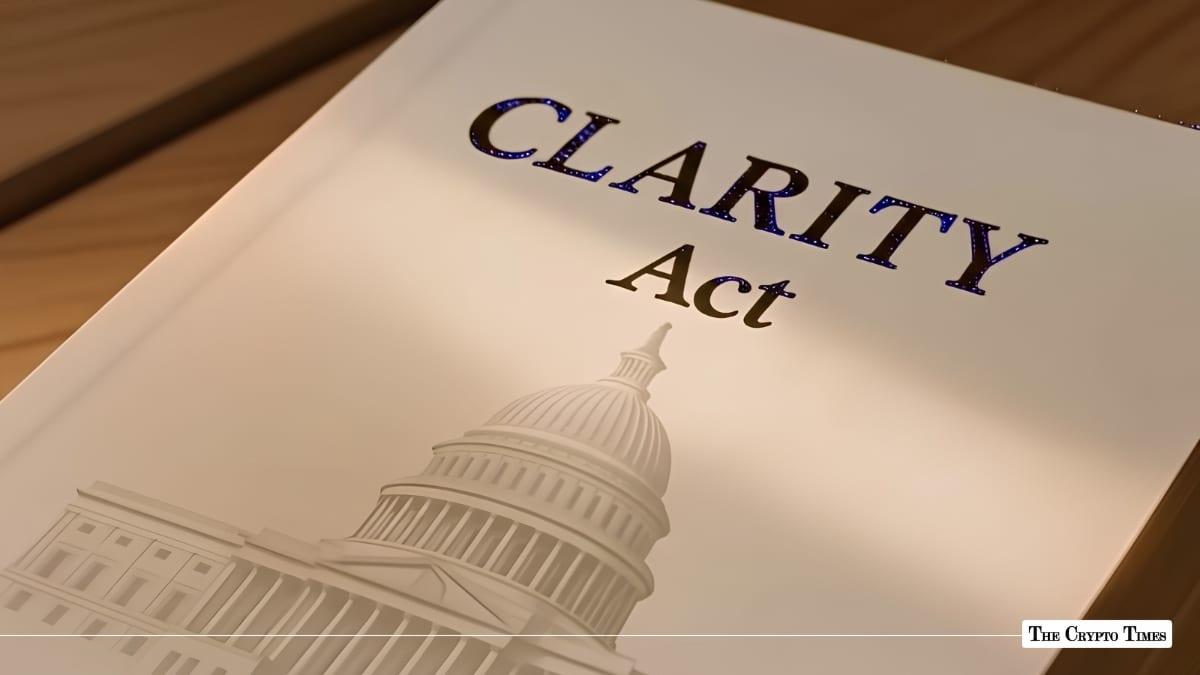
The CLARITY Act has survived stablecoin yield disputes, a Coinbase walkout, banking lobby pressure, and labor union opposition. But the one provision missing from the 309-page bill may be the one that kills it.
Senate Republicans released the final bill text on Tuesday morning, May 12. It contains nine titles, a stablecoin yield ban, NFT safe harbors, and zero crypto ethics provisions. That last omission is now the only thing standing between this bill and President Trump’s desk.
Schumer Steps In — But No Deal Emerges
The ethics standoff escalated Monday night and into Tuesday. According to journalist Eleanor Terrett, Senate Majority Leader Chuck Schumer attended a Democratic member meeting where he appeared engaged and eager for members to reach a “yes” on the CLARITY Act — but stressed that ethics negotiations need to be further along before Thursday’s markup.
On that front, Terrett reported that members left a bipartisan meeting Tuesday morning where ethics issues were discussed, but there appeared to be no concrete direction emerging from the talks. Discussions were expected to continue later that evening, with GOP and Democratic staff set to reconvene to review amendments once all have been filed. The filing deadline was 5 p.m. ET on Tuesday.
The Schumer intervention is significant. The Majority Leader’s direct involvement signals that Democratic leadership views the ethics fight not as a fringe concern but as the central obstacle to delivering a bill both parties can support on the Senate floor. His insistence on more progress before Thursday also suggests that a party-line markup without Democratic buy-in is something leadership wants to avoid — not just for the CLARITY Act, but for the broader political optics of regulating an industry in which the sitting President holds direct financial interests.
Warren’s Sharpest Shot Yet
In an official statement released via the Senate Banking Committee’s minority press page, Ranking Member Elizabeth Warren described the bill as putting “investors, our national security and our entire financial system at risk” and accused it of enabling what she called presidential crypto corruption. Warren pointed to an estimated $1.4 billion in crypto-related gains by the President and his family, calling the total absence of ethics provisions from the bill “stunning.” U.S. Senate Committee on BankingU.S. Senate Committee on Banking
Warren urged that no committee member should support legislation that fails to address what she described as massive conflicts of interest.
The statement — released via the official Senate Banking Committee minority newsroom — represents the most pointed opposition from the committee’s senior Democrat to date. Its timing, landing just hours before the amendment filing deadline, was a deliberate escalation designed to give wavering Democrats political cover to demand ethics language or vote no.
Gillibrand and Schiff Add Pressure
Warren is not operating alone.
Senator Kirsten Gillibrand, whose name is on Title I of the bill, told the audience at Consensus 2026 in Miami that the CLARITY Act cannot move forward without an ethics provision barring senior government officials from profiting off the industry while regulating it. Her office reinforced the position using a poll showing 73% of registered U.S. voters support such a restriction.
At an earlier session, Gillibrand left no room for interpretation: “This provision will be part of this bill, or it will not go forward. Because we cannot let greed and corruption in Washington tear this industry down, and without that provision, that’s exactly what will happen.”
Senator Adam Schiff, who joined the Senate Banking Committee in 2025, is reportedly pushing for even stronger provisions specifically targeting the Trump family’s crypto ventures, including World Liberty Financial and the TRUMP memecoin.
The White House Won’t Budge
The impasse is structural, not just partisan. The plan to make the passage to hit the goalpost stays on July 4, confirmed by White House crypto adviser Patrick Witt.
Witt has said the administration supports ethics rules that apply uniformly across government positions but would reject provisions targeting any specific officeholder. At Consensus Miami, Witt framed the administration’s position as backing rules “from the president all the way down to the brand new intern on Capitol Hill” — but only if applied broadly.
That framing puts the White House and Senate Democrats on a collision course. Democrats want provisions that address the Trump family’s expanding crypto portfolio. The White House says it will reject any language that singles out a specific person or family. The gap between “uniform rules” and “targeted restrictions” is exactly where the CLARITY Act could fracture — and Tuesday’s bipartisan meeting producing no concrete direction suggests that gap has not narrowed.
The 60-Vote Math Problem
Chairman Tim Scott can pass the bill out of committee on a party-line vote — the Senate Banking Committee has 13 Republicans and 11 Democrats. But the committee vote is not the real test.
Sixty votes are required for full Senate passage, meaning meaningful Democratic support is non-negotiable. The GENIUS Act cleared the Senate 68–30 last year with strong bipartisan support. Without ethics language, the CLARITY Act is unlikely to replicate that margin. At least seven Democratic senators would need to cross the aisle — and right now, the Democratic caucus is organizing in the opposite direction.
Chairman Scott has argued that conflict-of-interest rules do not fall under the Banking Committee’s jurisdiction and that the issue must wait for the plenary vote. That jurisdictional argument may be technically sound, but it does not resolve the political calculus: Democrats are conditioning their floor votes on seeing the language before they commit.
Senator Ruben Gallego of Arizona, a Banking Committee member who ran on a moderate platform with crypto industry support, has emerged as a potential Democratic swing vote but has not committed publicly. Gallego is the senator Republicans most need to flip if they want any bipartisan cover on Thursday.
From Demand to Dilution to Deletion
The conflict-of-interest question has been live in CLARITY negotiations since September 2025, when twelve Senate Democrats released a market structure framework demanding ethics provisions. By January 2026, when the Senate Banking Committee released a 278-page draft, the language was watered down. In the May 2026 309-page draft, it is gone entirely.
The trajectory — from demand, to dilution, to deletion — is the pattern that has Democratic senators signaling publicly that the bill is dead on arrival without a reversal. The fact that Schumer personally stepped into the discussions underscores how seriously Democratic leadership takes that risk. The fact that Tuesday’s bipartisan ethics meeting produced nothing concrete underscores how far apart the two sides remain.
What Happens Next
The Senate Banking Committee markup is set for Thursday, May 14, at 10:30 AM ET in Room 538 of the Dirksen Senate Office Building. Three variables will determine whether the CLARITY Act reaches the President’s desk or stalls into the fall: the number and substance of ethics amendments Democrats filed before Tuesday’s deadline, the vote count on those amendments Thursday, and whether any Democrats cross over to support the bill without ethics language.
If the ethics provision lands in a form both parties can accept, a July signing remains plausible. If the conflict-of-interest provision becomes the bill’s breaking point, the framework gets delayed, and every institutional allocation waiting on statutory classification waits with it.
The CLARITY Act solved stablecoin yield. It resolved DeFi liability. It drew the SEC-CFTC jurisdictional line. But 309 pages of regulatory architecture may not matter if the most consequential provision is the one that was never written.
Also Read: CLARITY Act Hits Labor Wall 2 Days Before Senate Committee Vote