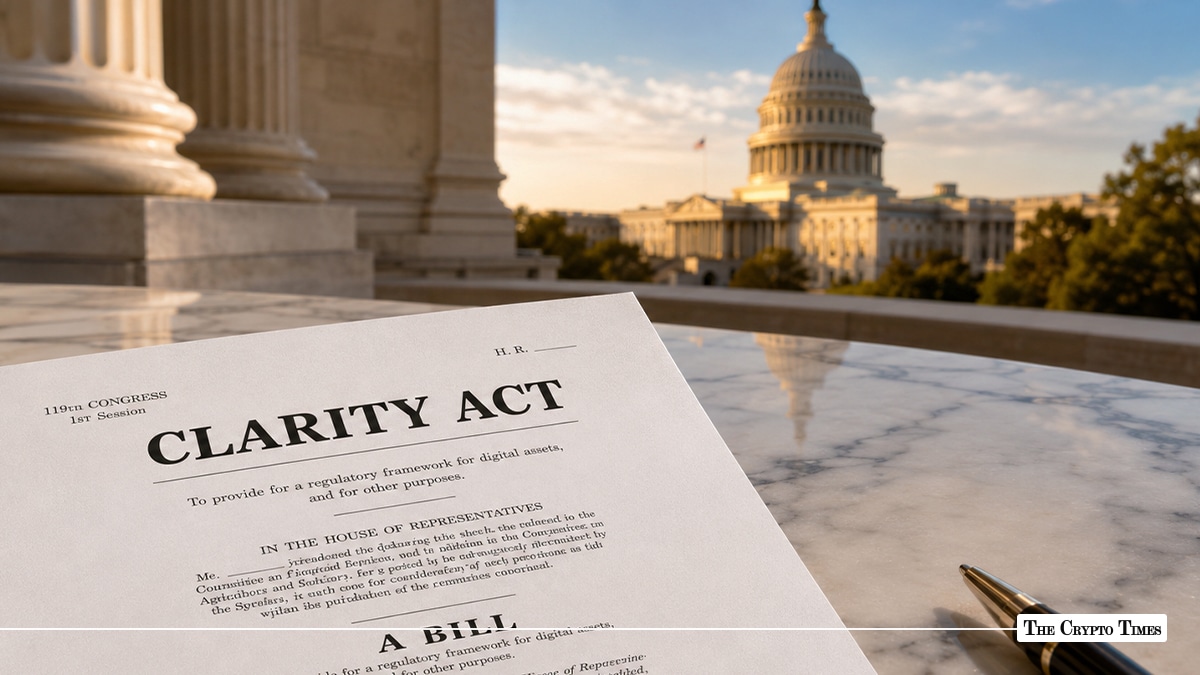
The largest labor unions in the United States are mounting a coordinated campaign to block the CLARITY Act, warning senators in a joint letter that the crypto market structure bill could put retirement savings at risk—opening a new front of opposition just 48 hours before the Senate Banking Committee’s scheduled markup vote.
The AFL-CIO, Service Employees International Union (SEIU), American Federation of Teachers (AFT), National Education Association (NEA), and American Federation of State, County and Municipal Employees (AFSCME) warned in a letter and email first reported by CNBC that the bill could jeopardize retirement accounts for millions of workers by legitimizing a volatile and insufficiently regulated asset class.
The push represents the most organized labor opposition to crypto legislation to date and arrives at the most sensitive moment in the CLARITY Act’s 10-month legislative journey—with the Senate Banking Committee set to mark up the 309-page bill at 10:30 AM ET on Thursday, May 14.
The Retirement Risk Argument
The unions’ core argument centers on the intersection of the CLARITY Act with President Trump’s February 2026 executive order that cleared the way for pension funds and retirement accounts to hold cryptocurrency assets. Senator Elizabeth Warren, Ranking Member of the Senate Banking Committee, has repeatedly warned that the combination creates a “tokenization loophole” through which financial products offered on blockchain could sidestep the SEC’s authority to regulate securities—directly exposing 401(k)s and pension portfolios.
The AFT, which represents 1.8 million members including teachers and public employees, had previously called the legislation “as irresponsible as it is reckless” in a December 2025 letter, writing that “this bill exposes working families to economic risk and threatens the stability of their retirement security.”
The AFL-CIO, the nation’s largest federation of unions with over 12.5 million members, adds significant political weight. The federation’s endorsement or opposition carries outsized influence with Democratic senators—precisely the votes the CLARITY Act needs to reach the 60-vote threshold for full Senate passage.
A New Pressure Point for Democrats
The labor opposition complicates an already challenging political environment for the bill’s Democratic supporters. The 309-page substitute text released by Chairman Tim Scott, Senator Cynthia Lummis, and Senator Thom Tillis contains no restrictions on senior government officials profiting from the crypto industry while regulating it—an omission that Senate Democrats are now organizing around.
Senator Kirsten Gillibrand told Consensus 2026 in Miami last week that the bill needs an ethics provision barring officials from profiting off the industry. Senator Ruben Gallego (D-AZ), the most likely Democratic crossover vote, has not committed publicly.
The Galaxy Research posture map identified Gallego and Senator Angela Alsobrooks (D-MD) as the most reliable Democratic backers, with Senators Mark Warner and Catherine Cortez Masto as potential deal-makers—but only if AML, ethics, and consumer protection concerns are addressed. The labor unions’ intervention gives wavering Democrats political cover to vote no or demand amendments without appearing anti-innovation.
Banking Lobby + Labor: An Unusual Alliance
The labor push arrives on top of the banking industry’s own opposition. On May 9, the three largest U.S. banking trade groups — the Independent Community Bankers of America, the Bank Policy Institute, and the American Bankers Association — formally rejected the Tillis-Alsobrooks stablecoin compromise, arguing that the activity-based rewards carve-out still functions too much like interest-bearing deposit accounts.
The banking lobby and organized labor rarely align on financial regulation. Their convergence against the CLARITY Act—banks objecting to competitive threats to deposits and unions warning about retirement risk—creates a two-pronged political squeeze on committee Democrats who might otherwise have supported the bill.
Chairman Scott has not blinked. The May 14 markup remains scheduled, and no procedural motion has been filed to delay. Scott can pass the bill out of committee on a 13-11 party-line vote without a single Democratic vote, but a pure party-line passage would signal that the 60-vote threshold on the Senate floor is in serious jeopardy.
Some Democrats Still Working on a Deal
CNBC reported that some Democratic senators are actively working with Republicans on the bill but say hurdles remain, including safety and ethics language. The window for amendments closes at close of business Tuesday, meaning any last-minute provisions addressing the unions’ retirement concerns or the ethics gap would need to be filed within hours.
The crypto industry is pushing back against the labor narrative. Coinbase CEO Brian Armstrong; Robinhood CEO Vlad Tenev; and trade groups including the Digital Chamber, Blockchain Association, and Solana Policy Institute have all publicly urged passage, framing the bill as a bipartisan, voter-backed priority. A HarrisX survey released last week found 52% of registered voters support the CLARITY Act, with 70% of Americans believing Congress should have already passed crypto legislation.
Polymarket currently prices the odds of the CLARITY Act becoming law in 2026 at approximately 67–75%, up from 47% earlier this month but reflecting persistent uncertainty around the committee stage and beyond.
Also Read: Breaking Down the 309-Page CLARITY Act: Ethics, Yield, and the May 14 Markup