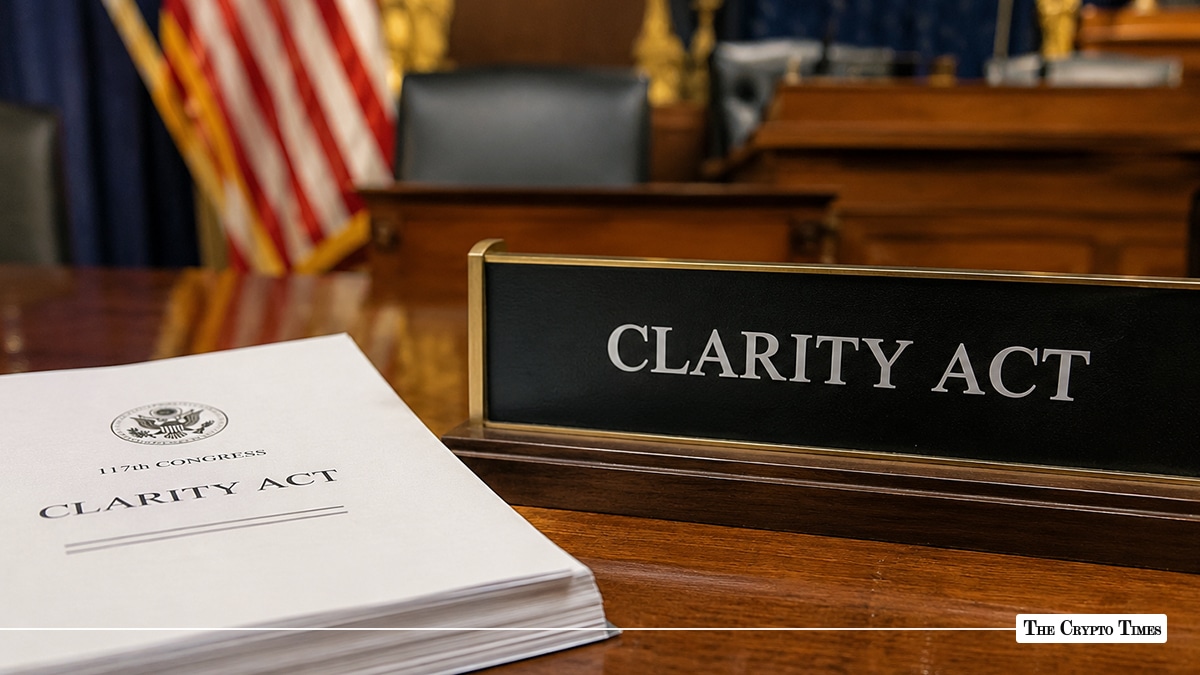
The Senate Banking Committee has scheduled a markup vote on the Digital Asset Market Clarity Act for Thursday, May 14, at 10:30 AM ET, bringing the United States one step closer to its first comprehensive crypto market-structure law.
The revised 309-page draft follows months of negotiations that stalled in January after Coinbase withdrew support, citing concerns over open-source developer protections, a stablecoin yield ban, and unclear DeFi rules.
Senate Banking Committee Chair Tim Scott described the updated draft as “good-faith work” between lawmakers and industry groups. At its core, the bill seeks to clarify whether digital assets are securities or commodities — defining which fall under the SEC and which under the CFTC, while strengthening consumer protections and addressing illicit finance risks.
The legislation was first introduced in July 2025 and cleared the House of Representatives before stalling in the Senate. A breakthrough came last week when Senators Thom Tillis (R-N.C.) and Angela Alsobrooks (D-Md.) released a compromise text on stablecoin yield, the final major sticking point. However, lawmakers remain sharply divided over ethics concerns tied to President Donald Trump’s expanding crypto ventures.
Crypto industry rallies behind markup
The markup announcement triggered an immediate wave of support from the crypto industry. Coinbase Chief Legal Officer Paul Grewal reacted on X, posting: “It’s on like Donkey Kong” — signaling renewed momentum for the bill.
Coinbase’s Chief Policy Officer Faryar Shirzad called the markup date a “big step forward,” arguing the legislation is essential for protecting consumers, supporting innovation, and ensuring crypto development stays in the United States rather than moving offshore.
Senator Cynthia Lummis, one of the Senate’s most prominent crypto advocates, urged her colleagues to act, posting on X: “Let’s pass the Clarity Act out of the Banking Committee on Thursday!”
Trade groups echoed the optimism. Digital Chamber CEO Cody Carbone called the markup “a major step” toward clarity for more than 70 million Americans who use cryptocurrencies. Blockchain Association CEO Summer Mersinger described it as “an important step toward establishing clear rules for digital asset markets.” Solana Policy Institute president Kristin Smith called the vote “a make or break moment for American leadership in financial markets.”
Stablecoin debate returns to center stage
The stablecoin yield provision had been the single biggest obstacle to advancing the CLARITY Act. The Senate Banking Committee postponed an earlier markup in January after Coinbase withdrew support, partly over a blanket ban on stablecoin yield.
The Tillis-Alsobrooks compromise, released on May 1, takes a more nuanced approach. It prohibits crypto firms from paying yield on stablecoin balances “in a manner that is economically or functionally equivalent to the payment of interest or yield on an interest-bearing bank deposit.” However, the text explicitly allows rewards tied to “bona fide activities or bona fide transactions” — effectively shifting the model from “buy and hold” to “buy and use.”
Coinbase CEO Brian Armstrong responded to the text with a two-word post: “Mark it up.” Grewal added that the language “preserves activity-based rewards tied to real participation on crypto platforms and networks.” Circle Chief Strategy Officer Dante Disparte endorsed the deal, saying the U.S. faces “a clear choice in digital assets: lead or be led.”
However, banking groups argue the compromise does not go far enough. American Bankers Association CEO Rob Nichols warned lawmakers that the bill could pull deposits away from traditional banks and into stablecoins. In a letter to bank executives, Nichols said the current proposal would “unnecessarily incentivize the flight of bank deposits into payment stablecoins.”
A joint letter from the ABA, the Bank Policy Institute, and the Independent Community Bankers of America told Senate Banking Committee leaders that “additional work is needed” on the bill’s text.
Trump crypto concerns deepen Senate divide
The revised draft still does not include restrictions preventing federal officials from profiting from digital assets. That omission has intensified criticism from Democrats, especially after Bloomberg estimated that Donald Trump earned at least $1.4 billion from crypto ventures linked to memecoins and World Liberty Financial.
Senator Elizabeth Warren criticized the proposal Monday night, warning that the bill could “turbocharge Donald Trump’s crypto corruption.” She added, “The President and his family have raked in at least $1.4 billion in gains from crypto deals alone.”
Senator Kirsten Gillibrand has separately pushed for ethics safeguards to prevent government officials from holding or profiting from crypto positions. Bipartisan support for the bill may hinge on whether these provisions are included before the final vote.
The bill also incorporates the Blockchain Regulatory Certainty Act, which would shield non-custodial software developers — such as those who build open-source wallets, node software, or smart contract tools — from money transmitter registration requirements. Supporters argue this is essential for protecting innovation and open-source development. However, some law enforcement groups warn the language could weaken oversight and create gaps in anti-money-laundering enforcement.
What’s next for the Clarity Act
The May 14 markup is the first formal gate. If the bill clears the Senate Banking Committee, it heads to the full Senate floor, where it will need at least 60 votes to advance — a threshold that requires significant bipartisan support.
The White House has set a July 4 target for the CLARITY Act’s passage, adding urgency to the timeline. Industry observers note that delays could push the bill into the second half of 2026, where midterm election dynamics could complicate progress.
Prediction market Polymarket currently estimates a roughly 67–71% probability that the CLARITY Act will be signed into law before the end of 2026.
For now, all eyes turn to Thursday’s committee session, where the 309-page bill will face its first legislative test.
Also Read: Consensys Asks SEC for Safe Harbor for MetaMask Wallets