
Aptos is undergoing a major upgrade that could make it the first Layer-1 blockchain to offer a native encrypted mempool, pending governance approval.
The feature delivers full transaction intent confidentiality at the protocol level, protecting users from frontrunning, censorship, and order-flow leakage—all while preserving the network’s high speed, performance, and post-execution transparency.
In a latest post on X, the Aptos team stated that the update will introduce full transaction intent confidentiality, no impact to speed, and same trust assumptions as the network itself.” The blockchain protocol noted that it will provide full protection from frontrunning with just one click.
How the Encrypted Mempool Works
Aptos Labs’ implementation uses a novel batched threshold encryption scheme integrated directly into the blockchain’s consensus protocol:
- Transaction Submission: Users or dApps submit encrypted ciphertexts. Transaction details remain hidden from validators and the public until after block ordering.
- Distributed Key Generation (DKG): At the start of each epoch, validators run a DKG protocol to generate a shared decryption key. Decryption requires a majority of staked validators — no single party can decrypt alone.
- Batched Decryption During Consensus: Validators produce partial decryptions for entire batches of transactions during block voting. Once the threshold is met, plaintexts are revealed just before execution. The process adds negligible latency (<20 ms online phase per batch) due to pre-computation and constant-size partial decryptions.
- Post-Execution Transparency: Transactions are recorded on-chain as usual, maintaining full auditability.
In a October 2025 blog, Aptos team claimed that this design solves longstanding MEV vulnerabilities in public blockchains. By hiding intent until after ordering, it eliminates the window for bots to exploit pending trades—all at the protocol layer, without new trust assumptions or throughput sacrifices.
The batched approach reduces communication and computation overhead dramatically (from O(nB) to O(n), where n is the number of validators and B is batch size), making it practical for high-throughput networks.
Why This Matters for DeFi and Institutional Adoption
In the past few years, decentralized exchanges have seen explosive growth, with spot volumes regularly exceeding $5 billion monthly in 2026. Yet visible mempools continue to expose traders to exploitation, limiting large-value and institutional participation.
Aptos’ encrypted mempool could enable secure, high-value on-chain trading with one-click privacy. It supports the team’s “full stack for markets and machines” vision while leveraging Aptos’ strengths in parallel execution (Block-STM) and Move smart contracts.
The upgrade aligns with recent ecosystem pushes, including a $50 million initiative in early May 2026 to accelerate on-chain markets and AI systems.
Aptos Ecosystem Snapshot
While Aptos continues to showcase impressive technical capabilities, its ecosystem metrics reveal a more tempered reality. The network’s total value locked (TVL) currently sits at approximately $275 million according to DeFiLlama, a sharp decline from its earlier 2026 peak of around $1 billion.
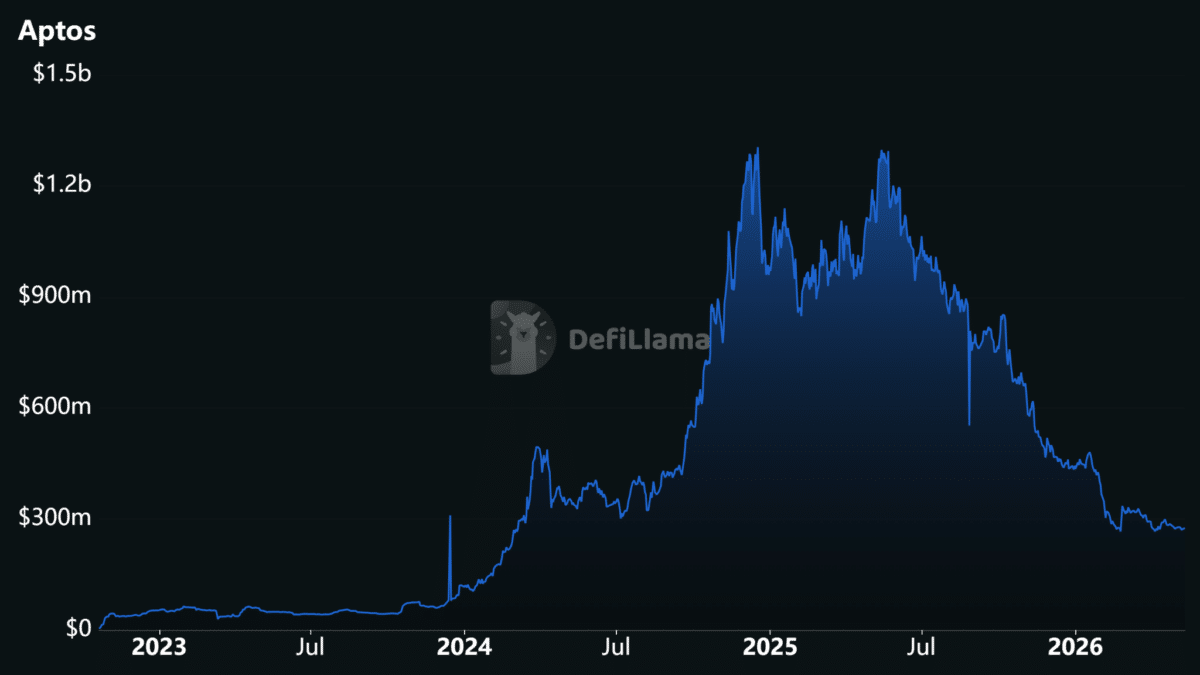
This contraction highlights limited capital retention and challenges in sustaining DeFi momentum, even as the network promotes institutional-grade features like the encrypted mempool.
Its stablecoin market cap, which hit a record $1.9 billion in H1 2026, has since moderated to roughly $1.65 billion, indicating some cooling in liquidity inflows despite earlier growth.
On the activity front, the network recorded a standout 12.3 million daily transactions on May 2, 2026, but broader traction remains inconsistent.
Its daily active addresses have fluctuated, often hovering well below peak levels seen in Q1, and overall user engagement has struggled to convert high transaction counts into sustained ecosystem growth or deeper liquidity.
With blockchain’s native token APT trading around $1.11 and a market cap near $890 million, the project demonstrates strong throughput potential (real-world peaks above 19,000 TPS) yet faces criticism for failing to maintain peak TVL and deliver consistent traction across key adoption metrics amid ongoing token unlocks and competitive pressures in the Layer-1 space.
This view underscores both the innovation in the encrypted mempool proposal and the need for stronger capital efficiency and user retention to support long-term institutional ambitions.
Also read: Ondo Finance Surpasses $1B TVL in Tokenized Stocks and ETFs