
Key Highlights
- Ethena seeded two Solana lending markets with $200M USDG each on Kamino and Jupiter Lend.
- Kamino reached 100% utilization within 24 hours, while Jupiter Lend crossed 78% utilization.
- USDe supply on Solana surged from $1.5M to $350M in just five days amid rising institutional DeFi activity.
Dune, a decentralized analytics platform, has highlighted a development in decentralized finance (DeFi), describing it as a new institutional yield template now live on Solana after Ethena-backed lending markets on Solana surged within days of launch.
According to the official announcement, Ethena seeded two isolated lending markers with $200 million of USDG each—one on Kamino Finance, curated by Sentora, and the other on Jupiter Lend, curated by Bitwise Asset Management.
The report mentions that the move marks the first time a traditional asset manager of Bitwise’s stature has taken on the curator role for a Solana lending protocol. Bitwise is responsible for setting risk parameters, real-time position monitoring, and liquidation decisions.
The product structure revolves around a leveraged yield loop. A user deposits USDe, which as of now offers around 4% native yield, borrows USDG at around 2%, swaps the borrowed USDG back into USDe, redeposits, and repeats the process.
The mechanism backs up to 12.5x leverage in a single transaction, aiming around 20% net APY while incorporating built-in liquidation protections. Mainly, it offers structured fixed-income exposure via completely auditable on-chain infrastructure.
Pool Hits 100% Utilization
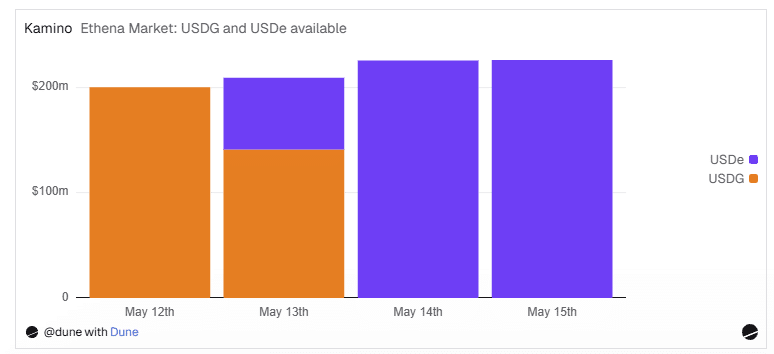
The Kamino pool witnessed explosive growth after reaching 100% utilization within 24 hours, hitting its $200 million USDG borrow cap and crossing $400 million in overall size. On the other hand, Jupiter Lend’s pool stood at around 78% utilization, with $156 million borrowed.
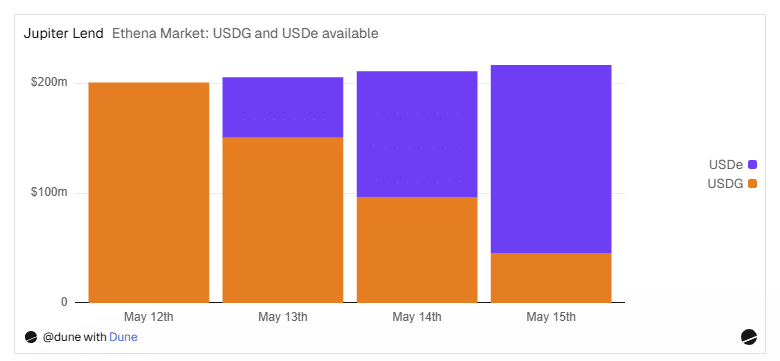
Amalgamating both, the market now holds around $397 million in USDe collateral. USDG inventory was withdrawn immediately as users executed the loop, normally shown in reserve curves where borrowed USDG declined in tandem with increasing USDe deposits.
Furthermore, USDe supply on Solana increased from around $1.5 million on May 10 to $350 million by May 15—a 230x surge in 5 days, mainly absorbed by these new markets. USDG supply on Solana has surged to around $1.2 billion.
Trading volumes affirm the loop activity: the newly made USDG-USDe pair listed $8 million in volume solely on May 13, while associated pairs with USDC also witnessed a surge.
Kraken provides institutional custody
In a separate development, in January, Kraken Institutional and Ethena Labs revealed that Kraken Custody has been chosen to manage the collateral for USDe, a synthetic stablecoin issued by Ethena.
The partnership has been approved by the Ethena Risk Committee after conducting an extensive evaluation. Utilizing Kraken’s state-regulated banking system and adding additional layers of security like hardware security modules and multi-party computation, the partnership will ensure the safety and transparency of the process for institutional clients.
Ethena Labs’ CEO, Guy Young, pointed out that custody is one of the major risks involved in the process, which is why Kraken’s compliance with regulation and internal controls fit Ethena’s USDe reserve management criteria.
The upcoming step
Kamino has also expressed intentions of increasing borrow caps. The following step will see testing of multiple key areas: rate of absorption of extra USDG capacity, strength of risk parameters under rapid scaling, and whether there will be more supply from increased top-ups or from new third-party lenders. With a 100% utilization rate, the current USDG providers on Kamino are generating about 1.78% APR of supply.
Also Read: Hyperbridge Offers $50,000 for Critical Vulnerabilities