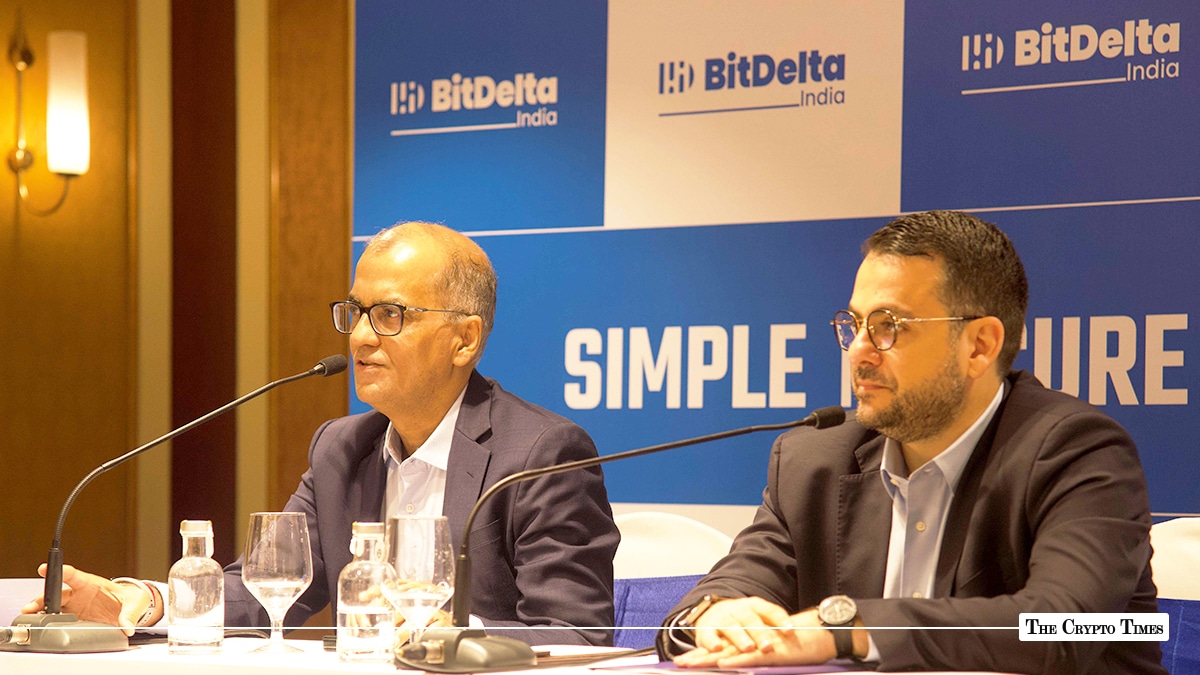
Global crypto exchange BitDelta launched its India platform on April 22, entering a market that now counts roughly 119 million registered crypto users and has held the top position on the Chainalysis Global Crypto Adoption Index for two consecutive years.
The Crypto Times attended the launch briefing in person.
What stood out was not the platform itself, which offers a standard combination of spot trading, derivatives, and INR-native pairs on a low-latency matching engine, but the operational playbook behind it.
BitDelta India is not running a remote registration with a handful of compliance staff. It is setting up full-scale, on-ground operations in the country, a move that distinguishes it from how most global exchanges have approached the Indian market so far.
A different kind of entry
The past 18 months have seen a wave of global exchanges either re-entering or freshly registering in India. Binance came back after paying an FIU penalty. Coinbase resumed onboarding Indian users in late 2025 and recently launched USDC-INR and BTC-INR trading pairs. Bybit restored full access after resolving compliance issues. Bitget and KuCoin are also in the mix.
But a pattern has held across most of these entries. Registration with the FIU-IND, followed by remote operations managed largely from abroad. Customer support through chatbots. Limited local hiring. Satellite offices at best.
BitDelta is making a conscious bet against that template.
Vikaas M Sachdeva, CEO of BitDelta India, said the company expects to grow its workforce to at least 100 employees by the end of June, with further hiring planned in the months ahead. BitDelta currently operates offices in Mumbai and Delhi and is exploring expansion into additional cities across India.
He said, “India’s virtual digital asset market is moving into a more mature phase, where participation will increasingly be shaped by trust, structure, and long-term reliability. BitDelta India has been built for this shift, with a security-first architecture and a compliance-led approach designed to enable users to engage with greater confidence over time.”
Sachdeva is not a crypto-native hire. He spent over three decades in Indian financial services, most recently as managing director at Sundaram Alternates. His credentials include serving on the Mutual Fund Advisory Committee constituted by SEBI and on the ETF and Indexing Committee at AMFI. The appointment itself signals that BitDelta is treating India as a regulated financial market first, and a crypto opportunity second.
The case for physical presence
Group CEO Demetrios Zamboglou, who was present in India for the launch, was direct about what he sees as a gap in how competitors operate here.
Zamboglou said BitDelta has taken a different approach by building a full operational presence in India, including local teams that handle decision-making and customer concerns directly, rather than relying solely on satellite offices. He added that the company sees this on-ground investment as a key part of its long-term commitment to the Indian market.
He framed the customer service function not as support but as “customer success,” with a stated goal of 24/7 human-led assistance. Whether that ambition holds up at scale remains to be seen, but the intent marks a departure from the industry’s reliance on automated ticketing systems.
The emphasis on physical operations also comes at a moment when India’s regulatory apparatus is paying closer attention. The Parliamentary Standing Committee on Finance has scheduled hearings with select crypto exchanges for late May. The FIU-IND, which now has 49 registered crypto service providers on its books, has the authority to deny or cancel registrations for non-compliance.
India’s 30% flat tax on virtual digital asset gains, the 1% Tax Deducted at Source (TDS) on transactions, and the penalty provisions introduced in Budget 2026 have collectively created an environment where compliance is not optional.
For a new entrant, demonstrating local accountability through offices, staff, and a named leadership team with regulatory credibility could matter more than any feature on the trading interface.
What the platform offers
BitDelta India operates through Durva Fintech Private Limited, an entity incorporated in India. It is registered as a Virtual Digital Asset Service Provider with the FIU-IND.
On the product side, the platform provides INR-native spot and derivatives trading, API access for institutional and algorithmic participants, and structured onboarding workflows. The matching engine is designed for low-latency execution during periods of volatility.
The security stack leans on Fireblocks-powered multi-party computation custody, cold storage for the majority of user assets, multi-level transaction authorisation, and real-time monitoring. The company cites an AAA rating from blockchain security auditor Hacken, along with ISO 27001 and SOC 2 certifications.
None of these features is unique in isolation. Fireblocks custody, cold storage, and compliance certifications are increasingly table stakes among exchanges seeking credibility. The question is whether the combination of institutional-grade infrastructure and local operational depth gives BitDelta a meaningful edge, or whether it arrives too late in a market already crowded with well-funded competitors.
Timing and context
BitDelta’s India launch lands during a period of heightened activity in the domestic crypto ecosystem. Coinbase launched BTC-INR trading just weeks later. The Parliamentary Standing Committee is actively studying the future of virtual digital assets.
India’s adoption numbers continue to grow even as the tax regime remains among the most punitive globally, with an estimated 72.7% of trading volume having migrated offshore according to recent industry estimates.
The broader trend is clear. India’s scale, its young and digitally fluent population, and its sheer volume of crypto participation have made it impossible for global exchanges to ignore.
The open question is whether showing up with real offices, real employees, and a traditional finance pedigree translates into trust and market share, or whether the exchange finds itself competing on price, asset selection, and liquidity against platforms that have had years of head start.
BitDelta says it is building for the long term. The next few quarters will show whether the market agrees.
Also Read: Coinbase Deepens India Push With Direct BTC-INR Trading