Retail investors are flooding into tokenized pre-IPO shares, snapping up exposure to the hottest private companies in artificial intelligence (AI), fintech and crypto at premiums as high as 40 % above their last private-round valuations.
But according to a new report from digital asset market maker DWF Labs, the infrastructure behind these on-chain products is immature, opaque and loaded with structural risks that could leave buyers exposed when the underlying firms finally go public.
Shared exclusively with The Crypto Times, the study paints a picture of surging demand colliding with lagging supply. With an estimated $160 billion in IPO proceeds expected this year, the report warns that the current setup—heavy on hype, light on liquidity and short-side discipline—is untested at scale.
The average company now takes roughly 12 years from founding to IPO, double the four-to-five-year timeline common in the 1990s. That shift has pushed the most explosive growth phase deep into private markets, leaving everyday investors hunting for alternatives through blockchain-based tokens and derivatives.
DWF Labs, a global player in crypto trading and research, examined how retail participants are gaining access today. The findings highlight persistent pricing distortions, redemption headaches and the absence of traditional market forces that normally keep valuations in check.
“Companies are staying private significantly longer, with the average time to IPO doubling since the 1990s,” said Andrei Grachev, managing partner at DWF Labs. “This concentrates the most valuable growth phase behind private markets, driving retail demand toward on-chain alternatives.”
The Extended Private Era: Growth Locked Behind Closed Doors
The numbers tell a stark story. Where Silicon Valley startups once raced toward public markets in under half a decade, today’s unicorns—especially those in AI—are content to remain private far longer, hoarding their biggest valuation jumps away from public scrutiny. The result is a vacuum that tokenized finance is rushing to fill.
Retail investors, shut out of traditional venture capital rounds and secondary platforms geared toward institutions, have turned to blockchain rails for fractional ownership. Yet the infrastructure, the report argues, has not caught up.
Most on-chain pre-IPO products trade without efficient price discovery, and the lack of short-selling means premiums rarely compress. When an IPO finally prices—often at or below the last private valuation—token holders could face sharp losses.
Hive, a leading secondary marketplace for private shares, provides a window into the frenzy. AI companies dominate by sheer number of deals, while crypto names pull the highest per-company demand. Average transaction sizes topped $1 million in 2025, signaling that Hiive primarily serves institutions.
Retail, by contrast, is left navigating the more accessible but riskier on-chain channels. The Hiive50, an equal-weighted index of the 50 most liquid pre-IPO names, delivered returns that handily beat the S&P 500 last year, underscoring the appetite for this asset class even before tokenization entered the picture.
Three On-Chain Structures: SPVs, Synthetics and Closed-End Funds
DWF Labs identifies three distinct mechanisms that have emerged for retail pre-IPO exposure, each with its own mechanics, risks and investor profile.
First are SPV-backed tokens. Here, a special purpose vehicle holds actual private shares or contractual rights to them. Tokens represent pro-rata claims on that basket. In theory, this offers the closest thing to real ownership. In practice, redemption depends on the SPV’s ability to sell or transfer the underlying positions—often restricted by the private company’s shareholder agreements.
OpenAI and Anthropic have already publicly condemned unauthorized tokenized offerings and signaled they will enforce strict controls over share transfers. If valuations in the SPV diverge from reality at redemption time, the structure could face a bank-run scenario: investors rush for the exit, but the NAV cannot be honored.
Second comes synthetic perpetual contracts. These derivative-style products, such as the pre-IPO perpetuals recently launched by TradeXYZ, allow traders to bet on a company’s valuation without ever touching the actual shares. TradeXYZ’s contracts are already handling roughly $7 million in daily volume at premiums approaching 90% to expected IPO prices in some cases.
Synthetics are easy to trade 24/7, offer built-in leverage and require no custody of illiquid private equity. But they carry counterparty risk, funding rate mechanics and zero claim on the underlying asset. When the real IPO lands, the perpetual simply settles against the public price—often with painful consequences for those who bought at inflated levels.
Third are registered closed-end funds. These sit at the more regulated end of the spectrum. Structured like traditional investment vehicles but listed or tokenized on-chain, they hold portfolios of pre-IPO positions and issue shares to retail participants.
Redemption terms tend to be clearer, and regulatory oversight provides some guardrails. Fees and liquidity profiles vary widely, however, and many still rely on the same SPV mechanics underneath.
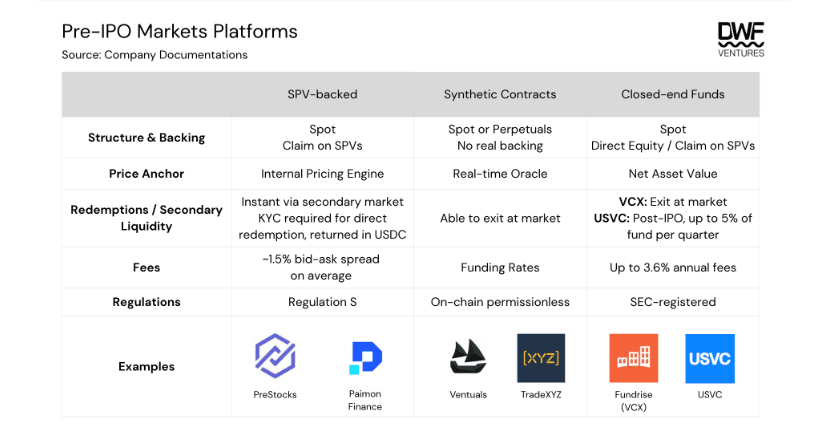
The report stresses that these structures serve materially different risk appetites. SPV tokens appeal to those seeking direct exposure; synthetics suit short-term traders comfortable with leverage; closed-end funds attract investors who value compliance and structure. Yet all share common vulnerabilities: opaque pricing, limited redemption windows and the absence of robust secondary liquidity.
Premiums That Refuse to Fade: No Shorts, No Self-Correction
Across most platforms, pre-IPO tokens trade at stubborn 20-40% premiums to the last known private valuations. In conventional markets, such gaps would invite short sellers to arbitrage them away. On-chain, short-side liquidity is almost nonexistent. The result is a one-way market that keeps inflating until the IPO provides a reality check.
The report, now public on X, calls this a structural flaw. “Pre-IPO shares usually trade at persistent premiums of 20–40% above last known private market valuations, with no short-side counterforce to correct them on most platforms,” Grachev noted.
Funds relying on SPV positions to calculate net asset value could find themselves unable to meet redemptions if reported valuations prove optimistic. The competitive rush is only accelerating the problem.
Crypto exchanges like Binance and Bitget have rolled out their own tokenized pre-IPO offerings through integrations or proprietary contracts. Backpack is experimenting with a fully on-chain IPO backed by Superstate and Solana. New categories keep emerging, each promising easier access but inheriting the same pricing distortions.
Demand Clusters in AI and Crypto as Competition Intensifies
Among pre-IPO markets, interest has concentrated heavily in three sectors: crypto, AI and fintech. Hiive’s data shows AI leading in volume of deals, crypto generating the strongest per-name enthusiasm. The outperformance of the Hiive50 index—materially ahead of the S&P 500 throughout 2025, with fintech up 167%, crypto up 107% and AI delivering strong gains—has only fueled the narrative that pre-IPO exposure is the place to be.
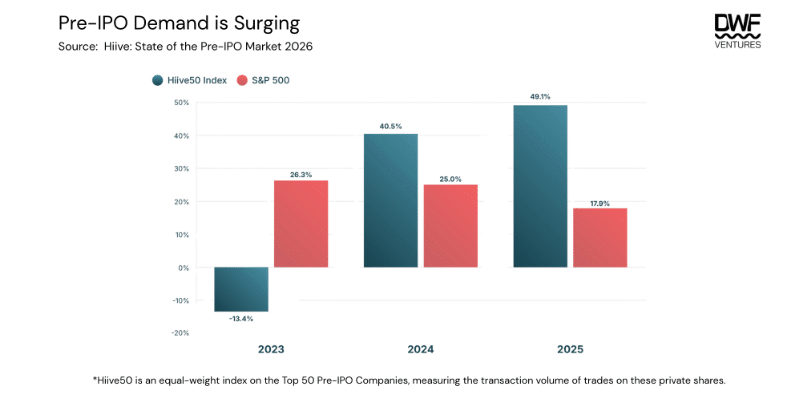
Yet the institutional and retail channels remain largely separate. Hiive’s million-dollar average trades underscore that sophisticated buyers still prefer off-chain secondary markets. On-chain products, by contrast, democratize access at the cost of higher premiums and thinner liquidity.
Grachev sees both opportunity and warning in the mismatch. “Retail demand for pre-IPO exposure remains an underserved market, and competition has begun to emerge on-chain,” he said.
The platform that first solves for genuine liquidity—while addressing redemption risks, regulatory clarity and credible backing—stands to capture an outsized share of the next cycle. Regulation, Grachev added, will ultimately decide the long-term winners.
Also read: Binance Research: Over $75 Billion in Illicit Crypto Stuck Onchain