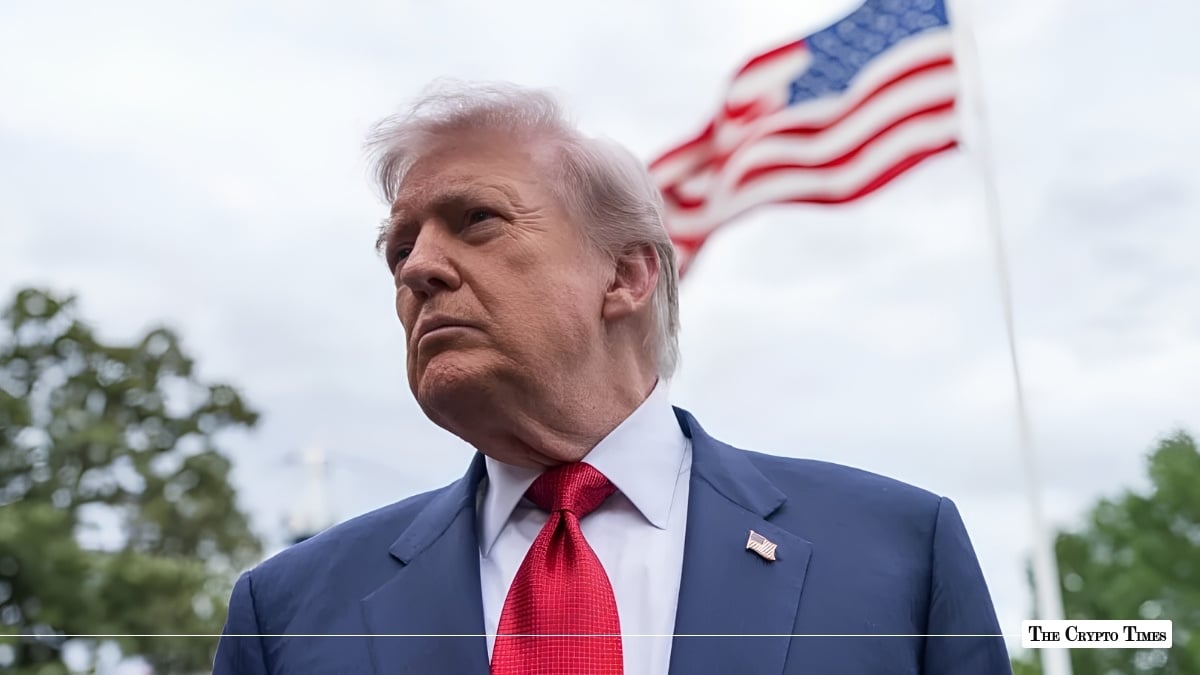
President Donald J. Trump and his family executed multiple purchases of shares in leading cryptocurrency-related companies during the first quarter of 2026, according to a detailed financial disclosure filed with the U.S. Office of Government Ethics (OGE).
The OGE Form 278-T, dated May 8, 2026, and publicly released this week, provides the clearest view yet into the Trump family’s securities trading activity for the period from January through March. The filing covers combined holdings of President Trump, First Lady Melania Trump, and any dependent children. All assets are managed through a trust controlled by the president’s children.
Nine Coinbase entries, two MARA purchases, and eight Strategy transactions
The OGE document records nine entries tied to purchases of Coinbase Global Inc. Class A Common Stock (COIN). The largest single Coinbase transaction occurred on February 10, 2026, valued in the $100,001 to $250,000 range. Additional Coinbase purchases were recorded at smaller sizes throughout the quarter.
Trump’s family also purchased shares of MARA Holdings (NASDAQ: MARA), the prominent Bitcoin mining and digital infrastructure company. The MARA purchases were smaller, each falling in the $15,001 to $50,000 range, with one such transaction appearing on page 35 of the 113-page filing dated March 20, 2026. MARA recently reported a $1.26 billion net loss in Q1 and has announced a strategic pivot toward AI and data center operations.
Strategy, formerly known as MicroStrategy and now the world’s largest corporate Bitcoin holder with over 818,000 BTC on its balance sheet, appeared in eight transactions across both the buy and sell sides. The largest Strategy purchase was made on February 12, valued between $50,001 and $100,000.
The largest sale occurred on January 12, falling in the $15,001 to $50,000 range. Strategy’s Class A Common Stock was the instrument involved in all eight entries.
Beyond these three core crypto-linked names, the filing also disclosed purchases of Block Inc. (SQ), the Jack Dorsey-led fintech company with Bitcoin treasury exposure through Cash App; Robinhood Markets (HOOD), which serves as the trustee for the Trump Accounts retirement program; and SoFi Technologies (SOFI).
Current market prices (as of May 14, 2026, close)
- MARA Holdings (MARA): $13.29
- Coinbase Global (COIN): $212.01
- Strategy Inc. (MSTR): $186.97
- Block Inc. (SQ): ~$78–$82 (recent trading range)
- Robinhood Markets (HOOD): $80.70
- SoFi Technologies (SOFI): $16.02
Crypto trades from a small slice of a massive filing
Crypto-related moves formed only a small slice of an exceptionally busy quarter. The filing documents more than 2,000 individual securities transactions — with some independent analyses citing as many as 3,642 trades — across the 113-page disclosure.
The aggregate notional value of all transactions falls in a wide band between approximately $220 million and $750 million, with a central estimate near $475 million according to reviews by Benzinga and The Kobeissi Letter.
The OGE filing uses standard dollar-range reporting rather than exact figures. As a result, it does not disclose precise transaction values, specific execution times within the reported dates, or which specific family member’s account handled each trade.
All transactions listed in the 278-T form part of the combined financial holdings of President Donald J. Trump, First Lady Melania Trump, and any dependent children. The document does not attribute individual trades to specific family members.
Large-cap technology and semiconductor names dominate the overall filing. Individual purchases of Nvidia (NVDA) at $235.74, Microsoft (MSFT) at $409.43, Broadcom (AVGO) at $439.79, Amazon (AMZN), Apple (AAPL), and Oracle (ORCL) at $195.61 each appeared in the $1 million to $5 million range.
Oracle alone accounted for an estimated $2.2 million to $10.6 million in purchases, while Microsoft purchases totaled an estimated $2.4 million to $8.1 million.
Financial sector exposure included purchases of Goldman Sachs (GS) at $968.96, JPMorgan, Bank of America (BAC) at $49.85, Visa, and Wells Fargo. The filing also records a notable $1 million to $5 million entry into Dell Technologies Inc. (DELL) Class C stock on February 10 — a transaction that has drawn scrutiny after President Trump publicly praised Dell at a White House event on May 8, after which the stock rose roughly 12%.
Other significant activity included Boeing Co. (BA) at $229.21, Meta Platforms Inc. (META) at $618.43, and broad positions in S&P 500 index funds, international ETFs such as iShares Core MSCI Emerging Markets (IEMG), as well as holdings across defense, energy, and pharmaceutical sectors. This sprawling portfolio underscores the scale and diversity of the Trump family’s Q1 trading activity.
Why the crypto purchases matter in context
The crypto stock purchases sit inside an active pro-crypto policy window that has defined Trump’s second term. Since returning to the office, the administration has signed executive orders creating a federal Bitcoin strategic reserve, replaced SEC leadership with officials more favorable to the digital asset industry, launched the Trump Accounts retirement program, and pushed for legislative clarity through the CLARITY Act, which cleared the Senate Banking Committee on May 14 with a 15-9 bipartisan vote.
Critics have flagged the overlap between the president’s securities holdings and his regulatory authority as a conflict of interest risk. The purchases of Coinbase, Robinhood, and other crypto-linked firms come during a period in which the SEC dropped or settled multiple enforcement actions against companies in the digital asset space, including Coinbase itself.
Democrats in the Senate, including Senator Elizabeth Warren, have argued that the CLARITY Act needs stronger ethics provisions to address elected officials profiting from crypto ventures.
The White House has defended the filings as full compliance with the STOCK Act and federal ethics requirements. Trump’s assets are held in a revocable trust controlled by his children, Donald Trump Jr. and Eric Trump, rather than a qualified blind trust.
What the filing does not reveal
Several important details remain opaque. The 278-T format does not disclose which specific accounts held the transactions, who placed the trades, or whether a broker acted with discretionary authority. Some transactions in the filing carry a notation suggesting broker-initiated activity, but the document does not clarify the full management structure.
The filing also does not reveal whether the purchases were coordinated with any policy decisions or whether family members had advance knowledge of upcoming regulatory actions. The OGE, when contacted by other publications, declined to address the specifics, stating only that it is committed to transparency and citizen oversight.
It is worth noting that the 278-T covers only securities transactions exceeding $1,000. Any positions below that threshold, as well as direct cryptocurrency holdings such as Bitcoin, Ethereum, or other tokens, are not captured in this particular filing format.
Also Read: Trump-Linked WLFI’s USD1 Heads to Binance Futures Market