
Key Highlights
- Ethereum rebounded above $2,300 after the CLARITY Act advanced in the Senate Banking Committee.
- Pre-vote on-chain data showed profit-taking, short-term holder selling, and slowing staking growth.
- The rally suggests traders are now pricing in regulatory optimism after earlier selling pressure was absorbed.
Ethereum climbed back above the $2,300 level after the Senate Banking Committee approved the CLARITY Act, triggering a broader relief rally across crypto markets.
The regulatory progress improved short-term market sentiment and helped ETH recover from recent weakness near the $2,240 region. Bitcoin, crypto equities, and major altcoins also moved higher as traders reacted positively to the Senate vote.
The move helped ETH recover from recent weakness near the $2,240 zone, where the asset had been consolidating before the vote. The rebound suggests traders are now responding to improved regulatory visibility rather than the cautious on-chain signals that dominated before the Senate decision.
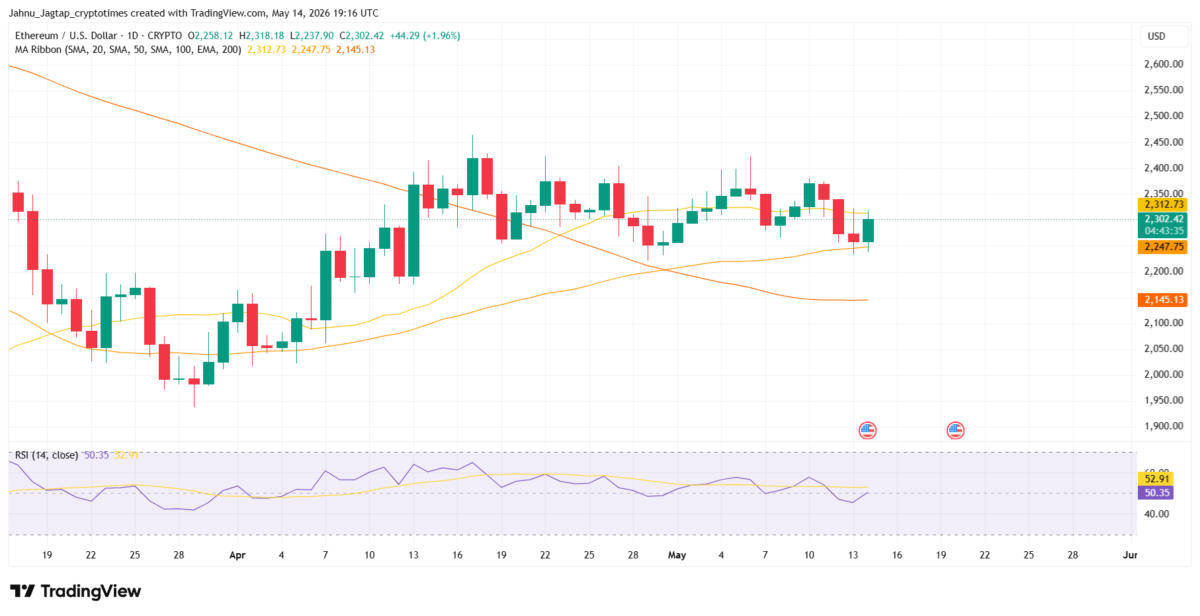
On the daily chart, ETH reclaimed the 50-day SMA near $2,247 and moved back toward the 20-day SMA around $2,313. A sustained move above this level could open the path toward $2,350, followed by $2,400 and $2,450.
On-Chain Data Showed Selling Before the Vote
Ethereum’s rebound comes after several on-chain indicators had already reflected selling pressure before the CLARITY Act vote.
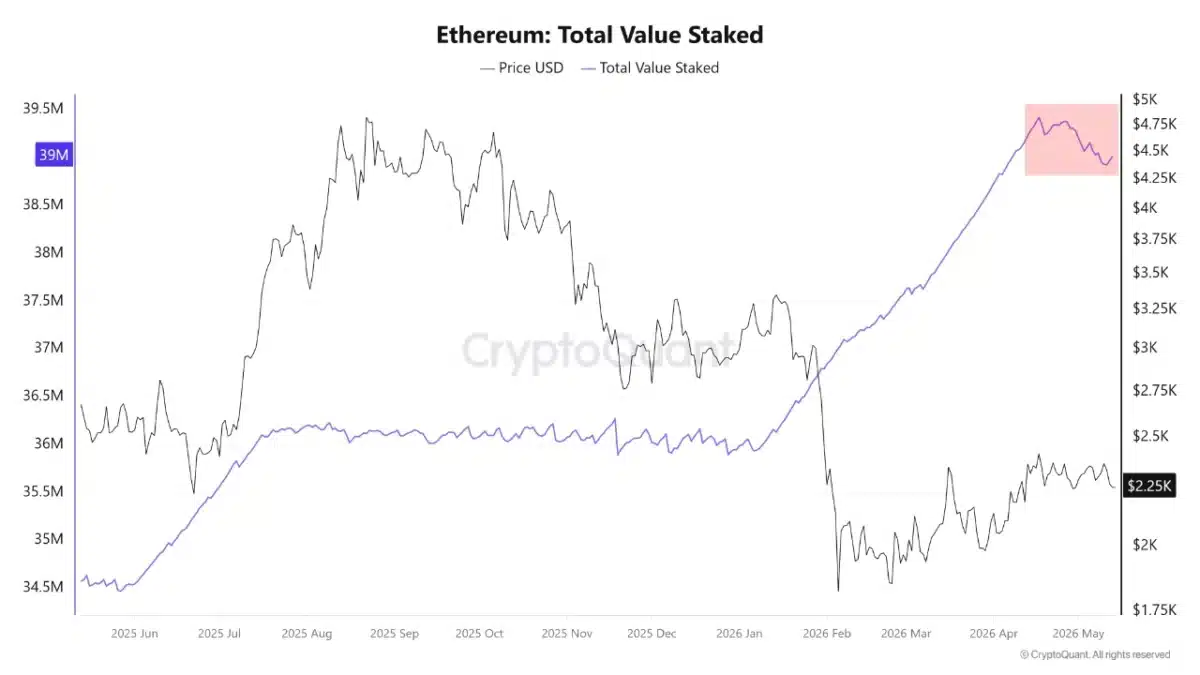
CryptoQuant data showed total staked ETH rising toward nearly 39 million ETH in 2026, pointing to strong long-term holder conviction. However, the staking curve began flattening in May, with a slight decline visible before the vote. That suggested some holders were unlocking ETH for liquidity, portfolio rotation, or risk management.
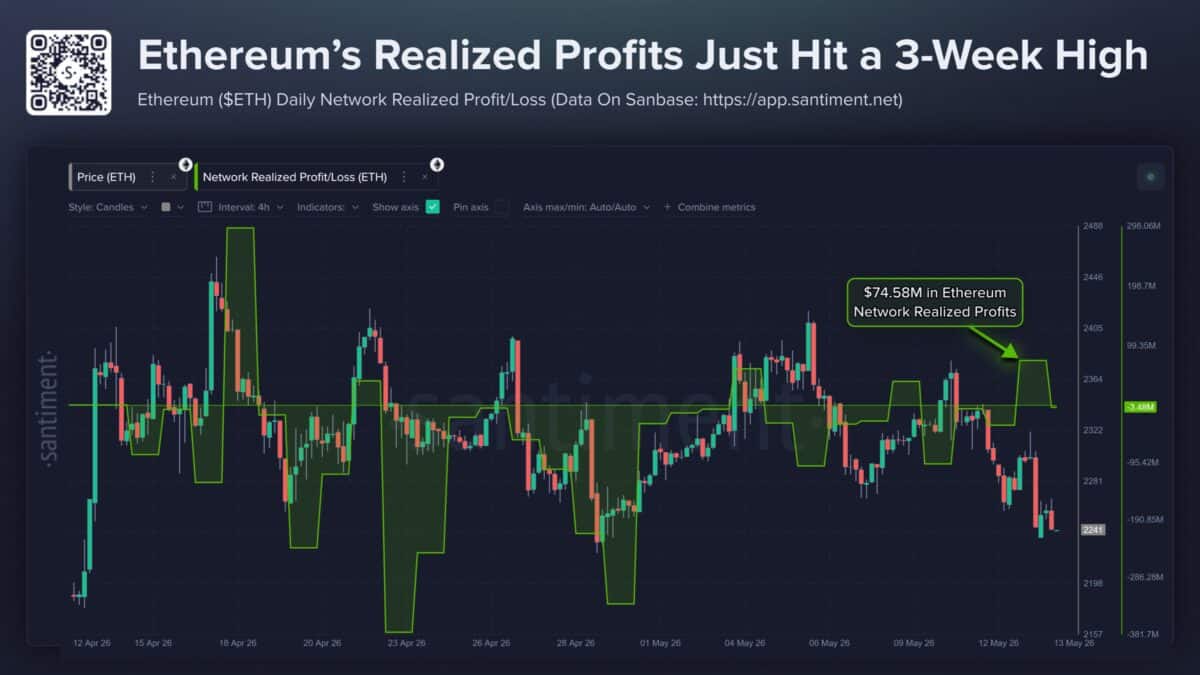
Santiment data also showed Ethereum network realized profits climbing to $74.58 million, the highest level in three weeks. The move came while ETH was already under pressure, indicating that holders who accumulated below $2,000 earlier in the year were taking profits before the regulatory catalyst.
Short-Term Holders Had Already Cut Exposure
Glassnode’s HODL Waves data showed ETH held by one-to-three-month holders falling to around 4.8% of supply, down from above 6% in late April and far below the mid-January level near 16%.
This cohort often reacts quickly to market uncertainty. Its steady decline before the vote suggests recent buyers had already reduced exposure during Ethereum’s consolidation phase.
That timing matters. Instead of confirming fresh post-vote weakness, the data shows ETH entered the CLARITY vote after a period of distribution. The market may have already absorbed much of that selling before the regulatory headline triggered a relief rally.
CLARITY Vote Becomes the Dominant Catalyst
The Senate Banking Committee’s approval of the CLARITY Act shifted market attention from pre-vote caution to regulatory optimism.
For Ethereum, the timing was important. ETH had already seen profit-taking, short-term holder exits, and a slowdown in staking growth before the vote. Once the bill advanced, traders moved back into risk assets, allowing ETH to rebound despite the earlier bearish data.
This does not erase the on-chain caution, but it changes how the data should be read. The bearish signals were part of the setup before the rally, not proof that fresh selling pressure is building after the vote.
Ethereum ETF Trends Show Institutions Are Still Waiting
Data from CoinGlass shows Ethereum spot ETFs experienced strong inflow phases during previous major ETH rallies, particularly when prices moved above the $3,000 and $4,000 regions.
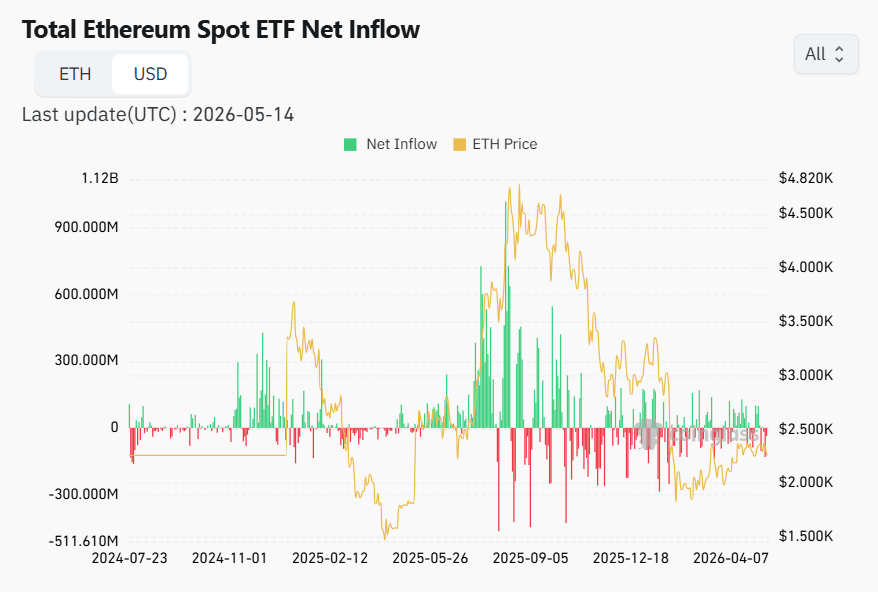
However, ETF activity became increasingly mixed through late 2025 and early 2026, with repeated periods of outflows and weaker sustained accumulation as ETH traded closer to the $2,000–$2,300 range.
The latest rebound following the CLARITY Act vote, therefore, appears to be driven more by the following:
- improving crypto market sentiment,
- regulatory optimism,
- and short-term trader positioning,
rather than a fresh wave of aggressive institutional ETF inflows.
Institutions are still cautiously watching Ethereum instead of fully chasing the breakout. At the same time, the earlier profit-taking and short-term holder selling seen before the Senate vote may have already reduced immediate downside pressure, allowing sentiment to temporarily take control of price action.
ETH Short Liquidations Rise After CLARITY Vote
Derivatives data from CoinGlass shows Ethereum’s post-CLARITY rally also triggered a wave of short liquidations across the futures market.
Total ETH liquidations reached roughly $43.36 million over 24 hours, with short liquidations slightly exceeding longs at $22.93 million compared to $20.43 million.
The imbalance suggests traders positioned for continued downside were caught offside as Ethereum rebounded above the $2,300 region following the Senate Banking Committee’s approval of the CLARITY Act.
At the same time, CoinGlass data showed Ethereum’s liquidation environment sitting at “0.27x Clear Deleveraging,” indicating the market is still reducing excess leverage rather than entering a euphoric speculative phase.
Ethereum Price Outlook
Ethereum now needs to hold the $2,300 area to keep the relief rally intact.
If ETH sustains above the 20-day SMA near $2,313 and breaks through $2,350, the next upside levels sit around $2,400 and $2,450. A stronger move could bring the $2,500 psychological level back into focus.
On the downside, failure to hold above $2,247 would weaken the short-term recovery and expose ETH to another test of $2,200. A deeper breakdown could bring the 200-day EMA near $2,145 back into play.
For now, Ethereum’s short-term trend has improved after the CLARITY Act vote, with regulatory optimism overriding the bearish on-chain signals that appeared before the rally.
Also Read: Bitcoin Rallies to $82K as CLARITY Act Clears Senate Banking