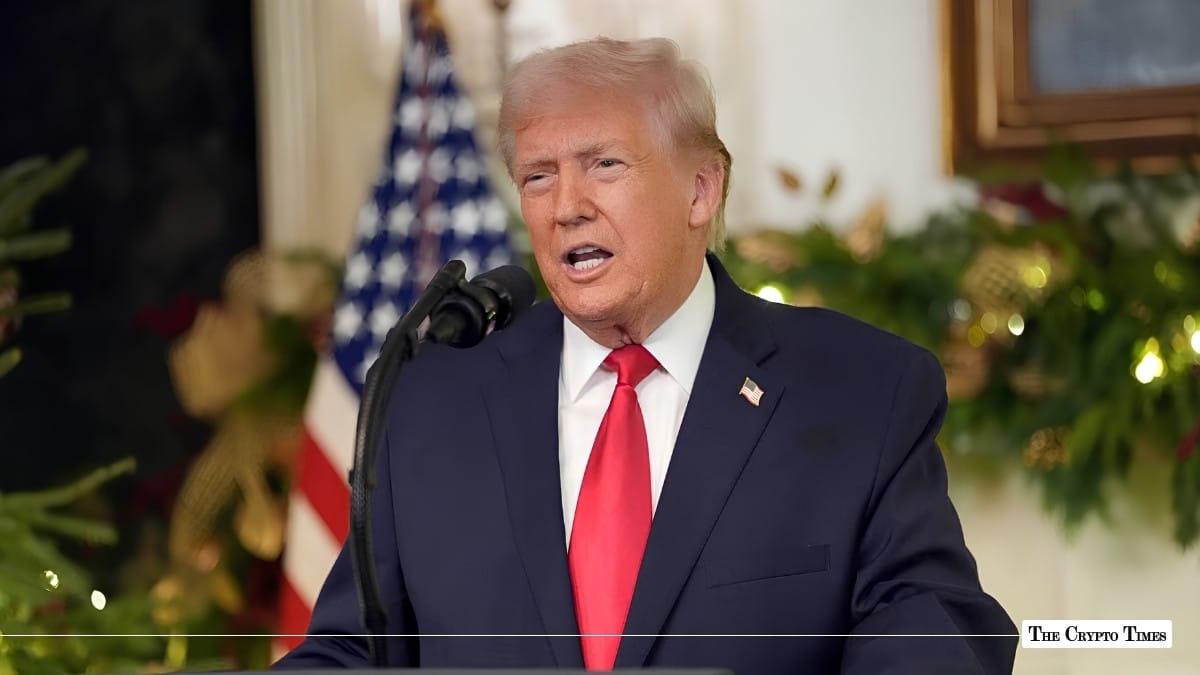
President Donald J. Trump signed an executive order on Monday formally directing the federal government to begin integrating fintech firms, including those in digital assets, into the regulatory plumbing of the U.S. financial system, including, for the first time in an explicit White House directive, by evaluating direct access to Reserve Bank payment accounts and payment services for non-bank crypto firms.
The order, titled “Integrating Financial Technology Innovation into Regulatory Frameworks” and dated May 19, 2026, sets policy that the federal government “must update regulations to allow integration of digital assets and innovative technology into traditional financial services and payment systems” and “must also remove overly burdensome and fragmented regulations and supervisory practices that form barriers to entry and primarily benefit incumbent financial services firms.”
In substance, the order does three things: it directs six federal financial regulators to overhaul fintech rules on a 90-day clock, it requests the Federal Reserve Board to evaluate granting crypto firms and other non-banks direct access to Reserve Bank payment infrastructure on a 120-day clock, and it defines “fintech firm” broadly enough to include nearly every category of regulated crypto activity in the United States.
The Federal Reserve Payment-Access Question
The most consequential provision is Section 4, which requests the Federal Reserve Board (FRB) to conduct a “comprehensive evaluation of the legal, regulatory, and policy framework governing access to Reserve Bank payment accounts and payment services” by uninsured depository institutions and non-bank financial companies, including those engaged in digital assets and other novel financial activities, and those operating as direct participants in real-time payment networks.
The order asks the Fed to deliver findings, options, and recommendations to the President within 120 days. Specifically, the evaluation is requested to assess:
- The Fed’s legal authority to extend direct access to Reserve Bank payment accounts and services to “covered firms.”
- Options for expanding such access, subject to risk management requirements.
- Legal impediments that currently preclude direct access, and the legislative or regulatory steps that would enable it.
- Whether each of the 12 individual Federal Reserve Banks has independent legal authority to grant or deny access; and, if so, what FRB-level policies would ensure consistent evaluation across the system.
If the Fed determines that existing law permits the extension of direct access, the order requests the FRB to “establish transparent application procedures” and to decide complete applications within 90 days of submission.
Why does this matter? Direct access to Reserve Bank payment accounts, in industry shorthand, “master account” access, is the most foundational piece of U.S. payment infrastructure. It allows an institution to hold reserves at the Fed, send and receive payments through Fedwire and FedNow, and operate as a fully participating financial entity rather than as a customer of a correspondent bank. For years, crypto-native firms, including state-chartered special-purpose depository institutions like Wyoming’s Custodia Bank, have argued that being denied this access constitutes a structural barrier that forces them to rely on intermediary banks, increasing cost, friction, and counterparty risk.
The Custodia Bank litigation against the Federal Reserve, which has been ongoing since 2022, has centered on this exact question: whether the Fed has discretion to deny a payment account to a legally chartered institution, and whether the 12 individual Reserve Banks act independently or under uniform Board-level policy. Monday’s order asks the Fed to answer precisely those questions on a defined timeline.
It is worth noting what the order does not do. It does not direct the Fed to grant such access, it does not name any specific firm, and it does not use the term “master account;” it refers throughout to the broader category of “Reserve Bank payment accounts and payment services.” That framing leaves the Fed substantial interpretive room, and any meaningful policy change will depend on what the FRB concludes in its 120-day review.
The 90-Day Fintech Review
Section 3 of the order directs the heads of six federal financial regulators to conduct a review of existing regulations, guidance, supervisory practices, and application processes within 90 days. These are: the Consumer Financial Protection Bureau (CFPB), the Securities and Exchange Commission (SEC), the National Credit Union Administration (NCUA), the Commodity Futures Trading Commission (CFTC), the Federal Deposit Insurance Corporation (FDIC), and the Office of the Comptroller of the Currency (OCC).
The review is required to identify:
- Regulations, guidance, orders, and no-action letters that “unduly impede” fintech firms from entering into partnerships with federally regulated institutions, including insured depository institutions, credit unions, broker-dealers, investment advisers, and futures commission merchants.
- Items that could be amended to streamline applications by fintech firms seeking bank charters, credit union charters, deposit or share insurance, and other federal licenses, registrations, and authorizations.
Each regulator must then, within 180 days, take steps to encourage innovation as a result of the review, in consultation with the Assistant to the President for Economic Policy.
The order frames this work explicitly as a competition-policy intervention. Per Section 1: existing “fragmented regulations and supervisory practices” “primarily benefit incumbent financial services firms,” and policy should now “streamline regulatory processes, reduce unnecessary barriers to entry, and encourage collaboration between fintech firms, federally regulated financial institutions, and Federal financial regulators.”
How “Fintech Firm” Is Defined
The definition in Section 2(a) is unusually broad. A “fintech firm” is defined as “a non-bank company that uses or develops technological means to offer or support the offering of financial products or services,” with the list of covered activities explicitly including: payment processing, lending, deposit-taking, derivatives, investment management, brokerage services, underwriting and capital-market activities, custodial and fiduciary services, digital banking, digital asset-related services, securities and commodities market activities, and blockchain-based services.
For the avoidance of doubt, the definition also pulls in financial activities listed in paragraphs (A) through (G) of section 4(k)(4) of the Bank Holding Company Act of 1956.
In effect, the order sweeps nearly the entire crypto industry, i.e. exchanges, custodians, stablecoin issuers, on-chain payment processors, derivatives venues, and infrastructure providers, into a single regulatory category subject to the streamlining mandate.
Why Now: The CLARITY Act Context
The order arrives at a precise moment in the broader crypto regulatory cycle.
Just days earlier, on May 14, 2026, the Digital Asset Market Clarity Act cleared the Senate Banking Committee on a 15-9 vote, with two Democrats crossing the aisle after a last-minute bipartisan deal in the committee’s ante room saved the markup. The administration has set a July 4 target for full congressional passage, per remarks by White House crypto adviser Patrick Witt at Consensus Miami earlier this month.
The CLARITY Act would establish jurisdictional rules of the road for digital assets; most notably, granting the CFTC primary authority over digital-commodity spot markets while preserving SEC oversight of investment contracts. Monday’s executive order is procedurally complementary: where CLARITY would define who regulates what, the EO directs the how: telling the regulators that will eventually administer those rules to start dismantling the existing fragmented framework now, ahead of any new statutory mandate.
The order also follows the House Agriculture Committee’s May 15 bipartisan letter urging the President to fill all four vacant CFTC commissioner seats before the agency takes on the expanded mandate the CLARITY Act would create. The EO does not address commissioner vacancies, but its 90-day fintech review will land on a CFTC currently operating with a single confirmed commissioner.
What Crypto Firms Should Watch For
Three specific outcomes from the order’s implementation will define its real-world impact:
- Whether the Federal Reserve concludes that existing law permits direct payment-account access for crypto-native firms. A finding that the Fed’s authority is sufficient would dramatically reduce structural barriers for state-chartered crypto banks and stablecoin issuers. A finding that legal impediments remain would shift the question to Congress.
- Whether the OCC, FDIC, and NCUA streamline charter applications for fintech firms. A meaningful liberalization of the bank-charter, credit-union-charter, and deposit-insurance application processes could open a path for the largest crypto firms, such as Coinbase, Circle, Kraken, and others, to become directly regulated banking entities rather than working through partner banks.
- Whether SEC and CFTC supervisory practices change. The order directs both agencies to identify and amend rules that impede fintech partnerships with federally regulated institutions; language that could affect everything from no-action letter practice to enforcement priorities.
The order does not, on its own, change any rule. It establishes a calendar: 90 days for review, 180 days for action, 120 days for the Fed’s evaluation. The administrative work begins immediately; the regulatory output will arrive late summer and fall of 2026.
The Limits and the Leadership Transition at the Fed
Like any executive order, the document includes standard general provisions: nothing in the order overrides existing law, the order does not create any enforceable right or benefit, and implementation is subject to the availability of appropriations. The Fed-related sections explicitly use the word “requested” rather than “directed,” reflecting the central bank’s independence — a constitutional design feature the order does not, and cannot, override.
For the Federal Reserve Board specifically, the order is closer to a formal policy invitation than a mandate. The timing also matters: the order arrives during a formal leadership transition at the Fed. Kevin Warsh was confirmed by the Senate on May 13, 2026 by a 54–45 vote as the 17th Chair of the Federal Reserve, succeeding Jerome Powell whose term as chair concluded on May 15. Powell was named chair pro tempore on May 15 to serve until Warsh is sworn in, per a Federal Reserve Board press release. In a break from tradition, Powell will remain on the Board of Governors after stepping down, the first time a former Fed chair has done so in nearly 80 years, with a governor term that runs until January 2028.
That means the 120-day Federal Reserve evaluation requested in the order will be conducted by a Board operating under new leadership for the first time in eight years. Whether the Fed engages with the order, on what timeline, and with what substantive conclusions will be decisions made under Chair Warsh (a Trump appointee who served on the Fed Board from 2006 to 2011 and led the central bank’s response to the 2008 financial crisis), and not by the White House directly.
What the order accomplishes regardless of the Fed’s response is the placement of direct payment-access for crypto-native firms squarely on the federal regulatory agenda, with a presidential deadline attached. That alone is a meaningful procedural shift from a status quo in which the question has been litigated case by case for years.
Also Read: Elizabeth Warren Accuses OCC of Illegal Crypto Bank Charter Approvals