Key Highlights
- Bernstein says Bitcoin miners control over 27GW of planned power capacity.
- AI-linked mining deals now cover about 3.7GW and more than $90 billion in contract value.
- Bernstein rates IREN, Riot, CleanSpark, and Core Scientific as Outperform.
Bitcoin mining companies are emerging as unexpected winners in the artificial intelligence infrastructure race, as Wall Street begins to value miners less for Bitcoin production and more for their access to large-scale power.
The shift gained fresh attention after Google and Blackstone announced a new AI cloud venture backed by an initial $5 billion equity commitment. The venture plans to offer Google’s Tensor Processing Units, or TPUs, through a compute-as-a-service model and aims to bring 500 megawatts of data center capacity online by 2027. Reuters reported that the broader investment could reach $25 billion with financing.
For Bernstein, the deal strengthens a larger thesis: the real bottleneck in AI infrastructure is no longer only chips or capital, but grid-connected power.
According to the investment bank’s latest note, Bitcoin miners collectively control more than 27 gigawatts of planned power capacity across the United States. Bernstein said this gives miners a strategic position as hyperscalers, chipmakers, and AI cloud firms compete for sites that can support dense computing workloads.
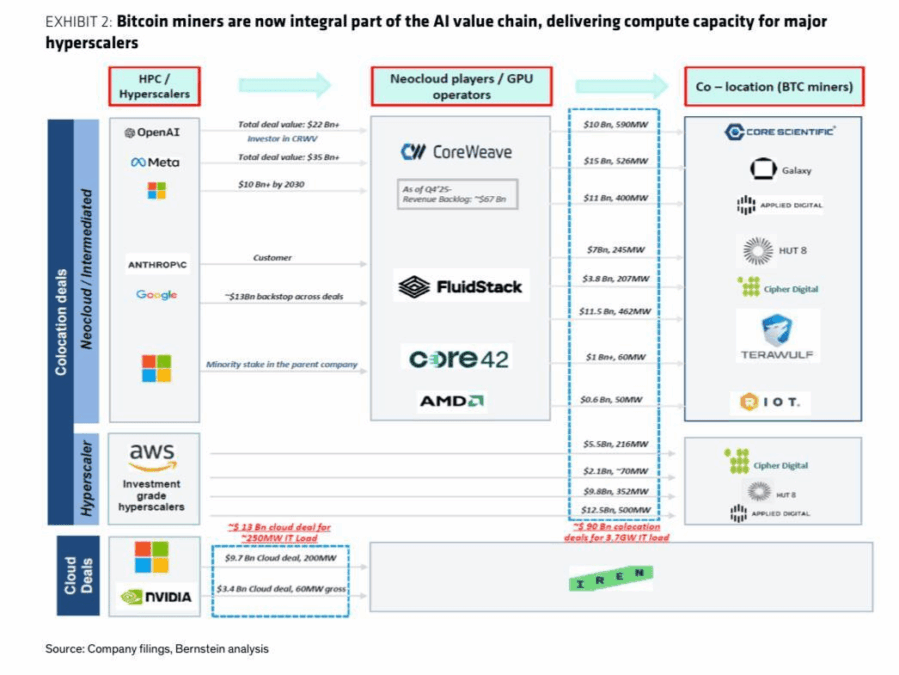
The bank also pointed to more than $90 billion in AI infrastructure deals already signed by Bitcoin mining companies, covering roughly 3.7GW of power capacity. The Block reported that Bernstein assigned Outperform ratings to IREN, Riot Platforms, CleanSpark, and Core Scientific, while keeping MARA Holdings at Market Perform.
Bernstein’s price targets stand at $100 for IREN, $25 for Riot Platforms, $24 for CleanSpark, and $24 for Core Scientific. MARA carries a $23 target with a Market Perform rating.
The logic is simple: AI firms need power fast, and miners already have what many traditional data center developers are still trying to secure. In many U.S. markets, bringing a gigawatt-scale site online can take years because of grid interconnection delays, permitting, land acquisition, and substation constraints.
That has pushed several miners to reposition themselves as high-performance computing and AI infrastructure providers.
IREN has become one of the most closely watched names in the sector. The company has been tied to major AI infrastructure expansion plans, while Bernstein’s $100 target implies strong confidence in its ability to monetize power capacity beyond Bitcoin mining.
Riot Platforms has also moved deeper into AI colocation, while CleanSpark and Core Scientific are being viewed as beneficiaries of the same power shortage. Core Scientific, in particular, has already become a central name in the miner-to-AI infrastructure pivot.
Market reaction across mining stocks remains mixed but active. IREN traded near $47.67, Riot near $22.77, CleanSpark near $14.69, Core Scientific near $22.86, and MARA near $12.43 during Tuesday’s U.S. session. CleanSpark was among the stronger performers, rising more than 9% on the day.
The Google-Blackstone venture also shows how fast the AI infrastructure market is changing. Instead of relying only on traditional cloud capacity, large technology companies are increasingly using private capital, custom chips, and dedicated data center partnerships to secure compute supply.
That trend could benefit miners even if the AI cloud market becomes more competitive. Whether hyperscalers build their own AI cloud platforms or lease capacity from independent providers, they still need power, land, cooling, and grid access.
For Bitcoin miners, that means the AI boom is creating a second valuation story. Hashrate and Bitcoin reserves still matter, but Wall Street is now asking a different question: how much power can a miner convert into AI revenue?
Also Read: AI Financial $271M WLFI Hit Sparks Going-Concern Warning for Trump Crypto Play