AI Financial Corporation, the Nasdaq-listed treasury vehicle for World Liberty Financial, has posted a $271.5 million net loss for the first quarter of 2026, underscoring the sharp volatility and structural vulnerabilities in one of the most politically charged cryptocurrency ventures in the US.
The results, filed to the SEC late on Monday, come as the Trump family’s flagship DeFi project faces intensifying scrutiny over governance, conflicts of interest, and its reliance on token price momentum amid a broader crypto market correction.
The quarterly loss, equivalent to $2.14 per share, dwarfs the company’s modest $4.7 million in revenue from legacy fintech operations. Nearly all of the red ink stems from a $348.3 million unrealized loss on its holdings of 7.28 billion WLFI governance tokens, now carried at $706 million after a steep decline from an acquisition cost of approximately $1.46 billion.
Management explicitly flagged “substantial doubt” about the company’s ability to continue as a going concern within the next 12 months, citing a working capital deficit, negative operating cash flow, and thin liquidity.
“These conditions raise substantial doubt about the Company’s ability to continue as a going concern within one year after the date these financial statements are issued,” the filing states.
The filing marks a stark reversal for a vehicle conceived in 2025 as a bold bet on the Trump family’s crypto ambitions. Rebranded from ALT5 Sigma and recapitalized through a $1.5 billion equity raise, AI Financial (ticker: AIFC) was positioned as the public-market proxy for WLFI exposure. Yet the locked nature of its massive token position—coupled with operational losses—has left it exposed as WLFI’s price has slumped.
Treasury Strategy Unravels Amid Token Depreciation
AI Financial’s pivot into a dedicated WLFI treasury holder was announced with considerable fanfare in mid-2025. Backed by shared leadership, including Zachary Witkoff—son of Trump Middle East envoy Steve Witkoff and CEO of World Liberty Financial—the company raised capital specifically to amass tokens.
Witkoff chairs AI Financial’s board, while other overlaps with the WLFI ecosystem, including a $15 million related-party loan from WLFI itself, underscore the tight integration.
At the time, the strategy was hailed by proponents as innovative “capital with a purpose,” allowing public investors indirect exposure to a DeFi protocol promoted by the sitting US president’s family.
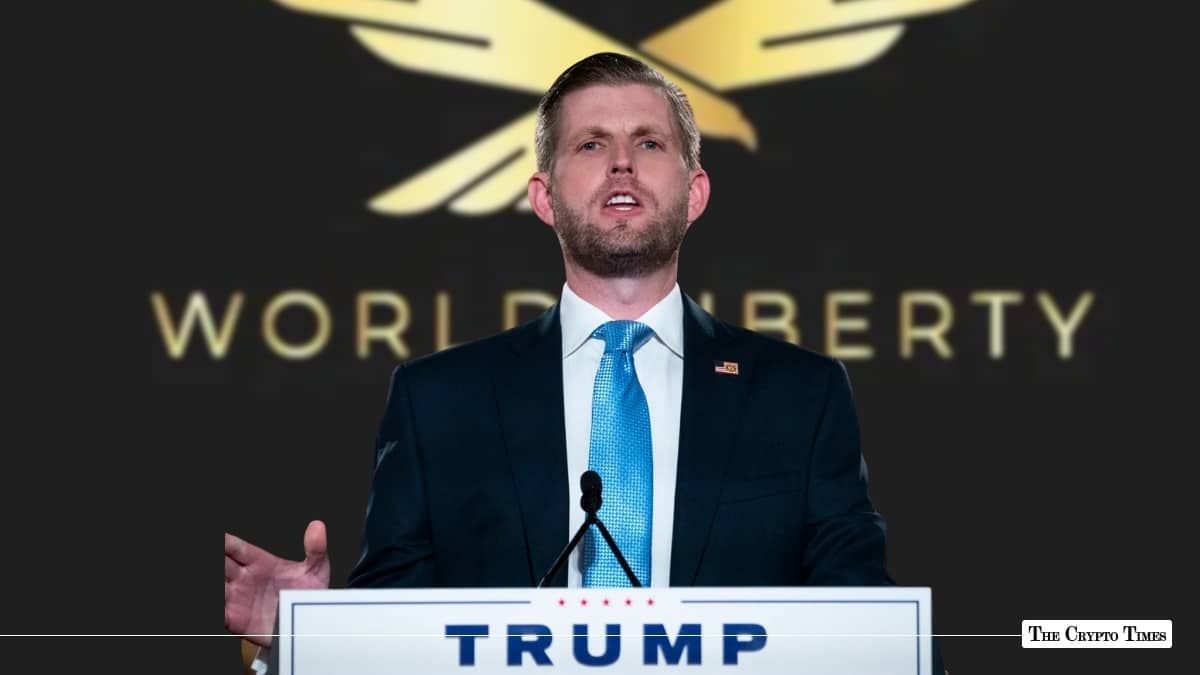
WLFI positions itself as a decentralized finance platform, with ambitions extending to stablecoins like USD1 and tokenized real-world assets. The Trump family entity receives 75% of net proceeds from token sales, according to project documents, with Eric Trump, Donald Trump Jr., and other family members holding prominent roles.
Yet the first-quarter results lay bare the risks of such concentrated exposure. With only $10.5 million in cash at quarter-end and cash burn from operations running at roughly $12.3 million for the period, AI Financial is heavily dependent on future WLFI appreciation or additional infusions.
The firm’s tokens remain subject to lock-up restrictions, limiting any near-term liquidity relief. Total assets contracted to $959.7 million from $1.22 billion at the prior year-end, driven almost entirely by the fair-value adjustment.
Analysts following the crypto treasury trend note parallels with other corporate Bitcoin or altcoin holders, but highlight the unique political overlay. “This is not just a balance-sheet story,” said one crypto fund manager who declined to be named. “It’s a proxy for confidence in the entire WLFI ecosystem, which carries both brand power and significant reputational baggage.”
Political Entanglements Fuel Governance Concerns
The financial strains at AI Financial arrive against a backdrop of broader criticism directed at World Liberty Financial and its presidential connections.
Launched in 2024, WLFI has drawn accusations of leveraging the Trump name for profit while raising questions about potential conflicts of interest in US policy-making. Democratic lawmakers and ethics watchdogs have repeatedly flagged the arrangement, pointing to the family’s substantial revenue share and the president’s titular role as “Chief Crypto Advocate.”
Recent controversies have amplified the unease. In April 2026, blockchain entrepreneur Justin Sun—once a major WLFI backer who committed tens of millions—filed suit alleging the project improperly froze his tokens, stripped voting rights, and engaged in coercive tactics.
WLFI has denied the claims, calling them baseless. Separately, reports of token sales or partnerships linked to foreign entities, including those under prior US scrutiny, have prompted calls for investigations from Congress.
Critics argue the structure blurs lines between private enterprise and public office. A Trump family-controlled entity stands to benefit handsomely from token sales and ecosystem growth, even as the administration advances crypto-friendly policies. Proponents counter that such ventures demonstrate American leadership in digital assets and that family involvement predates the presidency.
Yet the optics remain challenging: WLFI’s governance allows significant discretion, and early investor lock-ups have drawn complaints about unequal treatment.
For AI Financial shareholders, these dynamics translate into heightened uncertainty. The stock—down 9.61% on the last trading session of May 18—has reacted negatively to the earnings release, reflecting fears that a prolonged WLFI slump could exacerbate liquidity pressures.
The company’s auditors stopped short of issuing a formal qualification but emphasized the need for revenue growth, additional capital, or favorable token price recovery.
Market and Regulatory Ripples
The episode illustrates wider tensions in the crypto sector under the current administration. While pro-crypto rhetoric has boosted sentiment and regulatory clarity in some areas, high-profile family-linked projects have invited accusations of favoritism.
WLFI’s stablecoin ambitions and banking license applications add another layer, echoing that success could legitimize the ecosystem, but failure—or further scandals—risks broader reputational damage to the industry.
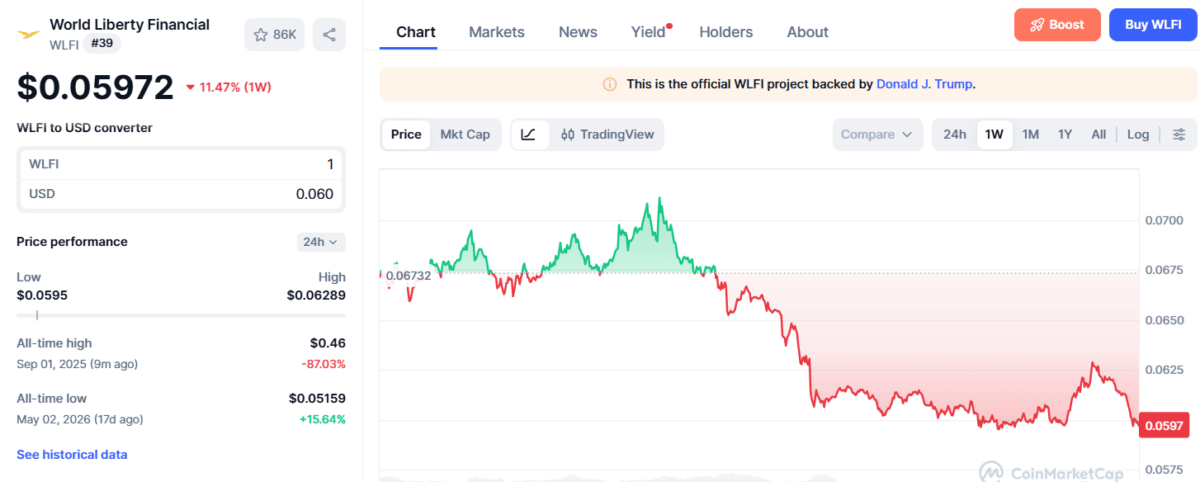
Broader crypto markets have shown resilience, with Bitcoin and Ethereum holding ground, but altcoins like WLFI remain sensitive to narrative shifts. At the time of publishing, WLFI trades at $0.05975—dropping 11.42% in the past 7 days while overall down 87% from its all-time high of $0.46, marked 9 months ago on September 1, 2025.
AI Financial’s management expressed confidence in the long-term thesis, pointing to WLFI’s underlying technology and strategic positioning. Yet the 10-Q offers little in the way of concrete mitigation plans beyond the existing WLFI loan and potential future financings. Operating revenue remains negligible relative to the scale of the treasury bet.
Outlook: High Stakes for a Politicized Crypto Experiment
As AI Financial navigates its going-concern warning, the saga reflects deeper questions about blending family business, politics, and public markets in the volatile crypto arena.
For investors in AIFC, the bet is clear: WLFI must deliver not just hype but sustainable value and liquidity. For the Trump ecosystem, the episode risks becoming a case study in how political capital can amplify both upside and downside in speculative assets.
Whether this proves a temporary markdown in a bullish crypto cycle or a harbinger of structural challenges remains to be seen. What is certain is that the fortunes of AI Financial—and by extension, perceptions of WLFI—will continue to be watched closely in Washington, Wall Street, and crypto trading floors alike.
Also read: Swan Bitcoin Sued for $970M Over Alleged Prime Trust Tipoff