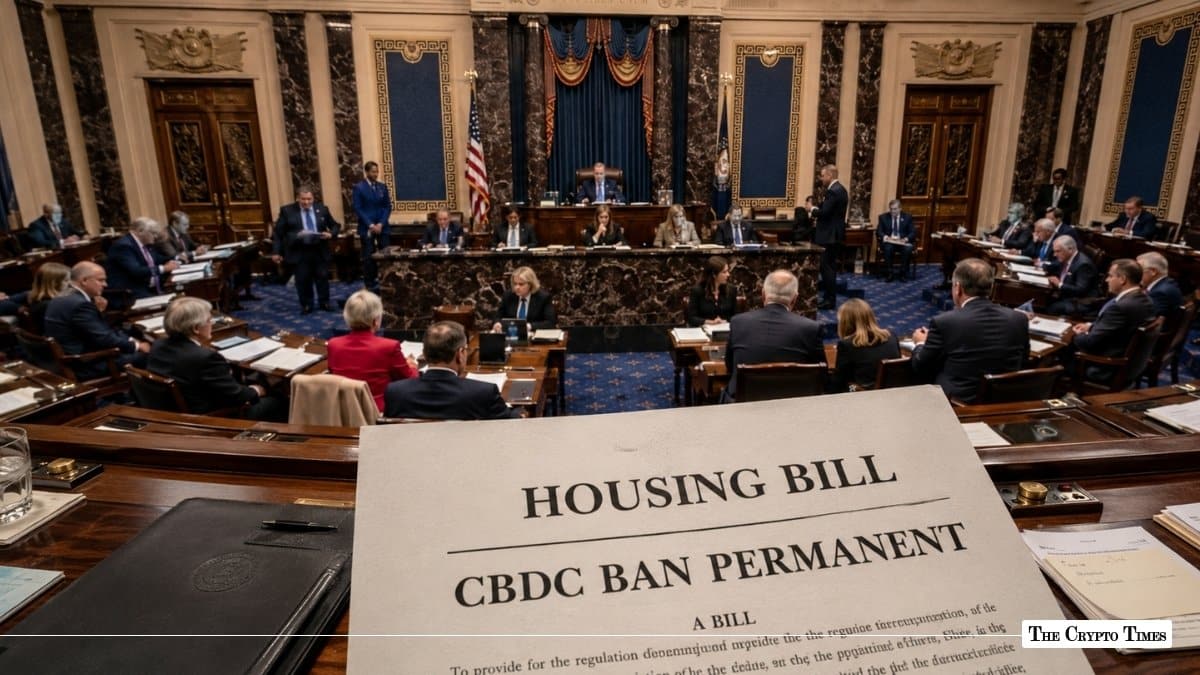
The United States may be days away from its most consequential vote on a central bank digital currency in congressional history—and it is happening inside a housing bill.
Republican lawmakers in the U.S. House have pushed to turn a temporary restriction on a central bank digital currency (CBDC) into a permanent ban as Congress prepares to vote on a major housing bill later this week. The bill at the center of the fight is the 21st Century ROAD to Housing Act—a sweeping bipartisan housing reform package that passed the Senate 89-10 in March. Its final section is where the CBDC battle lives.
According to Congressman Mike Flood, House lawmakers revised the Senate’s version of the bill to remove what he described as a “backdoor green light for a CBDC” by making the prohibition indefinite rather than allowing it to expire in 2030. The distinction is everything. A ban that expires in 2030 is a delay. A ban with no expiry date is a permanent closure of the Federal Reserve’s legal pathway to a government-issued digital dollar—and a structural clearing of the field for privately issued stablecoins.
The “Pre-Launch Window” Argument
The most pointed articulation of why the permanent ban matters came from Rep. Warren Davidson, who framed the Senate’s 2030 expiration not as a restriction but as a runway.
“The US House of Representatives could deliver a unifying win this week with bipartisan housing affordability legislation. Instead, they currently plan to deliver a go-live date for Central Bank Digital Currency, using housing as the Trojan Horse,” Davidson said. In a separate statement on X, Davidson added that the “2030 sunset works as a pre-launch development period,” while calling for a full and lasting prohibition on CBDCs in the United States.
The logic is precise: a Federal Reserve that begins CBDC infrastructure development today — in the four years between now and 2030 — emerges from the sunset period with a system that is ready to launch the moment the restriction expires. The temporary ban, in Davidson’s reading, does not prevent a CBDC. It funds the runway and sets the launch date.
Rep. Mike Flood reinforced that framing in a Washington Examiner op-ed published Monday: should Congress pass the House-amended bill, the development of thousands of housing units will restart, the backdoor green light for a CBDC will be reversed, and a bill that bans institutional investors from bidding against families for homes will become law.
What the Senate Bill Actually Says
The Senate Banking Committee first introduced the housing package in March as a sweeping reform bill focused on housing supply, affordability programs, mortgage access, and manufactured housing rules. Senators Tim Scott and Elizabeth Warren led the legislation, which advanced through the Senate with an 84-6 bipartisan procedural vote.
Buried within the housing proposal was a provision preventing the Federal Reserve or regional Federal Reserve banks from issuing a U.S. central bank digital currency without congressional approval. Under the Senate version, the restriction would remain in place only until December 31, 2030.
The ban’s inclusion was itself a political concession—added at the last minute to secure Republican support for a bill that also contained provisions conservatives objected to, including an Elizabeth Warren-backed requirement for large institutional investors to sell build-to-rent homes within seven years. The House has since stripped that investor provision from its amended version.
The Federal Reserve has already said it would not launch a CBDC without congressional authorization. The Trump administration also issued an executive order earlier this year prohibiting the establishment of a CBDC. So in practice, no CBDC is imminent regardless of the sunset clause. The fight is about the legal framework that governs what becomes possible in 2031 — and beyond.
The Emmer Parallel — and Why It Hasn’t Been Enough
House Majority Whip Tom Emmer has continued urging the Senate to pass his Anti-CBDC Surveillance State Act after it cleared the House earlier this year. Emmer’s standalone bill is the bluntest instrument in Congress on this issue—a direct, unconditional prohibition on any Federal Reserve CBDC issuance, with no sunset and no escape valve.
“The Chinese Communist Party uses a central bank digital currency to surveil and control its people. If the US adopted its own CBDC, privacy and economic freedom as we know it would cease to exist,” Emmer said.
The Anti-CBDC Surveillance State Act has cleared the House twice. It has never cleared the Senate. The housing bill is the first vehicle that has moved a CBDC ban this close to a presidential signature—which is precisely why the permanent-versus-temporary dispute has become so explosive and why House conservatives are determined not to let the 2030 sunset survive into the final law.
The Holdouts—and the Two-Thirds Problem
The House plans to bring the amended bill to a floor vote under “suspension of rules”—a fast-track procedure that requires a two-thirds majority, limits debate to 40 minutes, and allows no floor amendments. That procedural choice means the permanent CBDC ban language must survive into the version that goes to the floor, or it cannot be added from the floor once the vote begins.
The two-thirds threshold also means Republican votes alone are not sufficient. A meaningful number of Democrats must vote yes—and several have signaled discomfort with stripping the investor protections from the bill that the Senate’s Warren-backed version included.
Rep. Anna Paulina Luna (R-FL) has threatened to vote against the procedural rule entirely. She cited Senate Majority Leader John Thune’s previous remarks that a CBDC ban attached to a separate surveillance bill would be “dead on arrival” in the upper chamber. “John Thune also said in no way, shape or form is there going to be a CBDC ban,” Luna said. Luna’s threat points to the deeper risk: even if the House passes a permanent ban this week, the bill must return to the Senate—where Thune’s chamber will decide whether to accept the House’s changes or strip the permanent language back down to the 2030 sunset. The Senate’s track record on standalone CBDC bans is zero: every House-passed bill on the subject has stalled in the upper chamber.
What a Permanent Ban Means for Crypto
For the digital asset industry, this vote is not an abstraction. A permanent CBDC ban removes the Fed’s legal pathway to a government-issued digital dollar entirely—locking in the private stablecoin model as the dominant form of digital dollar in US commerce for the foreseeable future.
The GENIUS Act—which passed the Senate 68-30 in 2025 and established a regulatory framework for privately issued stablecoins—operates on the assumption that stablecoins, not a CBDC, will be America’s digital dollar. A permanent CBDC prohibition writes that assumption into permanent law. A temporary one leaves it open to revision from 2031 onward.
Circle, Tether, and every USDC or USDT issuer building for the US market have a direct stake in Thursday’s vote. So does Coinbase, which has actively lobbied both the GENIUS Act and the CLARITY Act and whose CEO Brian Armstrong called for lawmakers to “mark up” the stablecoin bill last month. The CBDC ban is the complementary provision — not the headline, but the backstop that makes the private stablecoin framework durable.
What Comes Next
If the House passes its amended version this week, the bill returns to the Senate. Senator Warren has already issued a warning: “If House Republicans continue to block legislation to cut housing costs in 2026, then Democrats will pass it ourselves when we take back Congress.” Senator Tim Scott has consistently urged the House to pass the Senate bill as written, arguing that the best path forward is the Senate’s Trump-backed bill.
Whether Thune’s Senate accepts a permanent CBDC ban — something it has never done before — will be the final test of whether the House’s push translates into law or becomes another standalone CBDC bill that cleared the House and died in the Senate.
Trump’s position remains uncertain. His executive order banned a US CBDC earlier this year. Yet he publicly urged the House to pass the Senate version—the version with a 2030 sunset. His silence on the permanent-versus-temporary question is conspicuous, and neither camp can claim a clear presidential mandate heading into the floor vote.
Also Read: GENIUS Act at 10 Months: Inside America’s New Stablecoin Rulebook