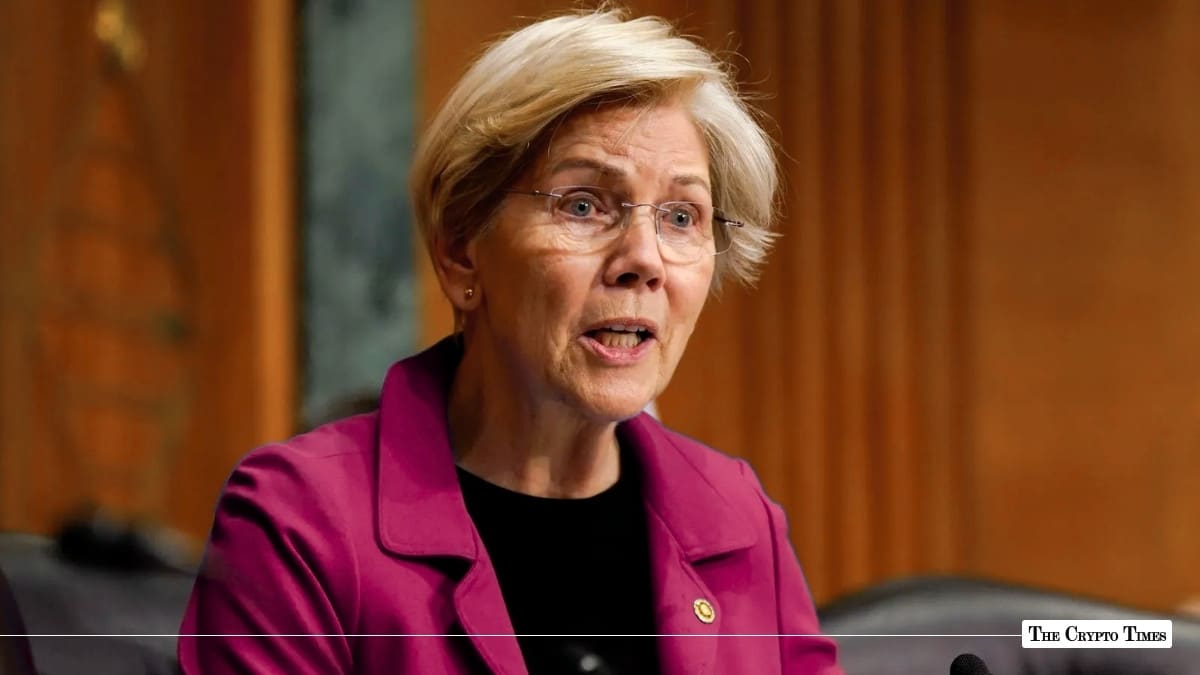
Senator Elizabeth Warren has accused the Office of the Comptroller of the Currency (OCC) of handing national trust bank charters to crypto companies that should never have received them—calling the approvals an “apparent violation of the National Bank Act” and escalating her campaign against the Trump administration’s rapid integration of crypto firms into the federally regulated banking system.
According to a Bloomberg report, in a letter to OCC Comptroller Jonathan Gould, Warren wrote that the regulator has approved at least nine national trust charters for crypto companies “that appear to go far beyond the narrow set of activities permitted by law,” describing the recipients as “seemingly ineligible” under the statute that governs what national trust banks are allowed to do.
The letter marks Warren’s most direct legal challenge to the OCC’s chartering spree—moving beyond the conflict-of-interest arguments she has made around World Liberty Financial to challenge the foundational legal authority behind the entire wave of crypto bank charters.
The Chartering Wave Warren Is Targeting
At the core of the dispute is what these charters unlock. National trust company charters grant crypto firms access to the Federal Reserve’s payment network and other banking services — the infrastructure backbone that enables real-time settlement, interbank transfers, and direct participation in the U.S. financial plumbing.
The framework permits limited financial activity and is subject to less intensive supervision than a traditional bank charter. Warren’s argument is that crypto firms are exploiting this lighter-touch framework to expand far beyond custody into activities that functionally replicate banking — without the capital requirements, deposit insurance obligations, or consumer protection safeguards that traditional banks must maintain.
The OCC has approved or received applications from at least 11 crypto and fintech companies seeking national trust bank charters since December 2025 — the fastest such wave in the agency’s history, with 11 companies filing for or receiving approvals in approximately 83 days.
Circle, Ripple, BitGo, Paxos, and Fidelity Digital Assets received conditional approvals in the first batch in December 2025. Bridge (Stripe’s stablecoin subsidiary), Protego, and Crypto.com followed in February 2026. Morgan Stanley, Payoneer, and Zerohash filed applications in February and March. Coinbase received its charter in early April. World Liberty Financial, President Trump’s family crypto venture, has an application pending.
The legal controversy centers on what national trust banks are permitted to do. The National Bank Act allows national banks to limit their activities to “the operations of a trust company and activities related thereto.” Traditionally, this meant fiduciary activities — holding and managing assets on behalf of clients in a trust relationship.
On March 2, 2026, the OCC finalized an amendment replacing the phrase “fiduciary activities” with “the operations of a trust company and activities related thereto” in its chartering regulations, effective April 1. The OCC said the change merely aligned regulatory text with statutory language. Critics — including Warren, the Conference of State Banking Supervisors, and traditional banking trade groups — argue it dramatically expanded what crypto firms can do under a trust charter without Congressional authorization.
“Franken-Charters” and Legal Challenges
The Conference of State Banking Supervisors (CSBS) has been among the most vocal critics. CSBS warned that the OCC’s proposal “would instead create uncertainty and could result in serious implications by overstepping National Bank Act authority,” and its president described the resulting structures as “Franken-“charters”—assembled from regulatory components not designed to work together.
Legal scholars have questioned whether the OCC’s interpretation stretches the statute beyond its intended scope. The core issue: national trust banks chartered under this framework do not take deposits, are exempt from FDIC insurance premiums and full bank capital rules, and may avoid Bank Holding Company Act oversight—yet they can now engage in custody, stablecoin issuance, and other activities that functionally compete with full-service banks.
Warren vs. Gould: A Running Battle
The letter is the latest salvo in a months-long confrontation between Warren and Gould. In January, Warren called the OCC’s review of World Liberty Financial’s charter application “a sham,” accusing Gould of refusing to delay the process until Trump and his family divest from the company.
At a February Senate Banking Committee hearing, Warren told Gould that approving the charter would take him “from being a cheerleader for President Trump to an accomplice in his corruption.” She cited a Wall Street Journal report alleging a senior UAE official secretly acquired a 49% stake in World Liberty Financial before Trump returned to office and questioned whether the foreign investor was properly disclosed in the application.
Gould rejected allegations of political influence, saying the only pressure he had felt “is from you,” and maintained the agency would process the application like any other.
Warren’s new letter broadens the attack from a single application (World Liberty Financial) to the entire chartering framework—arguing that the OCC is systematically exceeding its authority by granting charters to companies that do not qualify under the National Bank Act.
The CBDC Backdoor: A Second Front
Separately, Warren faces criticism from the opposite direction on digital currency policy. Rep. Mike Flood (R-NE), chairman of the House Housing & Insurance Subcommittee, wrote in the Washington Examiner this week that a Warren-authored provision in the Senate-passed 21st Century ROAD to Housing Act effectively authorizes a central bank digital currency “through the back door.”
Flood wrote that while the provision is framed as a “pause” on adopting a CBDC, “the provision implies that the Federal Reserve already has the authority to issue one without congressional approval—a central point of contention in the broader debate over congressional oversight of the Federal Reserve.” He accused Warren of laying “the groundwork for a CBDC to be introduced in 2030,” calling it “one of the greatest threats yet to the public’s financial privacy.”
The House-amended version of the bill strips the CBDC language. The bill is expected to come to a House floor vote this week, with Flood pushing for the Senate to take up the amended version promptly.
The two threads — Warren challenging crypto companies’ entry into banking, and Republicans challenging Warren’s alleged CBDC enablement — capture the broader tension in Washington: both sides are fighting to define the boundaries of digital money within the federal financial system, with fundamentally different visions of where those boundaries should lie.
What’s at Stake
If Warren’s legal argument gains traction—through legislation, litigation, or regulatory challenge—it could unwind the entire wave of crypto trust charters granted since December 2025. Circle, Ripple, Coinbase, and every other recipient would face the possibility of having their federal banking authority challenged or revoked.
“If they are allowed to engage in bank-like businesses without the same regulations and safeguards, it could create problems for consumer protection and the stability of the financial system,” Warren wrote.
If the OCC’s interpretation survives, the national trust bank charter becomes the primary pathway for crypto companies to operate within the regulated banking system—issuing stablecoins, custodying digital assets, and competing directly with traditional banks, all without deposit insurance requirements or Bank Holding Company Act oversight.
Neither Gould nor the OCC has publicly responded to Warren’s latest letter. The CLARITY Act, which would establish a broader federal framework for digital asset regulation, is currently working through the Senate after its May 14 Banking Committee markup.