In the cutthroat arena of meme coins, 币安人生 (Binance Life) stands out as a textbook case of hype triumphing over substance, and centralization masquerading as community victory.
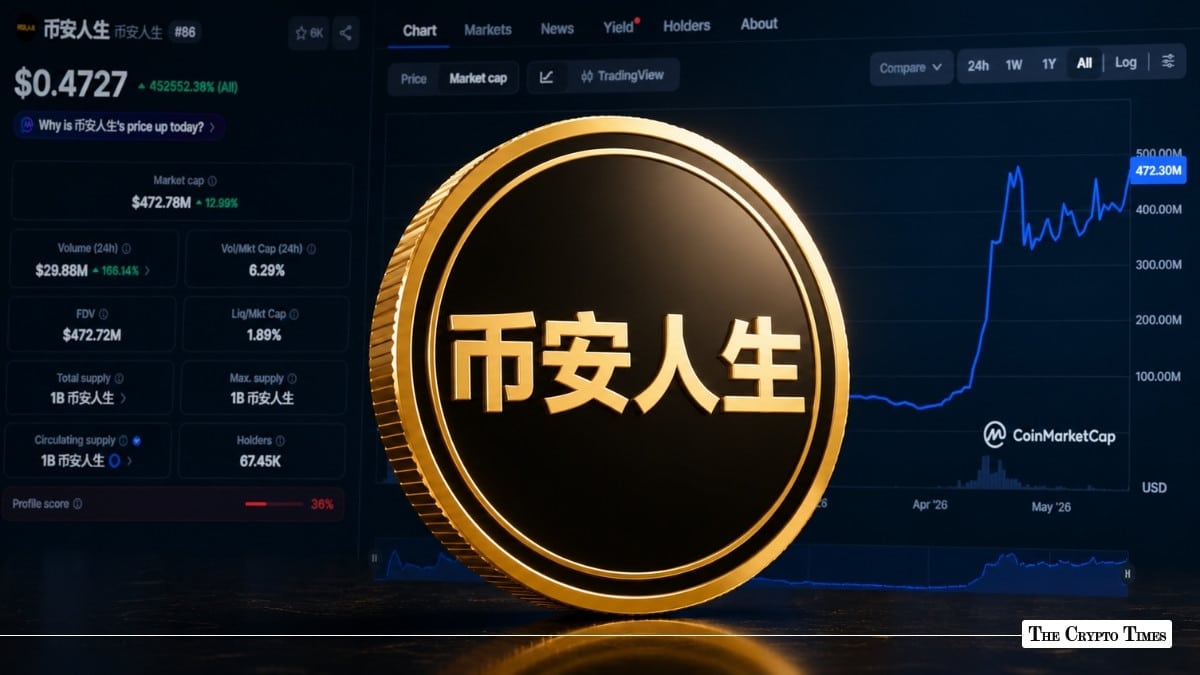
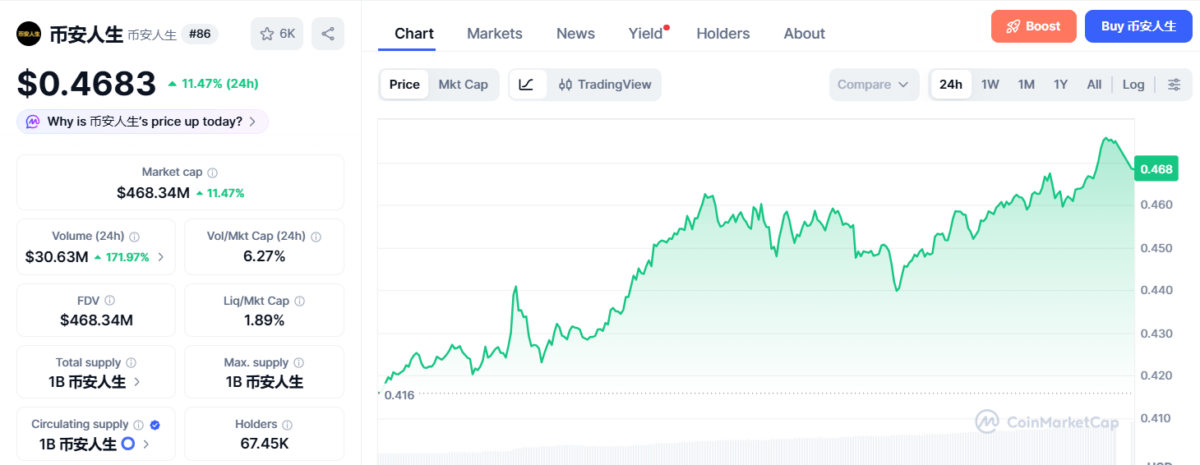
Launched in October 2025 on BNB Chain, the token rode a wave of viral Chinese internet memes and loose association with Binance executives to reach a market cap near $470 million.
The token’s pitch was seductive: live the “Binance Life,” drive the Binance car, enjoy the Binance community. Yet a closer look at its on-chain reality reveals something far less glamorous—a supply structure so heavily concentrated in exchange wallets that it mocks the very idea of decentralization.
At the time of publishing, the token has surged 11.5% to $0.4685 while its volume spiking by 170% in the past 24 hours. Notably, majority of the token’s volume comes from Binance exchange and PancakeSwap, the largest DEX on BNB Chain, which reportedly has ties with Binance team.
Custodial Dominance on Steroids
BscScan data lays bare the uncomfortable truth in the meme coin. Onchain analysis shows that Binance Hot Wallet 20 alone holds 667.19 million tokens—a staggering 66.72% of the entire 1 billion supply.
Another Binance-labeled wallet ranks fourth with 25.52 million tokens (2.55%). Combined, these two custodial addresses control nearly 70% of all tokens in existence.
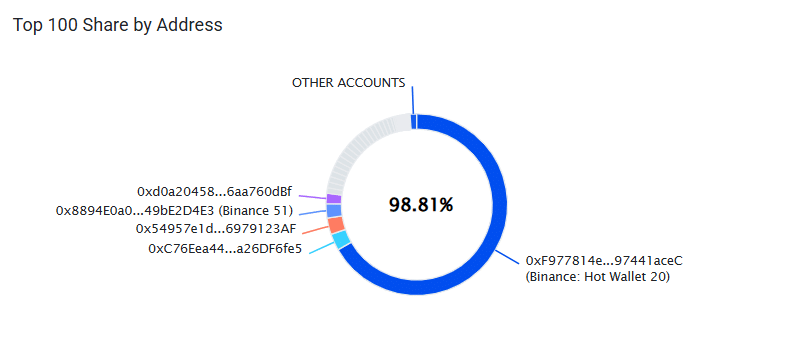
The next biggest non-exchange whales sit at roughly 3% each, while the remaining ~30% is scattered across 67,700 smaller holders. This isn’t broad retail ownership. It’s custodial dominance on an extraordinary scale.
Proponents will quickly point out that large exchange wallets are normal for CEX-listed tokens, representing user deposits. That defense misses the point. The sheer concentration here gives Binance operational control over the majority of the float.
Any major withdrawal wave, internal rebalancing, or liquidity adjustment by the exchange could trigger violent price swings—swings that retail bagholders would absorb in full. In a pure meme coin with zero utility, this level of single-point dependency isn’t just risky, it borders on recklessness.
Murky Origins and Convenient Anonymity
The project’s murky origins only fuel deeper suspicion. There is no identifiable team, no founders, no doxxed developers—just a “community takeover” narrative built around a casual reply from Binance co-founder He Yi and vague engagement from CZ.
The token launched via Four.Meme with a clean 1 billion supply, zero taxes, and immediate full circulation. Conveniently, nobody seems to know who originally seeded liquidity or walked away with the earliest slices.
In an industry littered with anonymous teams that pump and ghost, this opacity is not a feature, it’s a glaring red flag.
By tying its entire identity to the Binance brand while parking the overwhelming majority of tokens in Binance wallets, 币安人生 has created a perverse alignment. The token’s success depends almost entirely on continued Binance user inflows and platform goodwill.
When nearly seven out of ten tokens sit under one exchange’s roof, the line between “community meme” and “exchange-adjacent vehicle” becomes dangerously blurred.
Perhaps the most glaring question is this: how did a completely anonymous founderless meme coin with zero credibility, even with no website, managed to get officially listed on Binance itself—and what listing criteria were conveniently overlooked?
Critics might fairly ask whether this setup primarily serves to drive trading volume and fees back to Binance itself, while retail speculators chase the dream of “Binance Life” with most of the actual supply under custodial lock and key.
From High to Low to Another High
The token’s price action tells its own story of classic meme volatility. Multiple explosive rallies—including a push toward $550 million market cap earlier this year—have been followed by brutal corrections.
The current rebound near $0.46 feels more like another leg in the perpetual hype cycle than genuine conviction. With no roadmap, no product, and no fundamentals beyond slogans, the token lives and dies purely on sentiment.
That makes the concentrated supply even more hazardous: when the narrative falters, the exit liquidity could evaporate overnight, especially if large custodial movements coincide with fading retail interest.
This isn’t the first time a meme coin has thrived on exchange association, but few have done it with such heavy on-chain concentration. The setup effectively turns Binance into the de facto liquidity provider and price stabilizer, whether intentional or not.
For traders, that has delivered tight spreads and high volume. For true believers in decentralized finance, it represents a disappointing regression—a project waving the community flag while its supply structure screams centralized control.
In the broader 2025–2026 meme coin mania on BNB Chain, 币安人生 stands as both a cultural phenomenon and a cautionary tale. It has minted millionaires among early buyers and provided plenty of entertainment. Yet its heavily exchange-centric distribution exposes the uncomfortable reality: many so-called “community-driven” tokens are far more tethered to centralized platforms than their marketing suggests.
Investors piling in on the latest surge would be wise to look past the aspirational branding. “Binance Life” may sound glamorous, but when most of the tokens literally live inside Binance wallets, the good life appears reserved for those holding the keys—and it’s not the average holder.
In a market that rewards skepticism as much as FOMO, this one deserves far more scrutiny than hype.
Also read: AI Financial $271M WLFI Hit Sparks Going-Concern Warning for Trump Crypto Play