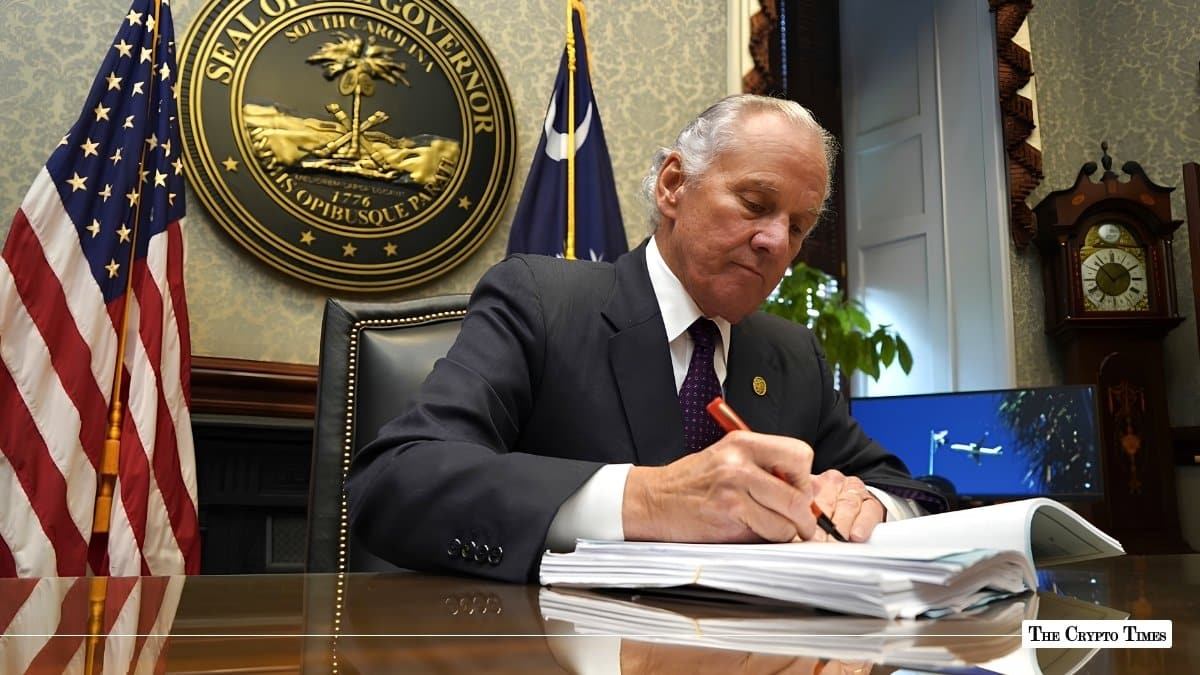
South Carolina has signed a major cryptocurrency-focused bill into law after Governor Henry McMaster’s approval on May 19, marking one of the state’s broadest digital asset regulatory frameworks to date.
The legislation, known as Senate Bill 163, adds a new Chapter 47 to Title 34 of the South Carolina Code of Laws, and was passed by the General Assembly earlier this month. It introduces legal protections for digital asset usage, self-custody rights, crypto mining operations, and blockchain infrastructure providers.
The bill was sponsored by Senators Daniel “Danny” Verdin and Matthew “Matt” Leber. Its path through the legislature took 17 months: filed in January 2025, passed the South Carolina Senate by a 38-1 vote on May 1, 2025, then reconciled with House amendments in April 2026 before reaching the governor’s desk this month.
State prohibits CBDC payments and federal participation
One of the law’s biggest provisions prohibits South Carolina government entities from accepting or requiring payments using a central bank digital currency (CBDC). The legislation also blocks state agencies from participating in any Federal Reserve or federal government CBDC pilot program or testing initiative.
Under the bill, a CBDC is defined as a digital currency issued directly by the U.S. Federal Reserve or a federal agency. Importantly, the definition includes an explicit carveout: it “does not mean a digital asset backed by legal tender or government treasuries and issued by a private entity.” That means privately-issued, treasury-backed stablecoins like USDC fall outside the CBDC ban; a meaningful distinction that keeps regulated private stablecoins viable in South Carolina even as Federal Reserve-issued CBDCs are blocked.
Globally, the trajectory is heading in another direction. India’s Reserve Bank has been actively piloting offline CBDC tools, tokenized KYC systems, and AI-powered fraud detection tools through its HaRBInger program; a contrast that highlights how state-level U.S. policy is increasingly diverging from international central-bank digital-currency development.
Self-custody and crypto payments protected
The law states that individuals and businesses cannot be restricted from accepting digital assets as payment for legal goods and services.
It also formally protects the use of self-hosted wallets and hardware wallets, allowing users to maintain independent control over their crypto assets without interference. In addition, the legislation bars state and local governments from imposing additional taxes or charges solely because digital assets are used as a payment method.
The bill defines “digital assets” comprehensively as “virtual currency, cryptocurrencies, natively electronic assets, including stablecoins, fungible tokens, and non-fungible tokens, and other digital-only assets that confer economic, proprietary, or access rights or powers.” This is one of the more inclusive state-level definitions in the U.S. legal landscape.
Crypto mining and staking receive legal clarity
The new framework also introduces protections for digital asset mining businesses operating in industrially zoned areas.
Local governments will be restricted from imposing unfair zoning rules, excessive sound limitations, or discriminatory regulations specifically targeting crypto mining facilities.
The legislation further clarifies that activities, including blockchain node operations, digital asset mining, blockchain software development, and staking services, do not require money transmitter licenses under certain conditions.
The bill also states that staking-as-a-service and mining-as-a-service providers will not automatically be treated as securities issuers under Title 35 of the state code.
Significantly, it also preserves the South Carolina Attorney General’s authority to prosecute fraud against any individual or business that fraudulently claims to be offering digital asset mining-as-a-service or staking-as-a-service. The new chapter explicitly retains this enforcement backstop as a consumer-protection counterweight to the broader deregulatory provisions.
Energy and consumer protection measures included
While supporting mining activity, the law also requires large-scale mining businesses to avoid placing additional stress on the electrical grid.
Mining firms may also be required to provide power purchase agreements to the Public Service Commission to demonstrate their ability to reduce energy consumption during periods of grid stress.
A growing state-level “Bitcoin Rights” movement
South Carolina now joins a growing list of U.S. states that have passed similar “Bitcoin Rights” or “Digital Asset Rights” legislation in 2024-2026, including Oklahoma, Kentucky, Arkansas, Florida, Mississippi, Montana, North Dakota, Louisiana, and Arizona. Much of this state-by-state push has been coordinated by the Satoshi Action Fund, a policy advocacy organization that has championed model legislation protecting self-custody, mining rights, and node operations across statehouses.
The law reflects a broader trend among U.S. states moving to establish independent crypto policies amid ongoing federal regulatory uncertainty around digital assets, stablecoins, CBDCs, and blockchain infrastructure. For states, the political calculus is increasingly favorable: a 38-1 vote in a state that has historically been cautious on financial technology suggests the “Bitcoin Rights” framing has succeeded in moving the issue out of partisan contestation.
Also read: US Lawmakers Move to Make CBDC Ban Permanent in Housing Bill