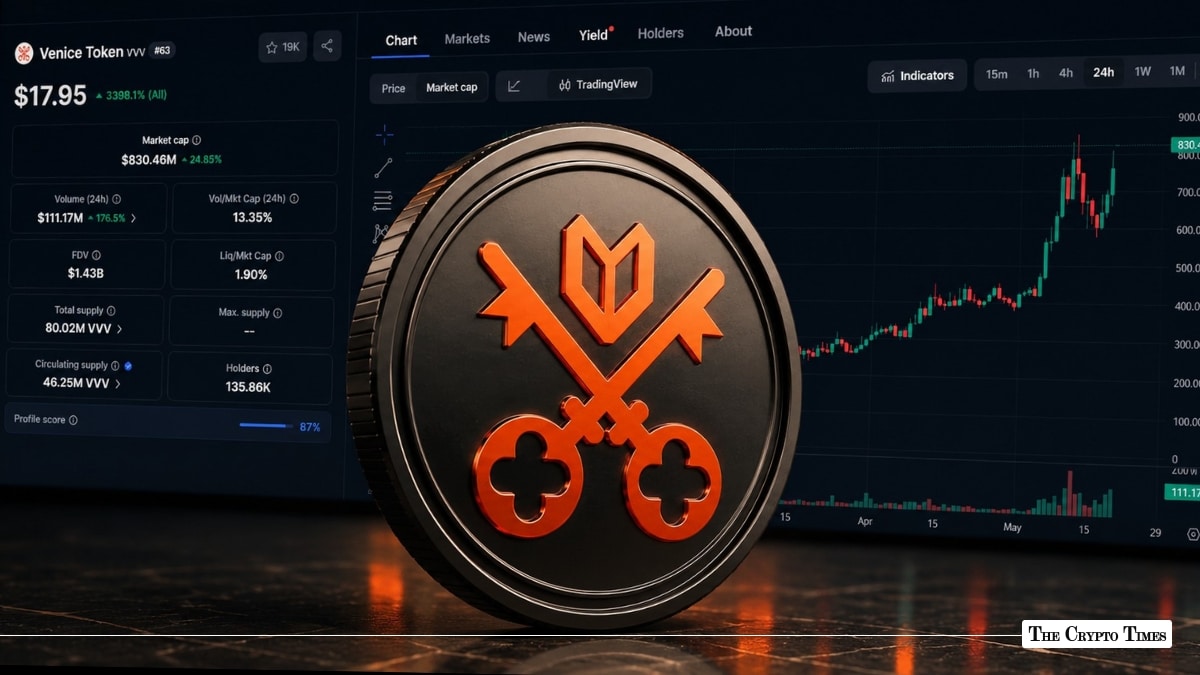
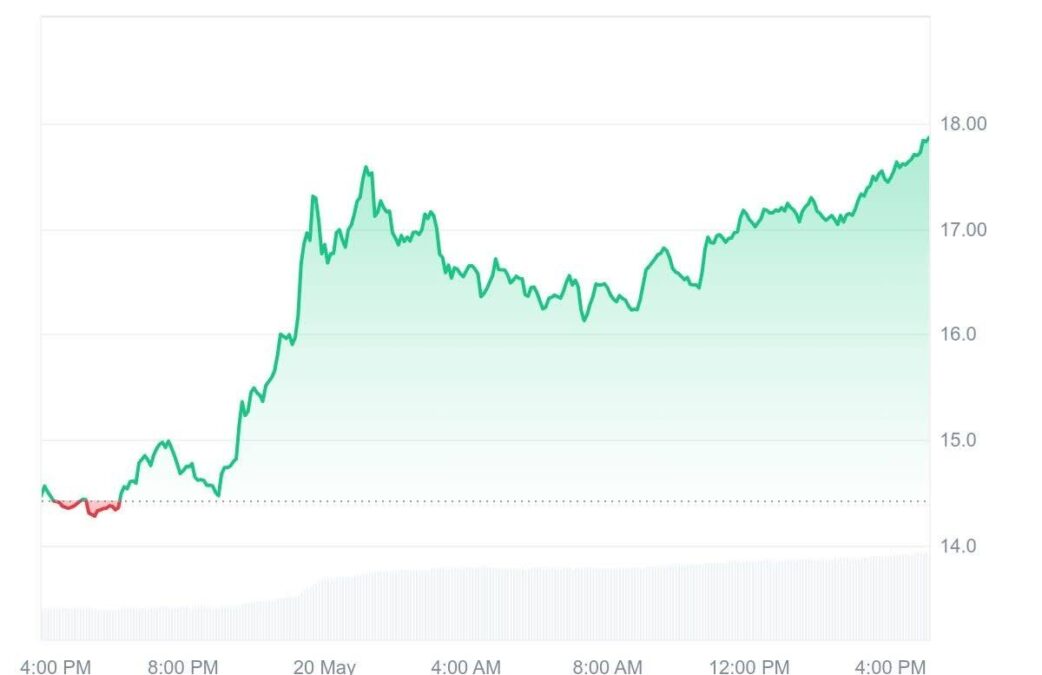
Venice Token (VVV) climbed sharply on May 20, 2026, surging more than 23% in 24 hours to trade around $17.80 as of latest market data. The move lifted its market capitalization to $825 million, with 24-hour trading volume exceeding $109 million—more than double the previous day’s figures.
On a day when Bitcoin traded flat, VVV stood out as one of the top performers in the mid-cap segment, highlighting renewed appetite for tokens with tangible product traction in the AI space.
The pump arrived just days after Venice AI announced it had crossed 3 million registered users around May 17.
The project, founded by Erik Voorhees of ShapeShift, offers a privacy-first, uncensored platform for generating text, images, and code. Unlike mainstream services that log data or refuse certain prompts, Venice runs on open-source models with no training on user inputs — a feature drawing growing interest amid ongoing debates over censorship and data privacy.
Robinhood Listing Sparks Retail Inflows
A major catalyst behind today’s surge appears to be Venice Token’s recent spot listing on Robinhood. The popular U.S. trading app added VVV on May 19, immediately exposing the token to millions of retail users. Community discussions and market observers noted an immediate uptick in volume and buying pressure following the announcement.
This access boost comes alongside earlier listings on platforms like Upbit, which tapped into strong Korean retail demand. High liquidity on both centralized exchanges and Base-chain DEXs such as Aerodrome has supported the move, with Coinbase, Bybit, and Gate.io also showing heavy participation. Traders point to leveraged positions and short covering as volume spiked, amplifying the upward momentum.
Utility and Tokenomics Underpin the Move
VVV operates as a capital asset in the Venice ecosystem. Users stake VVV to earn yields and can mint DIEM tokens, each delivering roughly $1 per day in perpetual API credits for inference. This structure ties token demand directly to platform usage: as more developers and autonomous agents tap into private compute, staking and buying pressure should increase.
Recent protocol updates have reinforced this dynamic in Venice. Its annual emissions have been reduced significantly, with programmatic buybacks and token burns creating deflationary pressure. These mechanics, paired with hundreds of thousands of active users, give the project clearer fundamentals than many pure hype plays in the AI sector. Furthermore, integrations with autonomous agents and DeFi tools have expanded the token’s real-world utility.
The timing also aligns with broader market rotation. Capital has flowed selectively into mid-cap AI tokens showing product-market fit, especially those emphasizing privacy and decentralized inference.
Upcoming NVIDIA earnings have added to sector optimism, with some traders positioning VVV as a proxy bet on decentralized AI infrastructure.
Volatility Persists Despite Strong Momentum
Despite a notable price surge, VVV still sits roughly 21% below its all-time high of $22.45 from early 2025, leaving room for further recovery but also reminding investors of the asset’s volatility.
At a market cap near $824 million, the token remains sensitive to profit-taking, broader market shifts, or changes in AI sentiment.
As of now, Venice Token’s breakout illustrates how tokens with real utility and timely retail access can draw capital quickly in a consolidating market.
Whether this marks the beginning of a larger run or a sharp rotation will depend on follow-through volume, staking metrics, and user engagement in the days ahead.
Also read: HYPE Rises 19% in a Week as Bitwise CIO Calls Hyperliquid a Super App