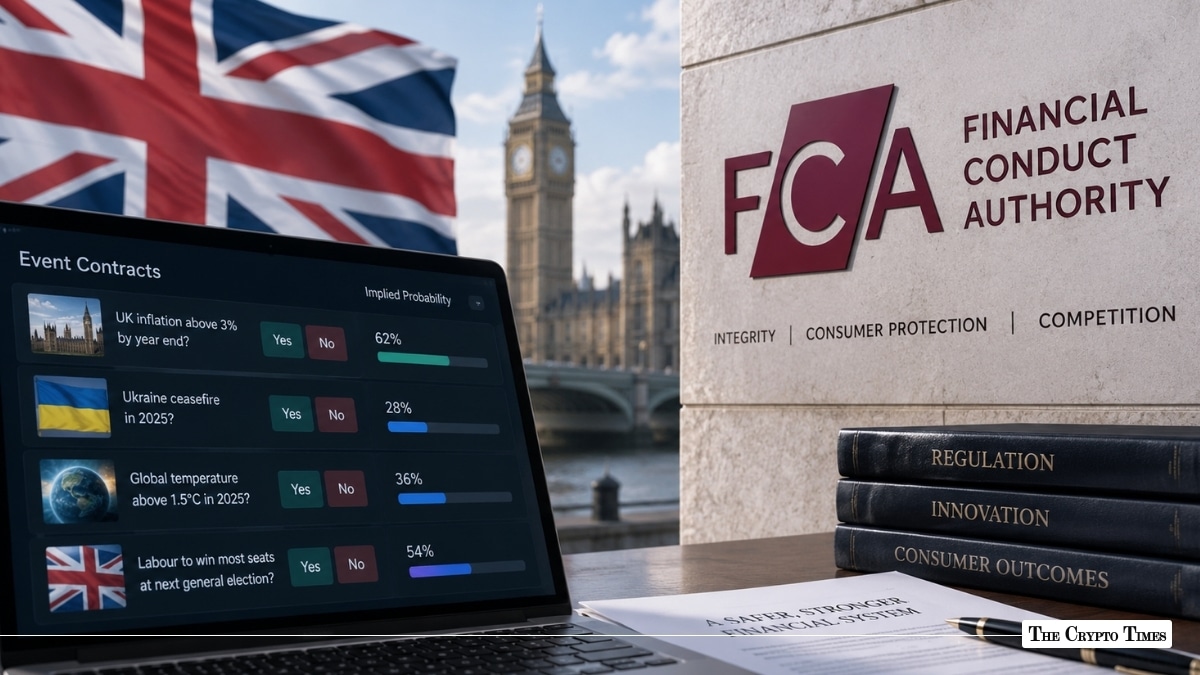
The UK’s Financial Conduct Authority (FCA) has reportedly held discussions with prediction-market platforms about potentially easing restrictions on retail access, as UK consumers increasingly turn to overseas platforms such as Kalshi and Polymarket, The Times reported. No rule has changed, however, and the FCA’s permanent 2019 ban on the sale of binary options to retail consumers remains in force.
The FCA’s current position is that the financial prediction-market products it has examined are binary options and therefore remain subject to the retail ban. The regulator said in its March 2026 Perimeter Report that it would consider whether further work is needed on access to prediction-market products and whether the regulatory perimeter should be clarified.
What’s Actually Happening
The FCA defines prediction-market products (PMPs) as speculative products that allow consumers to take binary “yes” or “no” positions on future events. In its March report it said these products have expanded rapidly overseas, particularly in the United States.
Under the FCA’s current framework, PMPs linked to financial or certain climatic events fall within its regulatory perimeter, while products linked to non-financial events such as sports and politics fall under the Gambling Commission’s remit. The FCA said the financial PMPs it has seen are binary options and therefore remain subject to its permanent ban on sales to retail consumers.
The regulator said the ban remains appropriate because of the speculative and gambling-like nature of these contracts and the potential for consumer harm. At the same time, the FCA said it would consider whether to do further work on access to these products or clarify where they sit within the regulatory perimeter.
The latest reported discussions come against that backdrop. The Times also reported that UK consumers are accessing US-based prediction-market platforms through virtual private networks (VPNs), putting those activities outside the UK’s domestic consumer-protection framework.
The Two-Regulator Question
Even if the FCA changed its treatment of financial prediction markets, the regulatory position would still depend on the type of contract being offered. The FCA says financial and certain climate-related prediction markets fall within its perimeter, while political and sporting markets fall under the Gambling Commission.
The Gambling Commission has separately said that commercial products meeting the definition of gambling in Great Britain must be licensed and regulated by the commission. It has also said that prediction-market operators without a UK licence should not target or transact with consumers in Great Britain.
That distinction could make a UK rollout more complicated for platforms offering a broad range of contracts. A financial-market product could fall within the FCA framework, while sports and political markets would remain subject to gambling regulation.
UK operators have already demonstrated that prediction-style products can be offered within the gambling framework. Matchbook launched a prediction-market product in January 2026 under its existing UK gambling operation, with the platform offering yes/no markets.
This creates a different regulatory route from the one pursued by Kalshi in the US, where the platform operates as a federally regulated event-contract exchange.
Why Crypto Is Watching
The UK review matters to crypto because Polymarket operates using blockchain infrastructure, while Kalshi represents the regulated financial-market model that has emerged alongside it. The Crypto Times previously examined the distinction between Polymarket’s crypto-native structure and Kalshi’s regulated exchange model as traditional financial firms entered the sector.
Polymarket’s latest reported funding round values the company at $21 billion, according to a September 1 report from The Crypto Times. The round is expected to raise $1 billion, with Donald Trump Jr.-linked 1789 Capital reportedly investing about $300 million.
Kalshi, meanwhile, raised $1 billion at a $22 billion valuation, according to the company’s announcement. The valuations illustrate the scale of investor interest in prediction markets, although they should not be interpreted as a forecast of future industry value or trading volume.
Industry activity has also expanded rapidly. The Crypto Times reported that Kalshi, Polymarket and Polymarket US recorded a combined $50.6 billion in trading volume in July 2026, a monthly record based on the market data cited in the report.
Bernstein has separately projected prediction-market trading volume could reach about $240 billion in 2026 and $1 trillion by 2030. Those are analyst estimates rather than confirmed future volumes.
The combination of growing trading activity, large private-company valuations and increasing regulatory scrutiny has pushed prediction markets further into the overlap between financial markets, gambling, and crypto infrastructure.
The Global Backdrop
The UK’s review comes as regulators in other jurisdictions take different approaches to prediction markets.
In the United States, Kalshi is facing legal challenges over whether sports-related event contracts should be regulated by the federal government or by state gambling authorities. New Jersey has asked the U.S. Supreme Court to review whether states have authority to regulate sports contracts offered by prediction-market platforms.
France has taken a more restrictive approach. Its national gambling regulator ordered internet service providers to block access to Polymarket in July after the platform’s geoblocking measures were found to be insufficient.
The UK approach remains unresolved. The FCA has not announced a change to its binary-options ban, and its March report continues to describe the financial prediction-market products it has reviewed as subject to that prohibition.
What Happens Next
The reported discussions do not amount to a rule change or a decision to authorize Kalshi or Polymarket for UK retail customers.
Any change to the FCA’s treatment of financial prediction markets would need to be considered within the regulator’s existing consumer-protection framework, while political and sporting contracts would continue to raise separate gambling-regulation questions.
For crypto, the immediate significance is therefore regulatory rather than a direct market-opening event. A change in the UK’s approach could affect how blockchain-based prediction markets such as Polymarket compete with regulated financial and gambling operators, but the scope and timing of any FCA action remain uncertain.
The Crypto Times will follow any formal FCA consultation, rule change or licensing development.