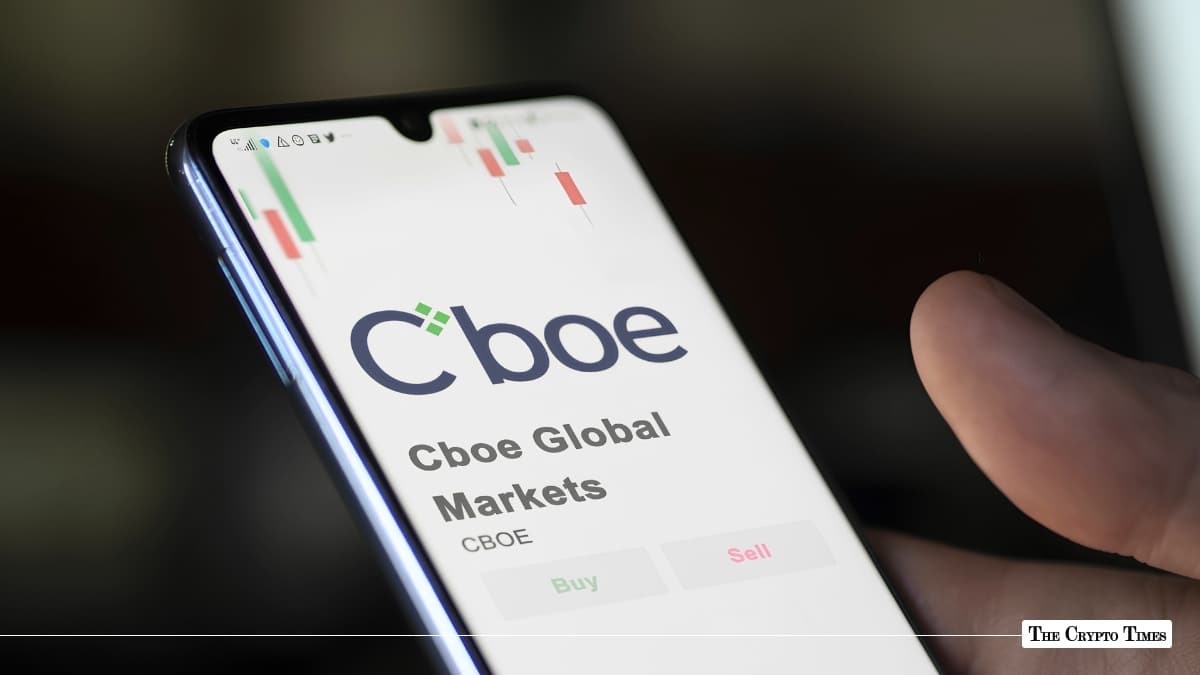
Cboe Global Markets has launched the first products in its prediction-markets suite, Cboe Predicts, staking a claim in a category that crypto-native platforms pioneered while pointedly avoiding the parts of it now mired in litigation.
What Cboe launched
According to the official press release, the initial offering is a set of binary option contracts based on the Mini-S&P 500 Index, or XSP, listed under the symbols XSPBW and XSPBX. XSP tracks the S&P 500 at one-tenth the size of Cboe’s flagship SPX contracts, a scale the exchange pitches as more accessible to retail traders.
The mechanics are the familiar yes-or-no of prediction markets. A trader takes a “yes” position that pays $100 if the index settles at or above a specified level and nothing if it does not, or a “no” position that pays out if it settles below. The contracts are live on Interactive Brokers now, with Charles Schwab expected to add access in the coming months and other retail brokers to follow.
Notably, they are centrally cleared through the Options Clearing Corporation and trade on the Cboe Options Exchange, placing them inside the same regulated, surveilled framework as standard U.S.-listed options, rather than a standalone event-contract venue.
Through the one door no one is fighting over
The strategic choice that defines this launch is what Cboe left out. The exchange is offering contracts on financial benchmarks only, deliberately steering clear of the politics, sports, and entertainment markets that have powered the prediction market boom—and triggered its legal reckoning.
That contrast is stark. Polymarket and Kalshi are currently fighting a multi-front war over exactly those categories: a federal preemption clash that has now pulled in nine states, with the CFTC suing to shield the platforms from state gambling enforcement while attorneys general argue their sports contracts are unlicensed sportsbooks.
State data cited in those cases pegged sports-related activity at roughly 70% to 90% of Kalshi’s volume—meaning the incumbents’ legal exposure is concentrated in precisely the markets Cboe declined to touch. By anchoring to the S&P 500, Cboe enters the category through its single uncontested entrance, sidestepping the gambling-law questions in one design decision.
It also avoids a cold start. By building on its SPX options complex, among the most heavily traded options in the world, Cboe does not have to bootstrap liquidity the way a new venue would, and it brings an institutional distribution network, through brokers like Schwab and Interactive Brokers, that the crypto-native platforms have never had.
Two models for one fast-growing category
The launch sharpens a split that has been forming all year between two visions of what a prediction market is.
On one side sit the crypto-native and event-contract platforms. Polymarket runs as a decentralized, non-custodial exchange on Polygon, settling in USDC, while Kalshi operates off-chain in dollars as a CFTC-regulated contract market. Both built their audiences on the breadth of what they list—elections, sports, economic data, and crypto prices—and both have been racing into adjacent territory, with each rolling out perpetual-futures products to turn one-off event bets into always-on trading venues.
On the other side, Cboe represents the regulated-financial-outcome model: a narrower menu of contracts tied to market benchmarks, distributed through brokerages and cleared like options. Its product design leans into that lane too. Where the incumbents offer strict binary payouts, Cboe has signaled it will later add XSP vertical spreads through a patent-pending framework it calls the Quoted Spread Book, designed to pay traders partially for being directionally correct even when an outcome misses the exact target—a more options-like structure aimed at converting yes-or-no traders into spread traders over time.
The category is large enough to support both: combined volumes across the leading platforms ran into the tens of billions in 2025 and have multiplied in 2026, a scale that has drawn in big-tech entrants like Meta and its planned Arena app alongside institutional desks.
Threat, or validation, for the incumbents
What Cboe’s arrival means for Polymarket and Kalshi cuts both ways. The competitive pressure is real on financial-outcome contracts, where Cboe’s clearing, surveillance, and broker distribution give it credibility and reach the newcomers spent years trying to establish—and where a trader nervous about the platforms’ unsettled legal status might prefer a contract that behaves like a listed option.
But the incumbents’ core franchise was never the S&P 500. Their volume lives in the sports, political, and cultural markets Cboe has chosen to avoid, and a 50-year-old derivatives institution validating the basic premise—that retail traders want to express defined-risk views on outcomes—arguably legitimizes the entire category as it pushes toward the mainstream.
The likeliest near-term outcome is not displacement but specialization: regulated financial-outcome products consolidating under established exchanges and brokers, while the broader, livelier, and legally contested event markets remain the domain of the platforms still fighting for the right to offer them. Cboe’s launch does not resolve that divide. It draws the line more clearly.
Also Read: Meta Eyes Prediction Markets With New ‘Arena’ App Project