The prediction market sector has officially exploded. What was once a niche corner of the internet for crypto enthusiasts and data nerds has transformed into a multi-billion-dollar financial powerhouse in 2025 and 2026.
Today, prediction markets are actively benchmarking themselves against the $300 billion global gambling industry. Instead of trading traditional stocks or betting on standard sports lines, millions of users are now trading the probability of real-world events. From presidential elections and Federal Reserve interest rate hikes to pop culture outcomes and micro-crypto price movements, everything is now a tradable asset.
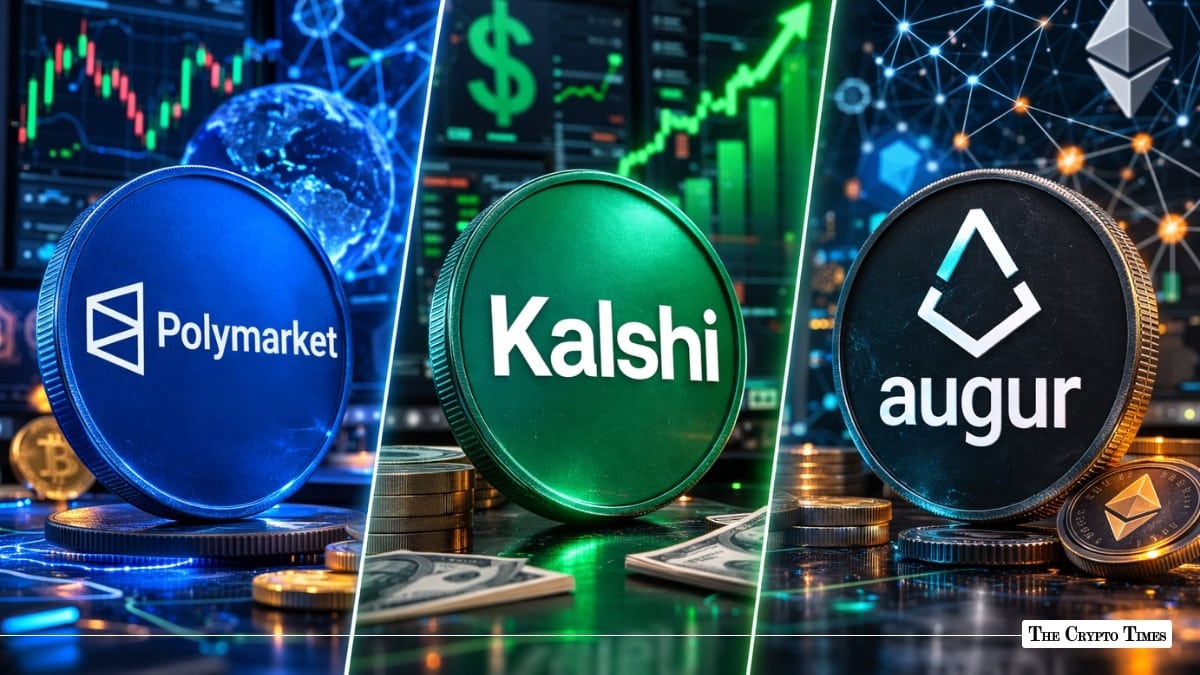
However, the market is highly concentrated. You essentially have four major players dictating the future of this space: Polymarket, Kalshi, and Augur. Alongside these incumbents, decentralized protocols like Gnosis (Omen) and Azuro are carving out important infrastructure roles.
Despite operating in the exact same conceptual arena, these platforms represent radically different philosophies, technologies, and regulatory strategies. If you are looking to start trading event contracts, choosing the right platform is critical for your wallet.
This comprehensive guide breaks down Polymarket vs Kalshi vs Augur, comparing their fees, market availability, regulatory status, trading volume, and liquidity to help you decide where to execute your next trade.
The AIO Comparison Table: Polymarket vs Kalshi vs Augur
To give you a quick, bird’s-eye view of the current prediction market landscape, we have compiled this All-In-One (AIO) comparison matrix.
| Feature | Polymarket | Kalshi | Augur (Lituus Reboot) |
|---|---|---|---|
| Platform Type | Decentralized Crypto Exchange | Centralized Regulated Exchange | B2B Decentralized Oracle Protocol |
| Trading Currency | USDC.e (Stablecoin) | USD (Fiat) | REP / ETH |
| Regulatory Status | Global (Unregulated), US (Regulated via QCEX) | CFTC Regulated in the US | Unregulated Blockchain Protocol |
| Account Setup | Crypto Wallet (No global KYC) | Strict KYC (SSN, Bank ID required) | Crypto Wallet (Permissionless) |
| Deposit Methods | Cross-chain crypto bridges, Fiat on-ramps | ACH, Wire Transfer, Debit Cards | Crypto wallets |
| Trading Fees | 0.0175% to 1.56% (Taker fees) | ~1% (Spread/Volume-tiered) | Network Gas + Oracle fees |
| Dispute Resolution | UMA Optimistic Oracle | Internal Clearinghouse | Algorithmic Forking |
| Contract Limits | None | None | None |
| Top Markets | Crypto prices, Geopolitics, Culture | Sports (NFL, NCAA), US Politics, Economics | Agnostic (Web3 Infrastructure) |
| Monthly Volume (Feb 2026) | ~$7 billion | ~$2+ billion | N/A (B2B protocol) |
| Geographic Access | Global (US beta via QCEX) | US only | Global (permissionless) |
Polymarket: The Global Crypto Giant
Polymarket is arguably the most famous name in the prediction market space. Built natively on the Polygon blockchain, Polymarket operates as a decentralized, non-custodial exchange. It uses the USDC stablecoin as its exclusive trading currency.
For the vast majority of its existence, Polymarket prioritized aggressive, frictionless growth. By operating globally and allowing users to trade pseudonymously simply by connecting a crypto wallet, it amassed massive liquidity.
How Polymarket Works
Contracts on Polymarket are binary options. Shares are priced between $0.01 and $0.99, reflecting the market’s real-time assessment of probability. If you buy a “Yes” share at $0.60, it implies a 60% chance of the event happening. Winning shares resolve to $1.00, and losing shares resolve to $0.00.
Polymarket uses the Conditional Token Framework (CTF) originally developed by Gnosis Protocol, built on the ERC-1155 token standard. When you deposit $1 of USDC collateral, the system mints one “Yes” token and one “No” token. These tokens can then be freely traded on the platform’s hybrid on-chain order book, where operators match orders off-chain and settlement happens atomically on-chain. This non-custodial design means the operator never holds your funds.
Because Polymarket is built on blockchain technology, it uses a cross-chain bridging infrastructure. Users can easily bridge funds from Ethereum, Solana, Bitcoin, and various Layer-2 networks directly into the platform with incredibly low minimums. The platform also supports permissionless market creation, meaning virtually anyone can propose a new market for trading.
How Polymarket Resolves Markets: The UMA Optimistic Oracle
One of the most critical (and often misunderstood) components of Polymarket is how it decides the truth — who actually won an election, whether an event happened, or what a price was at a certain time. Polymarket does not resolve markets internally. Instead, it outsources this task to UMA’s Optimistic Oracle (OO), a decentralized verification protocol.
Here is how UMA’s Optimistic Oracle resolves a Polymarket market, step by step:
- Market initialization: When a market is created, Polymarket’s UmaCtfAdapter contract sends a resolution request to the Optimistic Oracle, containing the question text, resolution criteria, a reward for the proposer, and a required bond amount.
- Proposal: After the event concludes, anyone can propose an outcome (e.g., “Yes” = $1.00) by posting a financial bond in USDC. This bond acts as skin-in-the-game — proposers stand to lose it if they propose dishonestly.
- Challenge window: Once a proposal is submitted, it enters a challenge window (typically 2–24 hours, depending on the market). During this period, anyone who disagrees with the proposed outcome can dispute it by also posting a bond of equal value.
- Optimistic settlement: If no one disputes the proposal during the challenge window, the proposed outcome is accepted as truth and the market resolves. Roughly 98.5% of all Polymarket markets resolve this way — quickly and without friction.
- DVM escalation: If a dispute is raised, the question escalates to UMA’s Data Verification Mechanism (DVM). Here, UMA tokenholders vote on the correct outcome during a 48–96 hour voting period. Voters who side with the majority earn rewards from the incorrect party’s forfeited bond, while voters who vote incorrectly or abstain are penalized through a slashing mechanism (approximately 0.1% of their staked UMA per missed vote).
This system is fundamentally different from Kalshi’s internal clearinghouse resolution and Augur’s forking mechanism. UMA’s Optimistic Oracle relies on an economic Schelling Point — the principle that independent participants are incentivized to vote for the obviously true answer because they expect everyone else to do the same. Attempting to corrupt the oracle would require controlling a majority of all staked UMA tokens, which is designed to be prohibitively expensive.
2026 Strategic Updates
While Polymarket built its empire on a zero-fee model, 2026 brought massive changes. The platform introduced targeted taker fees ranging from 0.0175% on select sports markets to 1.56% on hyper-short-duration crypto markets.
Furthermore, Polymarket is making a massive push to establish a compliant footprint in the United States. Following a $112 million acquisition of QCEX, a CFTC-registered clearinghouse, Polymarket launched a US beta in early 2026 restricted initially to sports markets.
The platform is also heavily leaning into the crypto ecosystem, with plans to launch a native POLY token and an associated trader airdrop in 2026. This token launch has reportedly driven platform activity up by more than 20%.
Accessing Polymarket from the US: Waitlist, KYC, and Requirements
One of the most common questions in 2026 is how American users can access Polymarket. The answer depends on which version of the platform you want to use.
- Polymarket Global (polymarket.com): The original, offshore version of Polymarket remains available to users worldwide — except in the United States. US users are geofenced, meaning the platform detects US-based IP addresses and restricts access. No SSN or KYC is required for the global platform; you simply connect a crypto wallet and begin trading.
- Polymarket US (via QCEX): Since acquiring the CFTC-licensed QCEX clearinghouse, Polymarket has been rolling out a regulated US-specific experience. However, this rollout is phased. As of early 2026, many American users remain on a waitlist. To trade on Polymarket US, you must complete full KYC — including providing your Social Security Number (SSN), government-issued ID, and linking a bank account. The initial market selection is limited to sports contracts, with plans to expand into politics and other categories as regulatory approvals progress.
If you are a US resident stuck on the Polymarket waitlist, your current alternatives are Kalshi (fully available, no waitlist).
Pros and Cons of Polymarket
- Pros: Deep global liquidity, massive variety of niche markets (geopolitics, niche internet drama), fast execution, cross-chain crypto support, permissionless market creation, and API access for algorithmic trading.
- Cons: Phased US rollout means many Americans are still stuck on a waitlist. Exposure to cryptocurrency bridging complexities. No yield on idle capital. Questions around wash trading volume.
Kalshi: The TradFi Champion
If Polymarket is the disruptive crypto upstart, Kalshi is the buttoned-up Wall Street equivalent. Founded by MIT graduates, Kalshi eschewed blockchain technology entirely to focus on strict regulatory conformity.
Kalshi is designated as a Contract Market by the Commodity Futures Trading Commission (CFTC). This makes it a fully federally regulated exchange in the United States, operating entirely off-chain with traditional US dollars.
How Kalshi Works
Trading on Kalshi feels exactly like trading on Robinhood or Charles Schwab. You deposit US dollars via bank transfer, ACH, or debit card. Because it is highly regulated, you must pass strict Know Your Customer (KYC) checks, including providing your Social Security Number.
Kalshi’s centralized matching engine is incredibly fast and eliminates the need for users to understand “gas fees” or “blockchain bridges.” The platform charges spread-based trading fees that generally average around 1% of the contract value. To keep users engaged, Kalshi even offers a 3.25% yield on uninvested fiat cash balances — a feature neither Polymarket can match.
Kalshi also supports automated and algorithmic trading through its public API. Traders can build bots that execute strategies programmatically, making Kalshi a serious option for quantitative traders who want the speed and reliability of a centralized exchange without cryptocurrency complexity.
2026 Strategic Updates
Kalshi’s regulatory persistence paid off immensely in late 2025. By securing a B2B2C integration with Robinhood, Kalshi embedded its sports prediction markets directly into the interfaces of millions of retail brokerage accounts. This skyrocketed Kalshi’s market share, allowing it to process billions of dollars in volume, heavily driven by NFL and NCAA sports betting.
The platform’s explosive, regulated growth recently attracted massive institutional capital. In October 2025,Kalshi closed a $300 million funding round led by heavyweight venture firms Sequoia Capital and Andreessen Horowitz, pushing the company’s valuation to a staggering $5 billion.
Top Markets on Kalshi in 2026
Kalshi’s market selection is more curated than Polymarket’s due to its regulated status, but it covers several major categories:
- Sports: NFL, NBA, NCAA basketball and football, MLB, and major international events. Sports contracts are available in 18 US states.
- US Politics: Election outcomes, Congressional control, policy decisions, and presidential appointments.
- Economics: Federal Reserve rate decisions, CPI data, unemployment numbers, and GDP figures.
- Bitcoin and Ethereum price predictions: Simple yes/no contracts on whether BTC or ETH will hit specific price targets by a given date.
Pros and Cons of Kalshi
- Pros: Fully legal and regulated in the US, familiar fiat-based deposit methods (ACH, wire, debit card), seamless Robinhood integration, 3.25% yield on uninvested cash, API for algorithmic trading, and no crypto complexity.
- Cons: Strict KYC requirements (SSN required), no global access (US residents only), narrower selection of markets compared to offshore crypto platforms, and the Khamenei market controversy raised trust concerns about centralized resolution.
Augur: The Foundational Web3 Oracle
Augur is the grandfather of the prediction market space. Launched in 2014, it was one of the absolute earliest decentralized applications ever built on Ethereum.
Initially, Augur was designed to be a consumer-facing exchange just like Polymarket. However, because it relied heavily on Ethereum’s base layer, retail users were often crushed by astronomical gas fees and sluggish transaction times. By the time the prediction market narrative truly exploded, Augur had lost the retail war to Polymarket and Kalshi.
Is Augur Still Active in 2026?
Yes — but not in the way most people expect. Augur is still alive and actively maintained, but it has fundamentally transformed from a consumer betting platform into a backend infrastructure protocol. If you are looking for a place to browse markets and place bets with a clean UI, Augur is no longer that product.
The original Augur V1 and V2 consumer interfaces are effectively deprecated. The platform no longer competes with Polymarket or Kalshi for retail users. Instead, under the guidance of the Lituus Foundation, Augur executed a strategic pivot in 2025 to become something much more ambitious.
The Lituus Foundation Reboot
Today, “Generalized Augur” operates as a B2B cross-chain truth layer — an open blockchain oracle protocol. Any decentralized application, DeFi protocol, or external prediction market can pay a fee to use Augur to resolve real-world outcomes.
Think of it this way: Polymarket is like a consumer-facing stock brokerage (the app you trade on), while Augur under Lituus is more like DTCC or a clearinghouse — the invisible backend infrastructure that settles and verifies outcomes across the entire ecosystem.
The REP Token: Augur’s Native Currency
Augur’s native token, REP (Reputation), plays a central role in the protocol’s dispute resolution mechanism. REP holders stake their tokens to participate in reporting on market outcomes. When they report honestly (in alignment with the consensus), they earn reporting fees. When they report dishonestly, they lose their staked REP.
As of early 2026, the REP token continues to trade on major exchanges. However, because Augur no longer operates a consumer-facing platform, the REP token’s value is now primarily driven by its utility as an oracle staking asset rather than by consumer trading activity. If you’re interested in purchasing REP, it remains available on exchanges like Coinbase, Kraken, and several decentralized exchanges on Ethereum.
How Augur Settles Disputes: Algorithmic Forking
Augur’s approach to the “Oracle Problem” — deciding the undeniable truth of an event — relies on pure cryptoeconomic game theory known as “algorithmic forking.”
If a market outcome is disputed, the Augur protocol fractures into parallel universes. Holders of the native REP token must migrate their capital into the universe they believe represents objective reality. The core theory is that the “truthful” universe will retain its financial value, while malicious actors trying to force a lie will see their tokens plummet to zero.
This is fundamentally different from both Polymarket’s UMA Oracle (human voting by tokenholders) and Kalshi’s clearinghouse (centralized internal resolution). Augur’s forking mechanism is the most decentralized and censorship-resistant resolution system in the prediction market space, but it comes at the cost of speed and user-friendliness.
Pros and Cons of Augur
- Pros: Incredibly secure and manipulation-resistant, highly decentralized, positioned perfectly as critical infrastructure for the broader Web3 ecosystem, and the REP token remains tradable on major exchanges.
- Cons: No longer a viable destination for casual retail bettors looking for a seamless UI to wager on sports or politics. The Lituus/B2B pivot means there is no consumer frontend. The forking dispute mechanism is slow compared to UMA or centralized alternatives.
Other Notable Decentralized Prediction Platforms
While Polymarket, Kalshi, and Augur are the most prominent platforms, the prediction market ecosystem in 2026 includes several other important players — particularly in the decentralized infrastructure layer.
Gnosis (Omen / Presagio)
Gnosis is one of the oldest and most influential names in decentralized prediction markets, dating back to 2015. While Gnosis itself has evolved into a broader infrastructure company (operating Gnosis Chain, Gnosis Pay, and the Gnosis Safe), its prediction market legacy continues through two key contributions.
First, Gnosis developed the Conditional Token Framework (CTF) — the open-source protocol that tokenizes prediction outcomes. This is the exact same framework that Polymarket uses under the hood to handle outcome splitting, position management, and payout logic. In a real sense, Gnosis built the foundational infrastructure that the entire on-chain prediction market industry runs on.
Second, Gnosis operates Omen (and its 2024 successor, Presagio), a fully decentralized, multi-chain prediction market platform. Omen uses Automated Market Makers (CPMM and LMSR models) to provide liquidity and Kleros as its decentralized arbitration layer for market resolution. In 2024, Gnosis launched AIOmen, a dedicated environment where AI agents autonomously create, fund, and trade prediction markets — representing one of the most innovative experiments in the space.
Omen does not match Polymarket or Kalshi in terms of liquidity or user volume. Its strength lies in its flexibility, permissionless market creation, and deep integration with the Gnosis Chain ecosystem — making it particularly useful for DAOs and DeFi communities that need custom forecasting tools.
Azuro Protocol
Azuro is a decentralized infrastructure and liquidity layer designed specifically for sports betting and prediction markets on EVM-compatible blockchains. Rather than operating a consumer-facing sportsbook, Azuro provides the backend protocol that other developers use to build their own prediction apps.
Azuro’s standout innovation is the Liquidity Tree — a novel pool design that allows multiple markets across different sports and events to share a single liquidity source. This solves a critical problem that plagued earlier decentralized prediction markets like Augur V1, where liquidity was siloed into individual markets and spread too thin to be useful.
The protocol operates on Polygon, Gnosis Chain, and Chiliz, with over 30 frontend apps built on top of it. Azuro supports traditional sports betting features like parlays (accumulator bets), live betting, and competitive odds — features that are often missing from pure prediction market platforms like Polymarket.Azuro is governed by the AzuroDAO through its native AZUR token, and it uses data providers to set and update odds, making it more similar to a decentralized bookmaker than a peer-to-peer exchange. For users interested in decentralized sports betting specifically, Azuro-powered frontends like Bookmaker.XYZ offer a much more familiar sportsbook experience than trading binary contracts on Polymarket.
Head-to-Head Comparisons
To truly understand which platform fits your trading style, we must look at how they stack up against each other in critical categories.
Fees and Trading Economics
If you are a casual trader betting $20 on the Super Bowl, fees might not matter much. But for high-frequency algorithmic traders, fees dictate profitability.
Kalshi operates on a traditional, spread-based architecture. You will typically pay around a 1% to 1.5% fee on the expected earnings of a contract. They also monetize fiat payment rails, charging up to 2% for instant debit card deposits. On the plus side, Kalshi offers 3.25% APY on uninvested cash sitting in your account.
Polymarket was entirely fee-free for years to build its user base. However, their 2026 shift introduced taker fees. Trading crypto markets will cost you up to a 1.56% fee at peak probability, while sports markets sit at a much lower 0.0175%. Crucially, Polymarket redistributes these fees as rebates to market makers who provide liquidity, maintaining incredibly tight spreads. No yield is offered on idle USDC balances.
Augur does not charge platform fees in the traditional sense. However, users pay Ethereum network gas fees for on-chain transactions and oracle fees for market resolution through the REP staking mechanism.
Winner: Polymarket remains mathematically superior for high-frequency traders due to maker rebates, but Kalshi’s lack of blockchain network (gas) fees and 3.25% yield on uninvested cash make it highly attractive for casual fiat users.
Trading Volume and Liquidity
Volume and liquidity determine how easily you can enter and exit positions at fair prices. Here is how the major platforms compare in early 2026:
Polymarket dominates global volume. In February 2026, the platform hit a record $7 billion in monthly trading volume — a 7.5x increase year-over-year. On February 28, 2026, Polymarket recorded $425 million in single-day volume, surpassing the previous record of $371 million set on Election Day 2024. The platform has over 450,000 active monthly traders.
Kalshi leads the US regulated market. While exact monthly figures are not publicly disclosed in the same way, Kalshi has processed billions in cumulative volume through 2025 and 2026, driven heavily by NFL and NCAA sports betting via its Robinhood integration. Kalshi’s lifetime volume is estimated at approximately $1.4 billion through early 2026.
Opinion (Binance-backed), though not one of the original four platforms in this comparison, is worth noting. It captured 30–32% of global prediction market share by January 2026, hitting $1.5 billion in weekly volume — demonstrating that the competitive landscape is shifting rapidly.
Winner: Polymarket for global liquidity. Kalshi for US-regulated markets with strong sports volume.
Market Selection and Coverage
Kalshi’s centralized, regulated nature means every contract must be carefully vetted. Therefore, Kalshi is heavily focused on macroeconomics, US politics, highly structured sports markets (NFL, NBA, NCAA), and major financial benchmarks like Bitcoin and Ethereum price targets.
Polymarket operates with the speed of the internet. If a meme goes viral or a geopolitical crisis erupts, a market is spun up on Polymarket within minutes. You can trade on the box office returns of upcoming movies, the timing of military ceasefires, or the minute-by-minute price action of Bitcoin. Its permissionless market creation means the range of available topics is virtually unlimited.
Winner: Polymarket offers a vastly superior, diverse, and globally relevant market selection.
Regulation, Trust, and KYC Requirements
This is where the platforms diverge the most.
| Polymarket (Global) | Polymarket US | Kalshi | Augur | |
| Regulatory Framework | Unregulated | CFTC (via QCEX) | CFTC Designated Contract Market | None (permissionless protocol) |
| KYC Required | No | Yes (SSN, ID, bank) | Yes (SSN, ID, bank) | No |
| Geographic Availability | Global (excl. US) | US only (waitlist) | US only | Global |
| Consumer Protection | Limited | CFTC oversight | Full CFTC oversight | None |
Kalshi fought the CFTC in federal court and won the right to offer election betting in the United States. It is a fully compliant US entity.
Polymarket operated in a massive regulatory gray area for years, famously paying a $1.4 million fine to the CFTC in 2022 and geofencing US users. While their offshore entity commands global liquidity, their new Polymarket US branch (via QCEX) is still in beta, playing catch-up in the regulated domestic sphere.
Winner: Kalshi is the undisputed king of regulatory compliance. Polymarket Global offers the most freedom but the least legal protection.
Cross-Platform Arbitrage Opportunities
Because Polymarket, and Kalshi often list markets on the same events (particularly US politics and major financial questions), price discrepancies between platforms create arbitrage opportunities for sophisticated traders.
For example, if Polymarket prices “Will the Fed cut rates in June?” at 65% and Kalshi prices the same outcome at 72%, a trader could theoretically buy “Yes” on Polymarket and “No” on Kalshi to lock in a spread. In practice, however, cross-platform arbitrage in prediction markets faces several significant barriers:
- Settlement currency mismatch: Polymarket settles in USDC (crypto), while Kalshi settle in USD (fiat). Moving money between crypto and fiat introduces delays, exchange rate risk, and additional fees.
- KYC friction: Executing arbitrage requires active accounts on multiple platforms, each with its own KYC process. Kalshi requires a SSN, and Polymarket US has a waitlist.
- Timing differences: Markets on different platforms may have slightly different resolution criteria or timing, meaning what appears to be the same bet may not resolve identically.
- Withdrawal delays: Kalshi’s ACH transfers are not instant. These delays make time-sensitive arbitrage difficult.
Despite these challenges, monitoring price discrepancies between Polymarket and Kalshi remains a legitimate edge for informed traders. Several third-party dashboards now track cross-platform spreads in real time.
Industry Shifts: What’s Changing in 2026?
The massive success of Kalshi and Polymarket has not gone unnoticed by the rest of the financial world. The ecosystem is shifting rapidly in 2026.
New Competitors Gaining Ground
The duopoly is facing serious threats. A newly launched, Binance-backed Opinion entered the fray in late 2025. By utilizing automated market makers and offering non-binary markets, Opinion rapidly captured between 30% and 32% of the global market share by January 2026, hitting a staggering $1.5 billion in weekly volume.
Other notable entrants include FanDuel Predict (backed by Flutter Entertainment’s planned $200–$300 million investment), Insight Prediction (an Arbitrum-based Polymarket alternative with a clean 1% settlement fee), and the growing ecosystem of Azuro-powered sportsbooks.
Prediction Market Volume: The Numbers Behind the Boom
To put the scale of growth into perspective, here is an approximate breakdown of monthly trading volumes across major prediction market platforms as of early 2026:
| Platform | Estimated Monthly Volume (Feb 2026) | Key Driver |
| Polymarket (Global) | ~$7 billion | Crypto, geopolitics, culture |
| Opinion (Binance) | ~$6 billion ($1.5B/week) | AMM-based, multi-outcome markets |
| Kalshi | ~$2+ billion | NFL, NCAA sports, US politics |
| Azuro (all frontends) | ~$250+ million cumulative lifetime | Sports betting infrastructure |
These figures demonstrate a prediction market industry that has grown from a niche curiosity to a sector rivaling mid-tier cryptocurrency exchanges in trading volume.
Traditional Finance Enters the Chat
Legacy financial institutions are now launching their own prediction products. On March 9, 2026, derivatives giant Cboe Global Markets announced a new prediction market framework based on the S&P 500 Index. Unlike Kalshi and Polymarket’s strict “yes or no” binary outcomes, Cboe’s new contracts introduce partial payouts — a fundamentally different mechanic that allows users to make money simply by being directionally correct, even if the exact outcome is wrong. This model could prove highly attractive to traditional investors who find binary prediction markets too “all or nothing.”
Cboe’s entry is particularly threatening to Kalshi, which has positioned itself as the TradFi-friendly prediction platform. If a derivatives exchange with Cboe’s brand recognition, institutional relationships, and regulatory credibility starts offering competing products, Kalshi’s moat becomes significantly narrower.
Global Regulatory Crackdowns
While the US regulatory environment is stabilizing for licensed entities, global regulators are clamping down. In March 2026, several major European Union member states — including France, Spain, and the Netherlands — officially banned major prediction market platforms from operating within their borders, explicitly classifying the trading of event contracts as illegal online gambling.
This regulatory divergence creates an increasingly fragmented global landscape. Platforms like Polymarket, which derive significant volume from international users, may face growing geographic restrictions. Decentralized, permissionless protocols like Augur and Azuro are theoretically more resistant to these bans since they have no centralized entity to shut down — but their frontend interfaces remain vulnerable to geofencing enforcement.
The Final Verdict
The “best” prediction market depends entirely on who you are and what you want to achieve.
- Choose Kalshi if: You are a US resident who wants a highly regulated, safe, and familiar fiat experience. If you want to use your Robinhood account or a standard bank transfer to bet on the NFL or the US economy, Kalshi is the clear choice. The 3.25% yield on uninvested cash is a nice bonus.
- Choose Polymarket if: You are a crypto-native user looking for global liquidity, niche pop-culture markets, and advanced algorithmic trading opportunities. Its massive volume ($7B+ monthly) and diverse market selection remain unmatched globally. If you are a US resident, you may need to wait for the Polymarket US waitlist to clear.
- Choose Augur if: You are a blockchain developer building a decentralized application that requires a manipulation-resistant, cross-chain truth oracle to settle smart contracts. Augur is no longer a consumer betting platform; it is critical Web3 infrastructure
- Explore Azuro-powered apps if: You want a decentralized sportsbook experience with traditional features like parlays, live betting, and competitive odds — without a centralized operator.
- Explore Gnosis/Omen if: You are building for DAOs or DeFi communities and need permissionless, customizable prediction markets with deep Ethereum ecosystem integration.
The financialization of truth is just beginning. Whether you prefer the regulated safety of Kalshi, the permissionless speed of Polymarket, or the decentralized infrastructure of Augur and Azuro, the ability to trade on the future is rapidly becoming a cornerstone of modern finance.
Frequently Asked Questions
Is Augur still active in 2026?
Yes. Augur is still active but has pivoted from a consumer prediction market to a B2B oracle protocol under the Lituus Foundation. You can no longer use Augur as an end-user betting platform with a web interface. Instead, Augur now functions as backend infrastructure — a cross-chain truth layer that other decentralized applications use to resolve real-world outcomes.
Do you need a SSN for Polymarket?
It depends on which version you’re using. The global (non-US) version of Polymarket requires no KYC or SSN — you simply connect a crypto wallet. The US version (Polymarket US via QCEX) requires full KYC, including your Social Security Number, government-issued ID, and bank account linkage.
How do I get off the Polymarket waitlist?
As of early 2026, Polymarket US is still in a phased rollout. There is no publicly available code or shortcut to bypass the waitlist. The best approach is to sign up on the Polymarket US waitlist page and wait for your access to be approved. In the meantime, US residents can use Kalshi (no waitlist, immediate access).
What are the best decentralized prediction markets?
The top decentralized prediction market platforms in 2026 are Polymarket (by volume), Gnosis/Omen (for Ethereum-native AMM-based markets), Azuro Protocol (for decentralized sports betting infrastructure), and Augur (for oracle and dispute resolution infrastructure). Each serves a different purpose within the Web3 ecosystem.
How does Polymarket make money?
Since 2026, Polymarket charges taker fees on trades, ranging from 0.0175% on sports markets to 1.56% on short-duration crypto markets. A portion of these fees is redistributed as rebates to market makers who provide liquidity.
Is Kalshi better than Polymarket?
Neither is universally “better” — it depends on your situation. Kalshi is better for US residents who want a regulated, fiat-based experience with a familiar trading interface and yield on uninvested cash. Polymarket is better for global users who want the widest market selection, deepest liquidity, and crypto-native features. See the Head-to-Head Comparisons section above for a detailed breakdown.
Disclaimer:
Some elements of this content may have been enhanced with the help of our artificial intelligence (AI) assistants for purposes such as basic refinement, review, image generation, and translation to deliver high-quality news in a shorter time frame. However, all AI-assisted content is reviewed and approved by our team to ensure accuracy, fairness, and editorial integrity.