Key Highlights
- Polymarket is a decentralized prediction market where users trade shares, priced from $0.00 to $1.00, in future outcomes.
- In late 2025, Polymarket gained CFTC approval to re-enter the U.S. market via an intermediate partnership with PrizePicks.
- The platform is built on the Polygon blockchain, uses USDC for stable settlements, and the UMA Optimistic Oracle for dispute resolution.
- Backed by a $2 billion strategic investment from the NYSE’s owner Intercontinental Exchange, Polymarket is transitioning from a crypto-niche to a major financial institution.
During the final stretch of the 2024 U.S. Presidential Election, the world watched two very different screens. On one screen, traditional polling aggregators like FiveThirtyEight and The New York Times painted a picture of a historical deadlock, a coin-flip race too close to call. On the other screen, a decentralized crypto platform called Polymarket told a radically different story. For weeks leading up to Election Day, Polymarket’s order book signaled a decisive 60%+ probability of a Trump victory, diverging sharply from the “expert” consensus.
When the results came in, the polls were wrong, and the market was right.
This divergence marked a watershed moment for Polymarket, cementing its status not merely as a gambling site, but as a “Bloomberg Terminal” for future events, a decentralized prediction market where the price of a contract represents the collective probability of an event occurring. By requiring participants to back their opinions with capital, Polymarket filters out the noise of pundits and biases, offering a raw, unvarnished signal of what the world actually believes is about to happen.
What is Polymarket?
The primary point to understand is that Polymarket is not a gambling site in the traditional sense. It is a Decentralized Prediction Market.
Unlike a casino where the “house” sets the odds to ensure a profit, Polymarket is a financial exchange. It treats future events, right from election results to interest rate hikes, as assets.
Users on the platform trade on “outcome shares.” The price of a share (e.g., $0.60) represents the collective market probability of that event occurring (60%). By requiring participants to back their opinions with capital, Polymarket filters out the noise of editorial bias, harnessing the “Wisdom of Crowds” to provide a raw, unvarnished signal of what the world actually believes.
Why prediction markets work differently than polls
Polls measure opinions. In contrast, prediction markets measure conviction.
Respondents in surveys face no cost for being wrong, whereas traders do. And that difference is what changes behavior.
On Polymarket:
- Confidence without evidence is punished financially
- Correct insights are rewarded
- Uncertainty is priced in, not hidden
This incentive structure often leads markets to react faster to new information than traditional forecasting tools.
Who is the CEO of Polymarket?
At the center of this financial revolution is Shayne Coplan, a 27-year-old New York University dropout who has quickly become one of the most significant figures in fintech.
Coplan founded Polymarket in 2020, operating initially from a bathroom in his Lower East Side apartment during the height of the COVID-19 pandemic. His motivation to build Polymarket stemmed from frustration with the conflicting narratives surrounding the pandemic; he wanted to build a system where the “truth” could be priced and traded.
Coplan’s rise has been meteoric. By late 2025, following a landmark $2 billion strategic investment from the Intercontinental Exchange (ICE), the parent company of the New York Stock Exchange, Polymarket was valued at approximately $8 billion, minting Coplan as the youngest self-made billionaire in the Bloomberg Billionaires Index.
However, his journey has not been without friction. In November 2024, just a week after the election that made his platform famous, the FBI raided Coplan’s Manhattan home, seizing his phone and electronics. The raid highlighted the ongoing tension between disruptive, decentralized technologies and traditional U.S. regulatory frameworks, setting the stage for the platform’s complex legal evolution.
How does Polymarket work?
Polymarket facilitates peer-to-peer trading using a Central Limit Order Book (CLOB). This means you are trading directly against other humans, buying and selling shares of an outcome.

The Binary Share system
The core unit of Polymarket is the Binary Outcome Share. Every market is broken down into mutually exclusive outcomes, typically “YES” and “NO.”
- The Math: The price of “YES” plus the price of “NO” always equals $1.00.
- The Probability: If “YES” is trading at $0.60, the market is assigning a 60% probability to that event occurring.
- The Payoff: When the event concludes, the winning share becomes redeemable for $1.00, and the losing share becomes worth $0.00.
For example, if you buy 100 “YES” shares at $0.60 (costing you $60), and the event happens, you redeem them for $100, netting a $40 profit.
The ‘Oracle Problem’: Who decides the truth?
This is where Polygon’s hardest problem lies. Blockchain cannot observe reality. It doesn’t actually know:
- Who won an election
- Whether Bitcoin (BTC) crossed $100k
- If a law was passed
- if a Taylor Swift song hit #1?
Yet Polymarket trades on these facts. This issue is known as the Oracle Problem.
So, how do you inject real-world truth into a decentralized system without trusting a central authority? Polymarket solves this dilemma using the UMA Optimistic Oracle, which replaces trust with financial incentive.
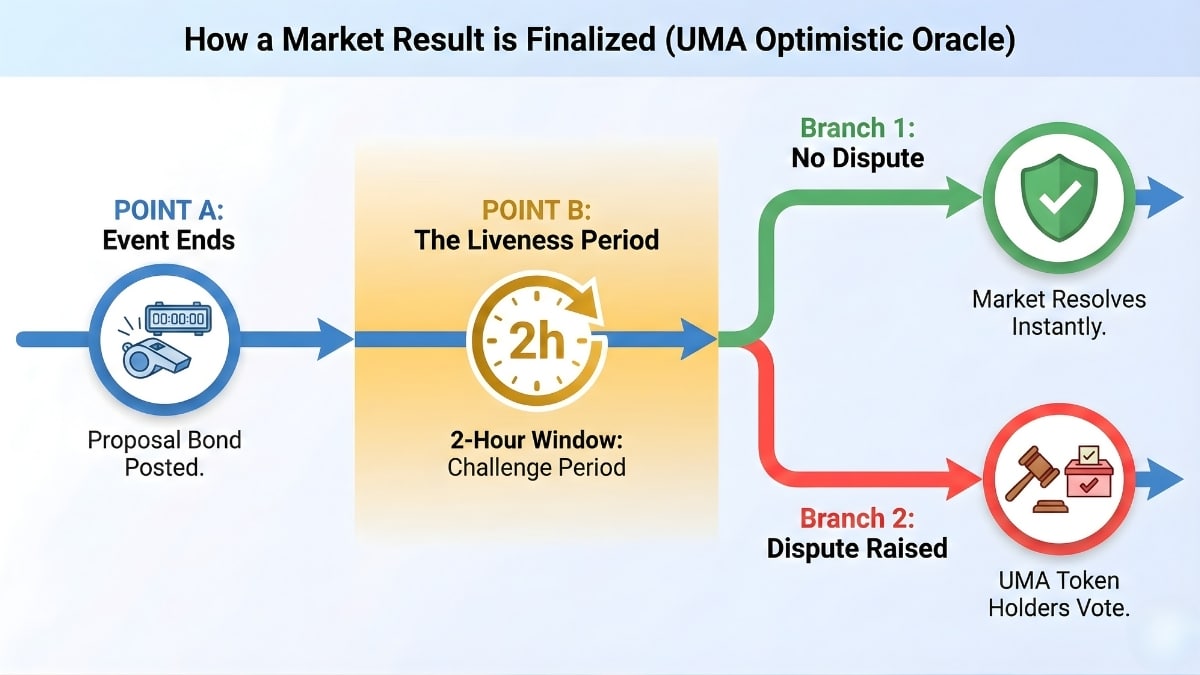
- Proposal: Anyone can propose a resolution (e.g., “Outcomes: YES”) by posting a financial bond.
- Liveness Period: This proposal sits for a “liveness period” (usually two hours). If no one disputes it, it is accepted as truth.
- Dispute: If someone disagrees, they can post a matching bond to dispute the result. This escalates the decision to UMA token holders, who vote on the correct outcome. The system relies on game theory: voters are incentivized to vote for the truth to maintain the value of the protocol.
Case study: The 2025 UFO declassification market
The UMA system is robust but not infallible. In December 2025, a market asked “Will the Trump administration declassify UFO files in 2025?” sparked a credibility crisis. Despite no official documents being released, “whales” (large holders) aggressively bought “YES” shares and pushed the resolution through the Oracle process. The dispute revealed the risks of “governance attacks,” where wealthy actors might attempt to brute-force a resolution that aligns with their financial position rather than reality.
Does Polymarket use real money?
Yes, but it operates on the rails of decentralized finance (DeFi).
- Currency: All trades are settled in USDC (USD Coin), a regulated stablecoin pegged 1:1 to the U.S. Dollar issued by the U.S.-listed firm Circle. This ensures that while the market outcome is volatile, the currency itself is stable.
- Blockchain: The platform runs on the Polygon network, a Layer-2 scaling solution for Ethereum. This choice allows for high-speed transactions with negligible gas fees, a critical requirement for a market where traders might bet as little as $10.
On-ramps and off-ramps
Getting money onto the platform has evolved significantly:
- Crypto Natives: Can deposit USDC directly via a Web3 wallet like MetaMask.
- Mainstream Users: Integrations with MoonPay and Robinhood allow users to buy USDC using credit cards, bank transfers, or existing Robinhood crypto balances. This bridges the gap between traditional banking and the blockchain.
Under the hood: The “decentralized” architecture
Polymarket’s ability to process millions of micro-transactions relies on a specific technical stack designed for efficiency and transparency.
Why Polygon?
The platform is built on the Polygon blockchain, a Layer-2 scaling solution for Ethereum. This choice is critical for unit economics. On the Ethereum mainnet, a single transaction could cost $10–$50 in gas fees, making a $20 bet irrational. Polygon reduces these fees to fractions of a penny, enabling high-frequency trading and low-value wagers that are essential for granular price discovery.
The Gnosis Conditional Token Framework (CTF)
At the smart contract level, Polymarket utilizes the Gnosis Conditional Token Framework to manage positions.
- Splitting: When a user (or market maker) deposits collateral (1 USDC), the system “splits” it to mint a complete set of outcome tokens: 1 YES Token + 1 NO Token. This ensures every position is fully collateralized.
- Merging: Because 1 YES + 1 NO will always result in a $1.00 payout regardless of the outcome, traders holding both can “merge” them back into 1 USDC at any time. This mechanism creates a hard arbitrage floor; if the price of YES + NO ever drops below $1.00, bots instantly buy both to merge them for a risk-free profit.
Non-custodial security
Crucially, Polymarket is non-custodial. The company does not hold user funds in a corporate bank account. Instead, funds are held in smart contracts on the blockchain. Users retain control of their assets via their private keys (or email-linked proxy wallets) until they choose to execute a trade.
Is it legal to trade on Polymarket?
The legality of Polymarket has been the subject of a multi-year tug-of-war with U.S. regulators.
The “ban” era (2022–2024)
In January 2022, the Commodity Futures Trading Commission (CFTC) fined Polymarket $1.4 million for operating an unregistered Swap Execution Facility (SEF).
As part of the settlement, Polymarket was forced to geoblock all U.S. users, officially cutting off its home market. For years, the platform operated as an offshore entity, accessible only to the rest of the world (or savvy users with VPNs).
The 2025 breakthrough: The intermediated model
In November 2025, the regulatory landscape shifted dramatically. The CFTC issued an “Amended Order of Designation,” officially permitting Polymarket to reopen to U.S. users—but with a catch.
It cannot operate directly; it must use an intermediated model. This means Polymarket acts as the backend exchange, while a regulated broker handles the customers.
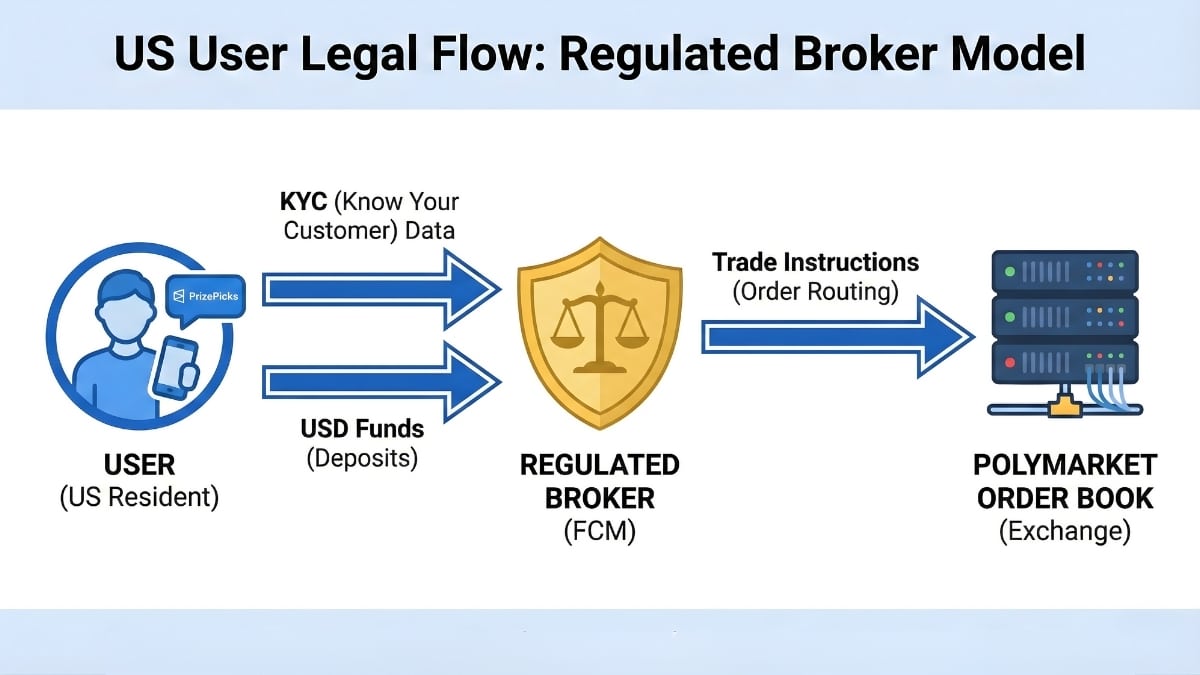
The PrizePicks partnership
To operationalize this, Polymarket partnered with PrizePicks, a popular daily fantasy sports operator that registered as a Futures Commission Merchant (FCM).
- How it works for US users: A user in Ohio or California does not go to Polymarket.com. Instead, they log into the PrizePicks app. There, they can trade event contracts that are routed to and matched on Polymarket’s order book.
- Tax implications: Unlike the “Wild West” days of DeFi, trading via PrizePicks brings tax obligations. PrizePicks will issue IRS Form 1099-MISC (for winnings >$600) or Form 1099-B to U.S. traders, ensuring full tax compliance.
Polymarket vs. Kalshi: The battle for prediction supremacy
With Polymarket’s legal return to the U.S., it entered a direct showdown with Kalshi, the only other federally regulated prediction market. The two platforms represent fundamentally different philosophies.
| Feature | Polymarket (via PrizePicks) | Kalshi |
| Architecture | Decentralized / Hybrid: Runs on Polygon blockchain; non-custodial settlement. | Centralized: Traditional exchange architecture; funds held in bank accounts. |
| Fees (U.S.) | ~0.01% (Basis Point): Polymarket plans an ultra-low fee structure for U.S. orders.9 | ~1.2% Variable: Fees scale with contract price; generally higher for retail traders.11 |
| Currency | USDC: Crypto-dollar stablecoin. | USD: Traditional fiat currency. |
| Market Variety | High: Famous for niche, user-generated markets (e.g., “Will Elon tweet X?”). | Strict: Every contract type must be self-certified or approved by CFTC, limiting variety. |
| Volume (2025) | Dominant: Routinely handles billions in monthly volume, driven by global liquidity. | Growing: Strong in institutional hedging but generally trails in retail virality. |



Future outlook: The financialization of truth
Polymarket’s evolution from a niche crypto experiment to a regulated financial powerhouse signals a shift in how society consumes information. With the backing of the New York Stock Exchange’s (NYSE’s) owner Intercontinental Exchange (ICE), prediction markets are poised to become a standard data layer for the global economy. The data layer will be a “truth machine” that prices the probability of everything from interest rate hikes to celebrity marriages.
As the platform matures, rumors of a $POLY token airdrop continue to drive massive engagement. Speculators believe a governance token is imminent to decentralize the platform further, though users should be wary of “farming” strategies as the team actively filters out wash-trading bots.
In a world increasingly fragmented by biased algorithms and subjective news, Polymarket offers a sobering alternative: a market where money talks, and the price is the closest thing we have to the truth.
Conclusion
Polymarket has successfully bridged the gap between a “crypto casino” and a regulated financial institution. By leveraging the Polygon blockchain for efficiency and partnering with regulated entities for compliance, it has built a resilient “Truth Machine.” In a world increasingly fragmented by subjective narratives, Polymarket offers a singular, objective metric: the price at which the world is willing to back its beliefs.
Disclaimer:
Some elements of this content may have been enhanced with the help of our artificial intelligence (AI) assistants for purposes such as basic refinement, review, image generation, and translation to deliver high-quality news in a shorter time frame. However, all AI-assisted content is reviewed and approved by our team to ensure accuracy, fairness, and editorial integrity.