Key Highlights
- Polymarket announced CTF Exchange V2 and a new collateral token, Polymarket USD, on April 6, 2026, with rollout expected over the next two to three weeks.
- The upgrade replaces bridged USDC.e with a wrapped 1:1 USDC-backed collateral token and adds EIP-1271 support for smart contract wallets.
- The announcement follows ICE’s completed ~$1.64 billion direct investment in Polymarket and record February volumes of over $7 billion.
On April 6, 2026, Polymarket announced what it called its largest infrastructure upgrade since launch: a rebuilt trading engine under CTF Exchange V2, a new wrapped collateral token called Polymarket USD, and updated developer tooling. The rollout is expected over the next two to three weeks, with users notified at least a week before the maintenance window begins.
The announcement comes at an inflection point for the platform. February 2026 set new records for both daily and monthly trading volumes. Intercontinental Exchange (ICE), the parent of the New York Stock Exchange, recently completed a $600 million tranche, capping its roughly $1.64 billion direct investment, and federal regulators have cleared the path for a full U.S. relaunch. The V2 upgrade is Polymarket’s technical response to this new scale.
Prediction markets meet volume records
Polymarket is a decentralized prediction market built on Polygon, an Ethereum Layer 2, where users trade binary outcome shares that settle at $1 if an event occurs and $0 if it does not. Market prices reflect the crowd-sourced probability of future events, from elections to Federal Reserve decisions to sports outcomes. Settlement is handled by UMA’s optimistic oracle, and all trading, clearing, and settlement happen on-chain.
The platform’s growth has been dramatic. The following table traces Polymarket’s volume trajectory across the election cycle and into the 2026 surge:
| Period | Monthly / Cumulative Volume | Context |
|---|---|---|
| Full year 2024 | ~$9B cumulative | U.S. election cycle peak |
| November 2024 | $2.63B monthly | Previous monthly ATH (Election Day) |
| October 2025 | $3.02B monthly | ~478K active traders |
| November 2025 (30 days) | ~$3.7B | Post-election momentum |
| February 28, 2026 | $425M single day | New all-time daily record |
| February 2026 | >$7B monthly | 7.5x YoY, new monthly ATH |
Then February 2026 eclipsed everything. On February 28, Polymarket processed $425 million in a single day, surpassing the previous daily record of $371 million set on Election Day 2024, and the month’s total exceeded $7 billion, a 7.5x year-over-year increase. That single-day record was driven almost entirely by Iran-related markets resolving simultaneously around U.S. and Israeli strikes, not by electoral politics.
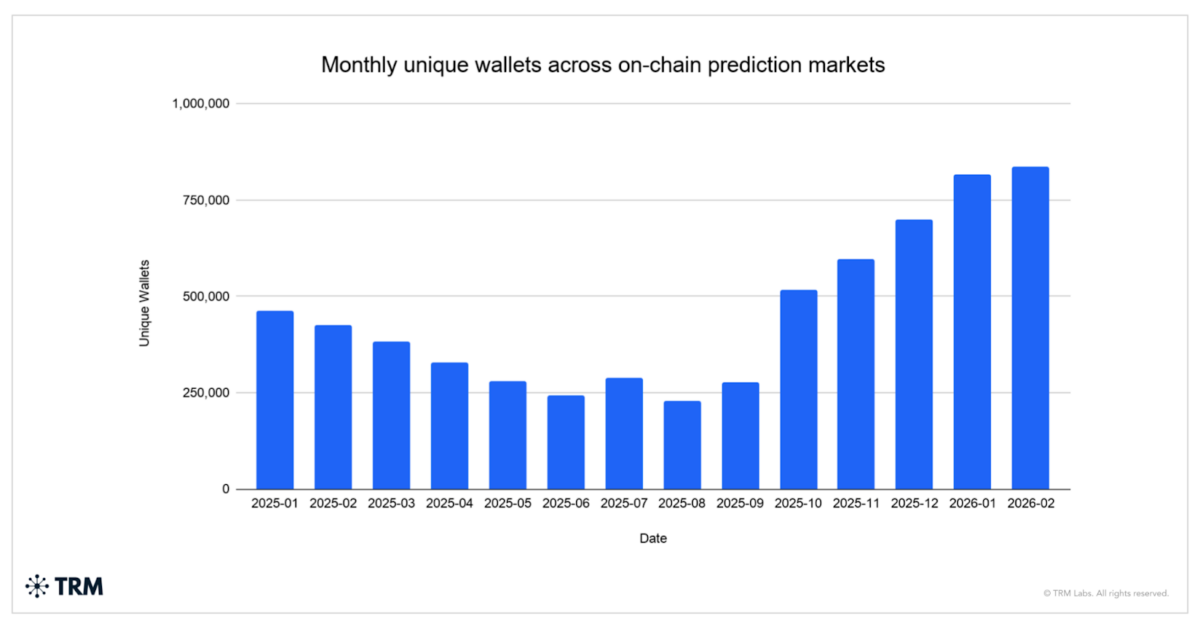
TRM Labs data shows monthly unique wallets interacting with major prediction market platforms nearly tripled in the six months leading up to February 2026, reaching roughly 840,000, evidence that growth reflects a broader user base, not just larger bets from existing participants.
The surge has not been without controversy. Columbia University researchers have estimated that roughly 20–25% of Polymarket’s volume over the past three years was wash trading, with a peak of about 60% in late 2024 before declining.
More pressingly, the Iran strike bets raised serious insider trading concerns: over 150 accounts placed roughly $855,000 on markets correctly predicting the American strike within 24 hours of the event, and multiple members of the Israeli Air Force have reportedly been interrogated or indicted over related bets. Polymarket and Kalshi both rolled out enhanced integrity measures in March 2026 in response.
Polymarket USD: Wrapped USDC, not a stablecoin
Polymarket USD is a wrapped collateral token, not a new stablecoin or speculative asset. It is minted 1:1 against Circle’s native USDC through Polymarket’s onramp contract and used as the core collateral across all markets on the platform.
For most users, the transition is automatic: the frontend wraps existing USDC or USDC.e balances into Polymarket USD through a one-time approval. API traders and power users will need to wrap manually through the collateral on-ramp contract. Deposits from networks such as Ethereum, Solana, Arbitrum, and Base are automatically converted to Polymarket USD on Polygon. Users can always unwrap Polymarket USD back to USDC; it is not a locked or one-way asset.
The token replaces bridged USDC.e, the cross-chain version of USDC that Polymarket has used as collateral since its Polygon launch. Bridged assets carry additional risks compared to native stablecoins, including exposure to bridge exploits and redemption friction. By moving to a wrapped collateral token backed 1:1 by Circle’s native USDC, Polymarket eliminates that bridge exposure and ties collateral directly to Circle’s reserves, which are redeemable for U.S. dollars through its regulated entities.
The Polymarket USD rollout builds on a partnership with Circle announced earlier in 2026 to move the platform’s trading, order placement, and settlement onto native USDC rails. It is separate from POLY, the long-rumored governance token that Polymarket’s CMO confirmed in October 2025 was planned as an airdrop contingent on a successful U.S. relaunch. Monday’s announcement did not address POLY, governance mechanics, or airdrop timelines.
CTF Exchange V2: What changes under the hood
CTF Exchange V2 is the new version of Polymarket’s core exchange contract. “CTF” stands for Conditional Tokens Framework, Gnosis’s standard for representing binary outcome tokens as ERC-1155 assets. Polymarket has used a hybrid-decentralized model since launch, with an off-chain operator providing order matching while settlement happens on-chain and non-custodially.
The V2 contract introduces several changes aimed at efficiency and broader wallet support. The table below summarizes the key differences between V1 and V2:
| Component | V1 (Current) | V2 (Rolling Out) |
|---|---|---|
| Collateral | Bridged USDC.e on Polygon | Polymarket USD (wrapped 1:1 native USDC) |
| Order Struct | Legacy | Simplified and optimized |
| Order Matching | Standard CLOB | Redesigned CLOB, faster matching |
| Wallet Support | EOA signatures only | EIP-1271 (smart contract wallets, multisigs, AA) |
| Order Attribution | Not supported | Builder codes (on-chain) |
| Fee Logic | Legacy | Revised collection and distribution |
| SDK Support | V1 CLOB client | New CLOB client (TypeScript, Python, Go) |
| Gas Costs | Baseline | Reduced via optimized contracts |
The EIP-1271 addition is particularly significant for institutional participation. The standard lets smart contract wallets, including multi-signature setups like Safe, DAOs, and account abstraction wallets, validate signatures through arbitrary on-chain logic rather than requiring an externally owned account. In practice, this means funds, DAOs, and institutional trading desks can interact with Polymarket directly from their existing wallet infrastructure.
Polymarket is also releasing updated CLOB client SDKs in TypeScript, Python, and Go. The new clients will handle the V1-to-V2 transition automatically for most integrations, but bot operators and custom integrations will need to update to the latest versions and re-sign orders using the new struct. Existing order books will be cleared during the migration, and Polymarket has committed to providing at least one week’s notice before the maintenance window begins.
Built for institutional throughput
Polymarket currently holds around $431 million in total value locked, according to DefiLlama, with weekly trading volumes routinely in the hundreds of millions of dollars and, during geopolitical event spikes, well above $2 billion.
| Metric | Value |
|---|---|
| TVL | ~$431M |
| Weekly Volume (recent) | Hundreds of millions to $2B+ during spikes |
| Weekly Volume (peak, Feb 23–Mar 1) | $2.40B (+31.9% w/w) |
| Monthly Volume (Feb 2026) | >$7B |
| Daily Volume ATH | $425M (Feb 28, 2026) |
| Monthly Unique Wallets (sector) | ~840K (Feb 2026) |
The V2 upgrade is designed to support substantially higher throughput and to make the platform more accessible to the kinds of sophisticated traders, algorithmic desks, market makers, and institutional participants who have been drawn in by the growth of the sector.
The shift to a wrapped native-USDC collateral token reduces bridging risk, while EIP-1271 support and builder codes lower the friction for institutional and algorithmic participants to connect. Together, these changes target the specific pain points that have historically separated crypto-native prediction markets from traditional financial infrastructure: collateral quality, wallet compatibility, and matching performance.
ICE bets on event-data feeds
The technical upgrade arrives alongside a significant deepening of Polymarket’s institutional relationships. On March 27, 2026, Intercontinental Exchange announced it had completed a $600 million direct cash investment in Polymarket, fulfilling the remainder of an investment arrangement first announced in October 2025. ICE’s investment thesis is not primarily about operating prediction markets; it is about data distribution.
In October 2025, ICE disclosed that it would become the exclusive global distributor of Polymarket’s event-driven data to institutional capital markets, and in February 2026, it launched the Polymarket Signals and Sentiment tool, which delivers normalized probability feeds through the same infrastructure ICE uses to distribute NYSE equity data.
The V2 upgrade supports this thesis indirectly by making Polymarket’s underlying markets more robust and institution-friendly, though the two initiatives are not directly linked.
Federal‑cleared, state‑under‑fire
Polymarket’s path back into the U.S. market has cleared considerably over the past year. The regulatory timeline:
| Date | Event | Significance |
|---|---|---|
| July 2025 | CFTC and DOJ drop investigations into Polymarket | Clears legal overhang |
| July 21, 2025 | Acquires QCX, LLC and QC Clearing LLC (QCEX) for $112M | Obtains CFTC-licensed DCM and DCO |
| September 2025 | CFTC grants QCX a no-action letter on reporting requirements | Operational flexibility |
| October 2025 | ICE announces up to $2B investment at $8B valuation | Institutional legitimization |
| November 2025 | CFTC issues Amended Order of Designation | Full U.S.-regulated operation cleared |
| January 2026 | Nevada Gaming Control Board files civil complaint | State-level challenge |
| March 17, 2026 | Portugal issues nationwide block order | International headwind |
| April 6, 2026 | Third Circuit rules for Kalshi on federal preemption | Favorable precedent for the sector |
In July 2025, the CFTC and Department of Justice dropped their investigations into Polymarket. Days later, the company acquired QCX, LLC and QC Clearing LLC, collectively QCEX, for $112 million, giving it CFTC-licensed exchange and clearinghouse infrastructure. In November 2025, the CFTC issued an amended order of designation allowing Polymarket to operate a federally regulated intermediated trading platform in the U.S.
The picture at the state level is messier. In January 2026, the Nevada Gaming Control Board filed a civil complaint against Polymarket over event contracts offered to state residents without a gaming license.
On March 17, 2026, Portugal issued a nationwide ban on Polymarket for lacking proper licensing. And the broader prediction markets sector remains the subject of active litigation across multiple states, with the CFTC and DOJ recently suing Arizona, Connecticut, and Illinois over their enforcement efforts against CFTC-registered prediction market platforms, a dispute in which the U.S. Court of Appeals for the Third Circuit ruled in Kalshi’s favor on the same day as Polymarket’s V2 announcement.
Prediction markets as infrastructure
The CTF Exchange V2 upgrade, Polymarket USD, and expanded wallet support collectively move Polymarket closer to the technical and institutional profile of a traditional financial exchange. Lower gas costs, tighter spreads, smart contract wallet support, and direct-to-Circle collateral all reduce friction for the kinds of participants, institutions, algorithmic traders, and professional market makers that have historically hesitated to engage with on-chain prediction markets.
Whether this translates into sustained growth depends on factors that the upgrade cannot address. The insider trading concerns around geopolitical markets remain unresolved, wash trading has declined but not disappeared, and state-level legal challenges to prediction markets are still working through the courts. The V2 upgrade positions Polymarket to capture more volume if those headwinds ease, and to defend its market position if competitors like Kalshi continue to win regulatory battles and close the gap.
For now, the announcement signals that Polymarket and its backers are betting heavily on the thesis that prediction markets will become a permanent, regulated infrastructure in the global financial system rather than a novelty tied to election cycles.
Also Read: Polymarket Pulls Bet on Downed U.S. Pilot’s Rescue After Backlash From Veteran Lawmaker
Disclaimer:
Some elements of this content may have been enhanced with the help of our artificial intelligence (AI) assistants for purposes such as basic refinement, review, image generation, and translation to deliver high-quality news in a shorter time frame. However, all AI-assisted content is reviewed and approved by our team to ensure accuracy, fairness, and editorial integrity.