Key Highlights
- Polymarket hit an all-time high of $478M daily volume on February 28, with politics markets at ~$220M and the “US/Israel strikes Iran” family exceeding $529 million cumulative since late 2025; Feb 28 contract alone drew ~$90 million.
- Bubblemaps flagged six new wallets netting ~$1.2 million on “Yes” bets for a February 28 strike, including one turning $61K into $493K (821% return); minimal prior activity sparked insider trading speculation, while one contrarian lost $6.5 million.
- Markets on regime change, ceasefires, and conflict end dates (e.g., “ends by March 31”) saw rapid millions in turnover; Polymarket calls it crowd wisdom, but big windfalls fueled calls for tighter regulation on offshore prediction platforms.
Polymarket, the decentralized event-odds trading platform, transformed into a high-stakes trading floor for war outcomes, as U.S. and Israeli airstrikes pounded Iranian targets over the weekend. A significant spike in activity on Polymarket shattered single-day volume records and sparked fresh debates over insider knowledge and market integrity.
The platform recorded an all-time high notional daily trading volume of $478 million on the day the joint strikes began late February 28, with politics-related markets alone accounting for roughly $220 million. As geopolitical contracts tied to the conflict surged, Polymarket became one of the most active venues for betting on real-time military developments.
The flagship market family “US/Israel strikes Iran by…?” (with variants for specific dates) amassed over $529 million in cumulative volume since late 2025.
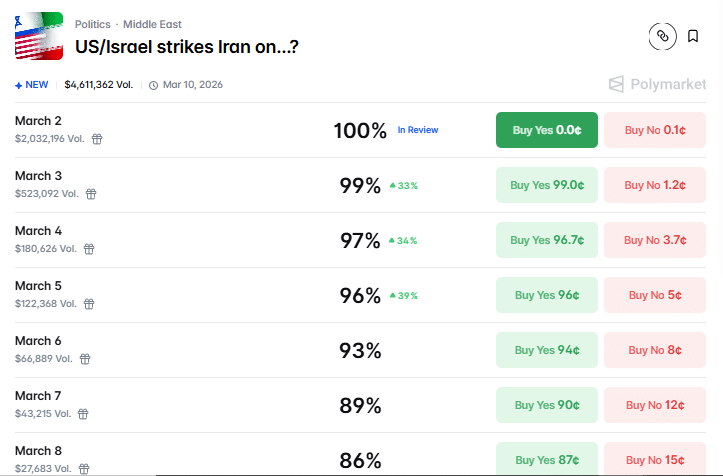
The February 28-specific contract drew nearly $90 million in trades alone before resolving “Yes” as bombs fell on facilities including suspected nuclear sites and military installations.
In addition, newer markets like “Iran x Israel/US conflict ends by…?” exploded in activity too, pulling $550,000 in volume by March 2, with traders heavily favoring an end by March 31.
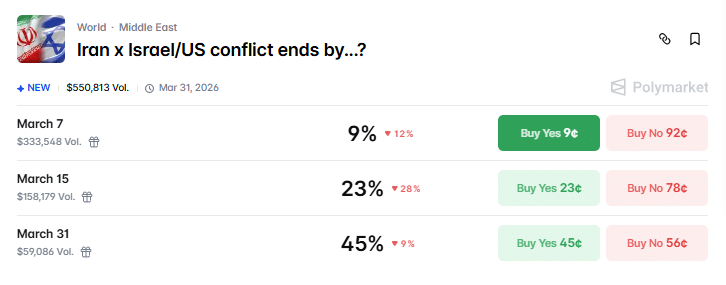
Besides, related wagers on regime stability, ceasefires, and potential escalations—including strikes on the Fordow nuclear plant—added millions more in rapid turnover.
The surge reflects how prediction markets have evolved from niche crypto experiments into mainstream barometers for geopolitical risk. Traders bet not just on binary outcomes but on precise timelines, probabilities shifting minute-by-minute as news broke.
While most positions were resolved cleanly, the episode exposed the platform’s vulnerability to asymmetric information in fast-moving crises.
Whales (or insiders?) pocketing huge PnLs
Amid this frenzy, what drew the sharpest scrutiny were the big winners. Blockchain analytics firm Bubblemaps identified six freshly created and funded wallets that collectively netted approximately $1.2 million by loading up on “Yes” shares for a U.S. strike by February 28.
Most accounts were established and capitalized within 24 hours of the attacks, with one turning roughly $61,000 into nearly $493,000—ammasing a staggering 821% return. Although a separate trader who had bet heavily against escalation reportedly lost $6.5 million in a single day when events unfolded.
Other high-profile trades included accounts like “Magamyman,” which reportedly pocketed over $500,000 on positions tied to regime change or the death of Supreme Leader Ayatollah Ali Khamenei in an Israeli strike.
The timing for these bets raised immediate questions about potential insider information. Bubblemaps’ on-chain clustering showed minimal prior activity on these wallets, fueling speculation that non-public knowledge of the operation, dubbed “Operation Epic Fury” by the U.S. Department of War, may have leaked to select traders.
Polymarket has defended the markets as tools for harnessing crowd wisdom on critical events, insisting they provide “invaluable” real-time insights, particularly in the Middle East. Yet the windfalls prompted calls for tighter oversight, with some Democratic lawmakers criticizing the lack of regulation on offshore platforms like Polymarket.
Also read: 50x Bitcoin Jackpot: It Now Only Costs $1,320 to Mine 1 BTC in Iran