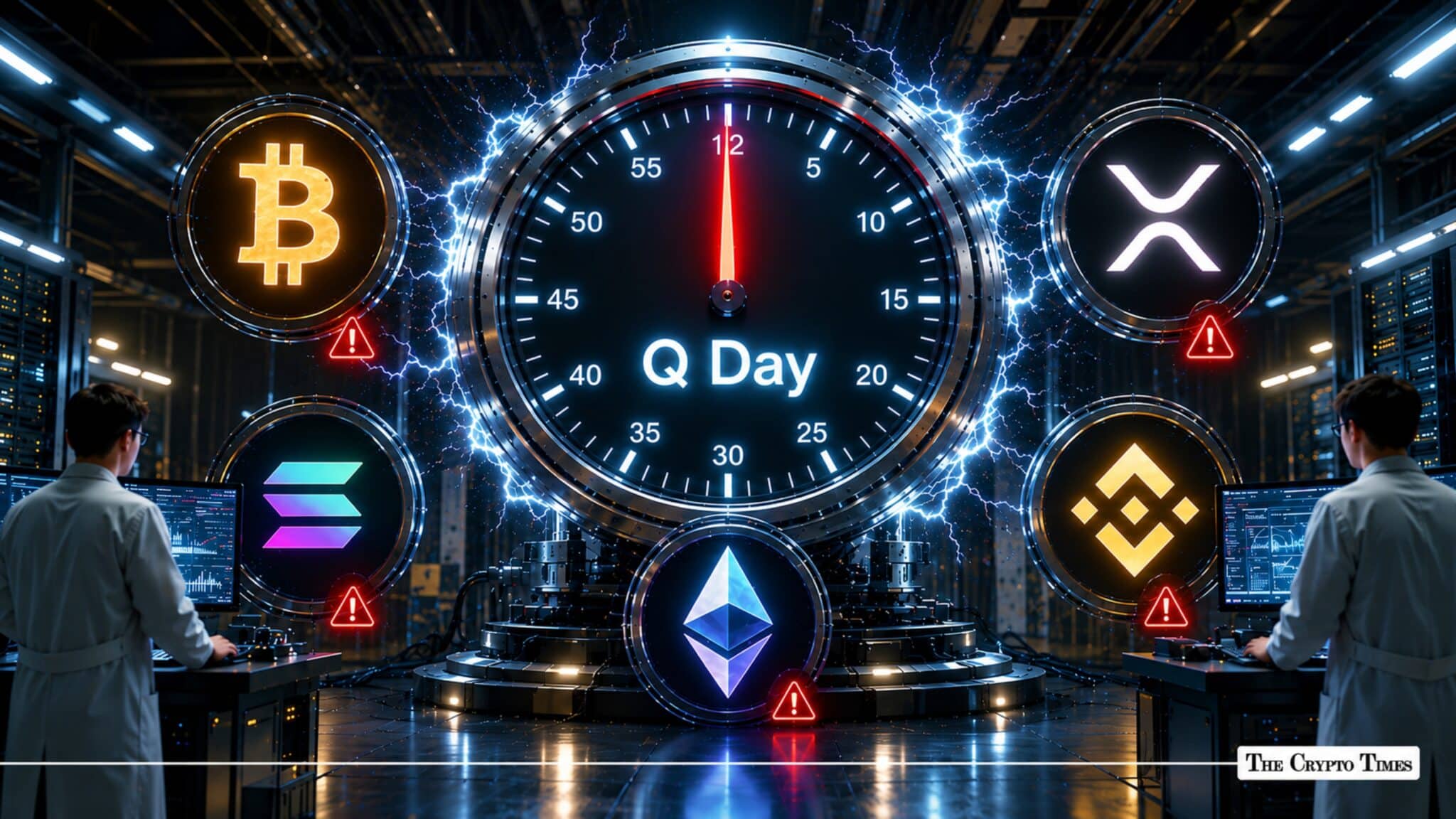
The blockchain industry’s most fundamental security assumption, that elliptic-curve cryptography is unbreakable, now has an expiration date. The question is no longer whether quantum computers will threaten crypto, but whether the largest networks can upgrade before they arrive.
In March 2026, Google Quantum AI published a paper estimating that breaking 256-bit elliptic-curve cryptography could require roughly 20 times fewer resources than previously believed — approximately 1,200 logical qubits and fewer than 500,000 physical qubits. Google responded by setting a 2029 internal deadline for migrating its own systems to post-quantum cryptography.
Project Eleven’s 2026 report places the baseline Q-Day estimate at 2033, with optimistic and pessimistic scenarios at 2030 and 2042 respectively. NIST finalized three post-quantum cryptography standards in August 2024 — FIPS 203 (ML-KEM), FIPS 204 (ML-DSA), and FIPS 205 (SLH-DSA) — and told organizations to begin migrating immediately.
U.S. federal agencies faced an April 2026 deadline to submit post-quantum transition plans under National Security Memorandum 10. The European Union has set a 2030 target. Canada’s federal procurement requirements took effect in April 2026. Against that backdrop, how are the largest blockchains actually preparing?
1. Bitcoin (BTC): ~$1.6 Trillion Market Cap
Status: Early-stage testnet | No mainnet timeline
Bitcoin faces the most complex post-quantum migration challenge of any blockchain. Approximately 6.9 million BTC, which is roughly one-third of the total supply and worth over $550 billion, sit in addresses with exposed public keys, directly vulnerable to Shor’s algorithm.
The primary proposal is BIP-360, authored by Hunter Beast, Ethan Heilman, and Isabel Foxen Duke, which introduces Pay-to-Merkle-Root (P2MR); a new output type that strips Taproot’s quantum-vulnerable key-path spend. BIP-360 entered Bitcoin’s official proposal repository in February 2026. BTQ Technologies deployed the first functional implementation on its Bitcoin Quantum testnet (v0.3.0) in March 2026, with over 50 miners and 100,000+ blocks mined.
A companion proposal, BIP-361 (“Post Quantum Migration and Legacy Signature Sunset”), landed in April 2026 with a three-phase plan to phase out ECDSA and Schnorr spends entirely. Lightning Labs co-founder Olaoluwa Osuntokun separately published a quantum defense prototype using zero-knowledge proofs.
The timeline problem is stark. Heilman estimates a full Bitcoin migration to quantum resilience would take seven years from the day consensus forms. SegWit took 8.5 years from concept to widespread adoption; Taproot took 7.5 years. Bitcoin’s conservative governance culture makes rapid protocol upgrades extraordinarily difficult.
The unresolved political question of what happens to Satoshi’s ~1.1 million dormant BTC could prove more contentious than the cryptography itself.
- Algorithm: FALCON, SPHINCS+, and ML-DSA (Dilithium) as candidates
- Biggest risk: Governance speed; seven-year migration timeline vs. accelerating quantum hardware
2. Ethereum (ETH): ~$280 Billion Market Cap
Status: Dedicated PQ team, four-year roadmap, weekly interop devnets
Ethereum has the most structured post-quantum preparation of any major blockchain. The Ethereum Foundation formed a dedicated Post-Quantum Security team in January 2026, led by Thomas Coratger, with researcher Justin Drake declaring PQ security “a top strategic priority.”
Co-Founder Vitalik Buterin published Ethereum’s post-quantum roadmap in February 2026, identifying four vulnerable cryptographic layers: consensus-level BLS signatures, KZG-based data availability, ECDSA account signatures, and zero-knowledge proofs. The four-year “Strawmap” targets approximately seven hard forks, with the Glamsterdam and Hegota forks confirmed for 2026.
The proposed solutions include hash-based signatures (leanXMSS) for consensus—paired with a minimal zkVM (leanVM) offering 250x compression—recursive STARKs for proof systems, and native account abstraction via EIP-8141 to enable smooth key migration. EIP-8141 is being considered for the Hegota hard fork (planned for the second half of 2026) and would let individual accounts choose their own signature verification, meaning users could switch to quantum-safe signatures without waiting for a protocol-wide migration.
The Ethereum Foundation runs weekly PQ interoperability devnets across 10+ client teams; tracks progress publicly at pq.ethereum.org, and has announced a $1 million Poseidon Prize to harden the Poseidon hash function used in Ethereum applications. Drake also sits on Coinbase’s newly formed quantum advisory board.
Ethereum’s advantage is its upgrade culture; the community is accustomed to hard forks. Its disadvantage is complexity: replacing four distinct cryptographic primitives across a network with $200+ billion in locked value requires extraordinary coordination. Solana Co-Founder Anatoly Yakovenko publicly warned in May 2026 that “Ethereum L2s are not quantum safe” — a valid critique since most rollups still rely on ECDSA for wallet security.
- Algorithm: leanXMSS (hash-based), STARKs (hash-based proofs), EIP-8141 (signature agility)
- Biggest risk: Complexity; four cryptographic layers to replace simultaneously
3. XRP Ledger (XRP): ~$90 Billion Market Cap
Status: AlphaNet integration complete, full transition targeted by 2028
XRPL may be the furthest along of any top-10 blockchain in terms of concrete post-quantum implementation. In December 2025, XRPL Labs lead engineer Denis Angell announced the integration of Dilithium-based post-quantum cryptography and native smart contract into AlphaNet, the project’s public developer network.
The integration is comprehensive: Quantum Accounts (lattice-based key generation replacing elliptic curves), Quantum Transactions (Dilithium-signed fund movements), and Quantum Consensus (validator signatures upgraded to PQ schemes).
Ripple published a formal post-quantum readiness roadmap in partnership with Project Eleven: H1 2026 for testing NIST-recommended algorithms under real workload conditions, H2 2026 for hybrid rollout on Devnet, and a formal amendment taking XRPL fully post-quantum by 2028.
Critically, XRPL already supports native key rotation at the account level—meaning users can swap out vulnerable keys without moving funds or changing accounts. This is a structural advantage that Ethereum and Bitcoin lack, where quantum migration requires users to actively transfer assets to new addresses.
- Algorithm: ML-DSA (Dilithium), with cryptographic agility supporting multiple NIST algorithms
- Biggest risk: Execution; the 2028 target depends on ecosystem partner alignment
4. BNB Chain (BNB): ~$90 Billion Market Cap
Status: No public roadmap
BNB Chain has no published post-quantum roadmap, no testnet implementation, and no dedicated research team working on quantum resistance. It is the largest blockchain by market cap with no concrete PQ preparation.
Binance Co-Founder Changpeng Zhao (CZ) addressed the quantum threat publicly in March 2026, downplaying the immediate risk but acknowledging implementation challenges. “It’s always easier to encrypt than decrypt. More computing power is always good. Crypto will stay, post quantum,” he wrote. He noted that disagreements over which cryptographic standards to adopt could lead to network splits.
BNB’s centralized governance model — where Binance exerts significant influence over protocol upgrades — theoretically allows faster deployment of cryptographic changes than decentralized networks like Bitcoin. But that speed advantage is meaningless without a plan.
- Algorithm: None selected
- Biggest risk: Complacency; assumes the threat gives advance warning
5. Solana (SOL): ~$55 Billion Market Cap
Status: Testnet deployed, Falcon selected, phased migration plan published
Solana has moved faster than most peers in terms of experimentation, though it faces a fundamental tension between security and performance. The Solana Foundation partnered with Project Eleven in late 2025 to run testnet experiments with post-quantum signatures and published a detailed phased migration plan in April 2026.
Two of Solana’s core development teams, i.e. Anza and Jump Crypto’s Firedancer, have independently converged on the same solution: Falcon (FN-DSA), a NIST-approved lattice-based signature scheme selected for its compact design and high throughput. Both teams have built early implementations on GitHub.
The migration plan is phased: continued research and testing first; wallet-level PQ upgrades when quantum computing poses a realistic threat; and full migration of existing wallets only if necessary. The Firedancer client, shipping from Jump Crypto in 2026, already supports multiple signature backends. The foundation has said it will propose an on-chain vote to lock a cutover date when at least 10% of stake votes with post-quantum keys.
The tradeoff is real. Early tests showed quantum-resistant signatures are up to 40x larger and made the network roughly 90% slower. Solana processes transactions at extremely high throughput, and adding PQ signatures could significantly impact performance. The foundation says the impact would be “manageable,” but the numbers demand further optimization.
Solana also has a unique structural vulnerability. Unlike Bitcoin and Ethereum, where addresses are typically derived from hashed public keys, Solana exposes public keys directly. As Project Eleven CEO Alex Pruden noted, “In Solana, 100% of the network is vulnerable.”
- Algorithm: Falcon (FN-DSA)
- Biggest risk: Performance degradation; 40x larger signatures on a throughput-optimized chain
6. Tron (TRX): ~$34 Billion Market Cap
Status: Testnet planned Q2 2026, mainnet Q3 2026
Tron Founder Justin Sun made what may be the boldest quantum claim in the industry: that Tron will become “the world’s first quantum-resistant network” by deploying NIST-standardized post-quantum signatures on mainnet in Q3 2026.
Sun announced the initiative in April 2026, stating that Tron would activate a quantum-resistant testnet during Q2 2026 with mainnet rollout following in Q3. He framed quantum-resistant infrastructure as a prerequisite for the AI era, arguing that “while Bitcoin debates whether to freeze weak coins and Ethereum forms research committees, Tron is building.”
No technical roadmap, algorithm selection, or implementation details have been published. The claim remains unverified, and the crypto community has received it with skepticism given the aggressive timeline and lack of supporting documentation. Tron holds approximately $86.7 billion in stablecoins and roughly $5.1 billion in DeFi TVL; assets that would be directly at risk in a quantum scenario.
- Algorithm: Claims NIST-standardized, but no specific algorithm published
- Biggest risk: Credibility; bold claims without published technical details
7. Cardano (ADA): ~$10 Billion Market Cap
Status: Academic research | No implementation timeline
Cardano’s approach to post-quantum security has been characteristically academic. IOHK, Cardano’s research arm, has published peer-reviewed work on post-quantum blockchain protocols through its research library. Founder Charles Hoskinson has emphasized that Cardano has “a large academic team working on issues like quantum safety.”
Cardano’s modular architecture, designed to separate the settlement layer from the computation layer, theoretically supports cryptographic upgrades without full protocol rewrites. Its Ouroboros consensus protocol and the academic rigor behind it position Cardano well for a structured transition.
However, Cardano has no testnet implementation, no selected algorithm, no published migration timeline, and no dedicated PQ team. The blockchain does not yet use any post-quantum cryptography. Research is ongoing, but “ongoing research” is not a deployment plan.
- Algorithm: None selected (research into lattice-based and hash-based approaches)
- Biggest risk: Speed; academic rigor without implementation urgency
8. Zcash (ZEC): ~$9 Billion Market Cap
Status: Quantum-recoverable wallet June 2026, full PQ overhaul by 2027
Zcash has one of the most aggressive and concrete post-quantum timelines of any blockchain. ZODL (Zcash Open Development Lab) CEO Josh Swihart announced in early May 2026 that a quantum-recoverable wallet will launch in June 2026 — an interim security measure allowing users to migrate funds to a secure environment if quantum computers suddenly break current encryption.
The full post-quantum protocol overhaul, targeting replacement of zk-SNARKs with quantum-resistant primitives, is planned for completion by 2027, just 12–18 months away. This includes Project Tachyon’s Oblivious Synchronisation, which removes ciphertexts from the blockchain entirely, and active testing of NIST-approved algorithms.
Zcash’s urgency is well-founded. Its privacy model relies on zk-SNARKs, which use elliptic curves and pairings (BLS12-381). A quantum attack could not only steal funds but potentially reveal private transactions; a catastrophic failure for a privacy-focused chain. Shielded transaction adoption hit 59.3% in February 2026, meaning a majority of ZEC activity now depends on cryptography that quantum computers could compromise.
The ecosystem restructured into five independent organizations in Q1 2026, with ZODL raising $25 million in private investment. Cypherpunk Technologies (Nasdaq: CYPH) acquired over $90 million in ZEC. This institutional backing gives Zcash the financial runway to execute an aggressive migration timeline.
- Algorithm: Transitioning from zk-SNARKs to quantum-resistant primitives
- Biggest risk: Execution speed; privacy guarantees are at stake, not just fund security
9. Monero (XMR): ~$7 Billion Market Cap
Status: No public roadmap | Structurally vulnerable
Monero uses Ed25519 for its ring signatures and stealth addresses, both of which would be broken by quantum computing. A quantum attack on Monero would not only enable theft of funds but could potentially compromise the privacy of past transactions by forging or decoding ring signatures.
Unlike Zcash, which has published a concrete PQ timeline, Monero has no public post-quantum roadmap, no testnet implementation, and no dedicated research team working on the problem. The Monero Research Lab has discussed quantum resistance in academic terms, but no binding protocol commitments have been made.
Monero’s decentralized, community-driven governance model makes rapid protocol changes possible; the community has historically been willing to hard fork for security improvements. But willingness to fork and having a fork ready are different things. The privacy-coin community’s emphasis on decentralization may slow the kind of coordinated research effort that Ethereum and Zcash are executing.
- Algorithm: None selected
- Biggest risk: Privacy compromise; past transactions could be retroactively de-anonymized
10. NEAR Protocol (NEAR): ~$2 Billion Market Cap
Status: FIPS-204 (ML-DSA) testnet by end of Q2 2026 — most imminent deployment
NEAR Protocol may be the closest of any major blockchain to shipping a post-quantum-safe signing scheme to testnet. Near One CTO Anton Astafiev announced in May 2026 that the first post-quantum signing scheme for implicit accounts and user signing is planned for testnet by the end of Q2 2026 — weeks away.
NEAR chose FIPS-204 (ML-DSA, formerly CRYSTALS-Dilithium), a lattice-based signature scheme that is NIST-approved and widely considered the leading candidate for production PQ deployments.
NEAR has a structural advantage that no other major blockchain shares: its account model was designed from inception with future quantum safety in mind. Unlike Bitcoin and Ethereum, where addresses are cryptographically tied to breakable keypairs, every NEAR account uses human-readable IDs controlled through rotatable “access keys.” This means any NEAR account holder will be able to run a single transaction to rotate their keys to a quantum-safe scheme — no address migration required.
Near One is also researching a zero-knowledge proof fallback mechanism inspired by the Bitcoin ecosystem: if a quantum computer renders conventional signatures untrustworthy, the protocol could block standard transactions but allow users to prove ownership through a ZKP demonstrating knowledge of the original seed phrase. The Defuse team is separately working to bring quantum-safe Chain Signatures to NEAR Intents users across 35+ chains.
Near One is already collaborating with hardware wallet manufacturers including Ledger on post-quantum support, an area Astafiev flagged as “one of the most important areas of research in the next few years.”
- Algorithm: FIPS-204 (ML-DSA / CRYSTALS-Dilithium)
- Biggest risk: Small ecosystem relative to top chains; hardware wallet support in early stages
The Comparison: Who’s Ready, Who’s Not
| Blockchain | Market Cap | PQ Stage | Algorithm | Testnet | Mainnet Target | Key Vulnerability |
|---|---|---|---|---|---|---|
| Bitcoin | ~$1.6T | Testnet (BIP-360) | FALCON/ML-DSA | ✅ | No timeline | ~6.9M BTC exposed keys |
| Ethereum | ~$280B | Active R&D | leanXMSS/STARKs/EIP-8141 | ✅ | ~2029 | 4 crypto layers to replace |
| XRP Ledger | ~$130B | AlphaNet live | ML-DSA | ✅ | 2028 | Ecosystem partner migration |
| BNB Chain | ~$85B | No public plan | None | ❌ | None | Largest chain with zero PQ prep |
| Solana | ~$65B | Testnet live | Falcon (FN-DSA) | ✅ | TBD (vote) | 100% exposed public keys |
| Tron | ~$25B | Announced | Claims NIST-standard | ❌ | Claims Q3 2026 | $86.7B stablecoins at risk |
| Cardano | ~$18B | Research | None | ❌ | None | Research without implementation |
| Monero | ~$10B | No plan | None | ❌ | None | Past txns could be de-anonymized |
| Zcash | ~$9.8B | Wallet Jun 2026 | Transitioning from zk-SNARKs | ✅ | 2027 | Privacy guarantees at stake |
| NEAR | ~$4B | Testnet Q2 2026 | FIPS-204 (ML-DSA) | Imminent | Phased | Small ecosystem, HW wallet gaps |
Three Tiers of Quantum Readiness
The data reveals a clear three-tier structure across the industry.
- Tier 1 — Active Implementation: Ethereum, XRP Ledger, Zcash, NEAR Protocol, and Solana have moved beyond research into testnet implementations with specific timelines and NIST-approved algorithms. These chains are treating Q-Day as an engineering problem with a deadline.
- Tier 2 — Research Without Implementation: Bitcoin and Cardano have significant academic discussion and draft proposals but no binding protocol commitment or mainnet timeline. Tron has made bold claims but published no technical details.
- Tier 3 — No Public Preparation: BNB Chain and Monero have no published post-quantum roadmap, no testnet, no selected algorithm, and no dedicated research team. These are among the largest blockchain ecosystems in the world operating with no visible quantum preparation.
The Clock Is Running
The uncomfortable truth is that cryptographic transitions take years to plan and execute safely. Bitcoin’s BIP-360 co-author estimates seven years for a full migration. Ethereum’s roadmap targets 2029. XRPL is aiming for 2028. Google, which is one of the most technically capable organizations on Earth, has given itself until 2029.
The blockchain industry does not have the luxury of certainty about timelines. What it does have is the certainty that “harvest now, decrypt later” attacks are already underway; adversaries collecting encrypted blockchain data today to unlock it with future quantum hardware. Every day of delay enlarges that corpus.
The chains that survive Q-Day will not be the ones that started preparing on the day a quantum computer was announced. They will be the ones that started preparing now.
Also Read: How Crypto Billionaires Are Preparing for Q-Day — Or Quietly Choosing Not To
Disclaimer:
Some elements of this content may have been enhanced with the help of our artificial intelligence (AI) assistants for purposes such as basic refinement, review, image generation, and translation to deliver high-quality news in a shorter time frame. However, all AI-assisted content is reviewed and approved by our team to ensure accuracy, fairness, and editorial integrity.