
On January 2, 2026, spot Bitcoin ETFs opened the year by pulling in $471.14 million in net inflows in a single trading session — before most retail investors had finished their New Year’s resolutions.
Five days later, that record was shattered: total ETF inflows hit $694.67 million in one day, led by BlackRock’s iShares Bitcoin Trust (IBIT) at $371.9M and Fidelity’s FBTC at $191.2M. By the end of Q1 2026, the ETF complex had absorbed $18.7 billion in net new capital — pushing total assets under management (AUM) past $155 billion. So now it’s a story about who controls the price.
Giants vs. Bitcoin: When Institutional Money Enters the Room
When BlackRock allocates capital, markets notice. The world’s largest asset manager, overseeing roughly $10 trillion in global AUM, has publicly reframed Bitcoin to core financial infrastructure.
IBIT alone now commands approximately $54 billion in assets under management, representing nearly 49% of the entire U.S. spot Bitcoin ETF market. On its single biggest day in Q1, January 27, the fund absorbed $1.3 billion, in 24 hours. Fidelity’s FBTC, the distant second at ~$17–18 billion AUM, benefited from direct integration into Fidelity brokerage accounts, allowing retirement savers to allocate to BTC alongside index funds without touching a crypto exchange.

Here’s why this “pushes” Bitcoin’s price even when ordinary investors stay quiet: ETFs buy physical Bitcoin. Every dollar flowing into IBIT requires the fund’s custodian to purchase actual BTC on the open market. There is no synthetic exposure, no paper promise. When $471 million enters on a slow January Thursday, $471 million worth of Bitcoin must be bought. Supply is finite. Price follows demand. Its eighth-grade economics applied to a 21-million-coin asset.
The Supply Shock Nobody Is Talking About Loudly Enough
Following the April 2024 halving, Bitcoin’s network produces exactly 450 Bitcoin (BTC) per day, approximately $40 million at current prices. That number will not change until the 2028 halving cuts it in half again.
On a day when ETFs record $500 million in inflows, institutions absorb more than 12 days of total global mining supply before lunchtime. On peak days, like the sessions seen during the late 2024/2025 cycle, when IBIT alone pulled in $1.38 billion, the ETF complex absorbed the equivalent of 34 days’ worth of new Bitcoin in a single session.
The old halving narrative of “supply drops, price soars on a four-year schedule” has been superseded. The halving still matters structurally; it just no longer drives the price alone. What drives the price now is the gap between 450 BTC produced daily and the billions of dollars institutional channels absorb weekly. The spark exists. The fuel is now measured in AUM.
Retail Fear = Institutional Opportunity
ETF inflows during periods of retail fear reflect a classic “smart money absorption” pattern – professional capital using the window of widespread anxiety to accumulate at lower prices ahead of the next anticipated move.
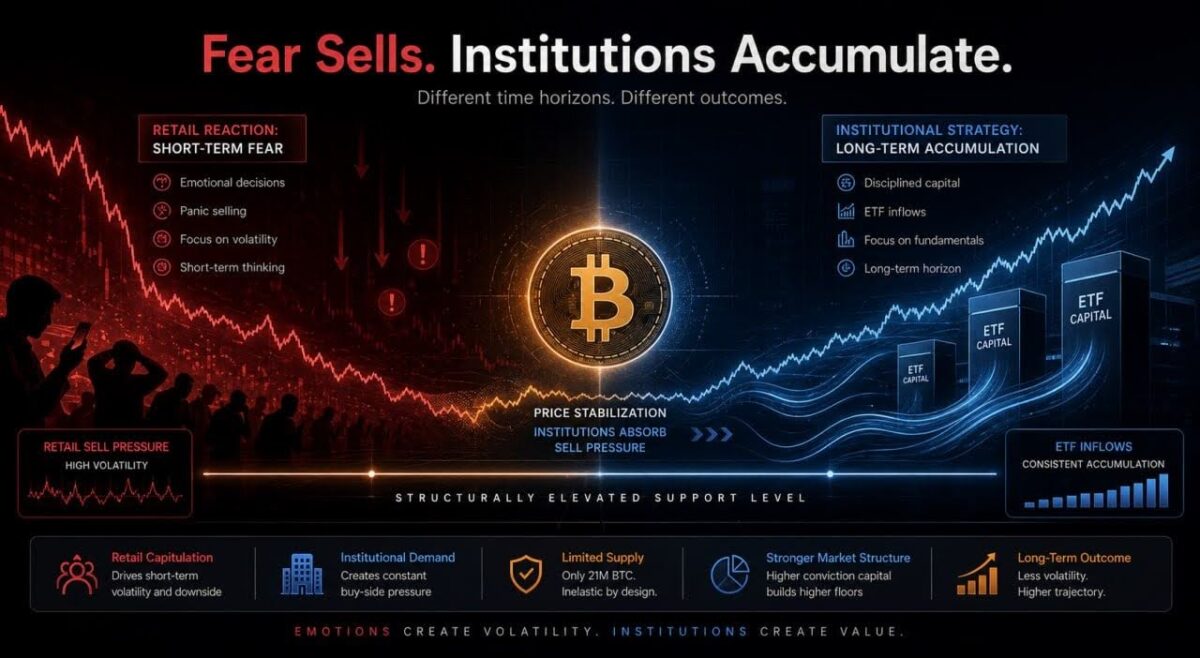
The critical difference is the time horizon. A retail trader checking their portfolio during a geopolitical news cycle is measuring risk in days and weeks. A pension fund that allocated to IBIT after BlackRock’s investment committee approved a 1–2% Bitcoin position in a diversified portfolio is measuring risk in years.
Institutional ETF holdings also create a structurally higher price floor. The average cost basis of ETF investors who allocated in 2024-2025 sits around $80,000.
What This Means for BTC Tomorrow
Bitcoin in 2026 is not the asset it was in 2021, let alone 2017. It is increasingly a macro instrument – one that moves in tandem with global liquidity cycles. Four structural shifts define the current market:
1. Volatility compression is real, but not guaranteed
Bitcoin’s realized volatility has declined since ETF approval, and institutional ETF options trading, which allows large investors to hedge positions using puts and calls, contributes directly to this dampening effect. When institutions can hedge exposure rather than exit it during downturns, selling pressure decreases.
2. The signal hierarchy has changed
Monthly ETF flow data, long-term holder supply metrics, and regulatory developments now rank above CPI prints and halving countdowns as price drivers.
3. The wealth management channel is barely open
Institutional allocators currently account for an estimated 38% of total spot Bitcoin ETF holdings — but the advised wealth channel, financial advisors and registered investment advisors managing trillions in client assets, remains below 1% allocated to crypto.
4. Who wins, who’s at risk, and what to watch
Active short-term traders face a more complex environment: the old technical setups built on retail sentiment cycles are increasingly unreliable. Those most at risk are leveraged traders caught in the gap between institutional patience and short-term volatility events.
The Bottom Line
Bitcoin has not been “tamed.” But it has been institutionalized – and those are meaningfully different things. The asset still carries risk, still correlates with macro conditions, and can still surprise to the downside. What has changed is the composition of who holds it and why. And one important thing now is that new Bitcoin doesn’t run on hype cycles. It runs on AUM.
Also Read: First U.S. Bank Bitcoin ETF: Morgan Stanley’s MSBT Filing Sparks Buzz
Disclaimer:
Some elements of this content may have been enhanced with the help of our artificial intelligence (AI) assistants for purposes such as basic refinement, review, image generation, and translation to deliver high-quality news in a shorter time frame. However, all AI-assisted content is reviewed and approved by our team to ensure accuracy, fairness, and editorial integrity.