For years, DeFi sold a simple idea: put your tokens to work and earn something back. This could mean lending stablecoins, parking assets in liquidity pools, or using auto-compounding vaults that move funds around the crypto ecosystem in search of the best return.
But the full picture is more nuanced and more optimistic for most of DeFi than that one story suggests. The landmark joint interpretive release issued by the Securities and Exchange Commission (SEC) and Commodity Futures Trading Commission (CFTC) on March 17, 2026, is, in its dominant thrust, a liberalizing document. It explicitly states that most crypto assets are not securities. It confirms that staking, liquid staking, wrapping, and airdrops are not securities transactions. It establishes a clear five-part token taxonomy for the first time at the Commission level.
The regulatory tightening is real. But it is targeted. And understanding exactly where it falls, and where it does not, is now the most important analytical task for anyone building, investing in, or writing about DeFi in 2026.
The new U.S. rulebook: The five-part token taxonomy
The SEC and CFTC’s joint interpretive release, formally titled ‘Application of the Federal Securities Laws to Certain Types of Crypto Assets and Certain Transactions Involving Crypto Assets’ (Release Nos. 33-11412, 34-105020, March 17, 2026), establishes a five-part token taxonomy. This is the first Commission-level interpretation to do so, and it expressly supersedes prior SEC staff statements, including the 2019 Framework for Investment Contract Analysis of Digital Assets.
| Category | Examples | Status | Key Principle |
|---|---|---|---|
| Digital Commodities | Bitcoin, Ether, Dogecoin | NOT securities | Intrinsically linked to decentralized network operation and supply-demand dynamics |
| Digital Collectibles | NFTs, in-game items, music tokens | NOT securities | Designed for collection or use; may represent rights to artwork, music, or digital content |
| Digital Tools | Governance tokens, utility tokens | NOT securities | Enable access or functionality in a protocol; value derives from use, not profit expectations |
| Stablecoins | USDC, USDT, USD1 | Context-dependent | Payment stablecoins (GENIUS Act) are excluded from the securities definition; others evaluated case by case |
| Digital Securities | Tokenized stocks, bonds, fund shares | ALWAYS securities | Instruments enumerated in the securities definition formatted as or represented by a crypto asset |
The release’s central message, confirmed by SEC Chairman Paul S. Atkins at its unveiling, is that ‘most crypto assets are not themselves securities.’ The investment contract analysis applies to the surrounding activity, not to the token in isolation. A governance token (digital tool) is not a security. But if that same token is pooled, actively managed, and bundled with a return promise, the surrounding structure may constitute an investment contract.
The release is an interpretation, not a statute. It is not binding on federal courts, and post-Chevron, courts are no longer required to defer to agency interpretations of ambiguous statutory terms. Private litigation risks remain. But for enforcement purposes, both agencies have committed to administering their statutes consistently with the release, meaning it is the most authoritative regulatory roadmap the industry has ever had.
Where the regulatory hammer actually falls
The release draws a line between passive, decentralized activity and actively managed, yield-promising structures. The practical effect on DeFi’s core playbook:
- Pooled vaults that direct capital across strategies and promise returns begin to look like investment vehicles.
- Auto-compounding liquidity vaults can resemble managed funds if the protocol actively rebalances.
- Protocols that pool money, direct strategy, and promise returns occupy the same structural logic as funds and investment advisers, regardless of whether they are on-chain.
SEC Chairman Atkins, in his March 17, 2026 speech accompanying the release, also previewed possible exemptive rulemaking for crypto-native structures that cannot cleanly fit existing registration frameworks. The rulemaking agenda, tied to ‘Project Crypto,’ the joint SEC-CFTC harmonization initiative launched in January 2026, is the next regulatory development DeFi builders should watch.
The effect on U.S.-facing interfaces has already been visible: ‘vaults’ and ‘yield-aggregators’ are being re-labelled; jurisdiction gates are appearing; front-end access is being separated from protocol layers. None of this is a full shutdown of DeFi. It is an indication that the United States is beginning to treat actively managed, yield-promising on-chain structures as financial products.
The data behind the story: DeFi and stablecoins in May 2026
All of this tension unfolds against a very large on-chain market. As of May 2026, DeFiLlama shows DeFi’s total value locked (TVL) at approximately $86 billion, with the stablecoin market cap tracked by DeFiLlama at roughly $322 billion (broader stablecoin aggregators, including RWA.xyz, place the figure near $305 billion, reflecting a different methodology).
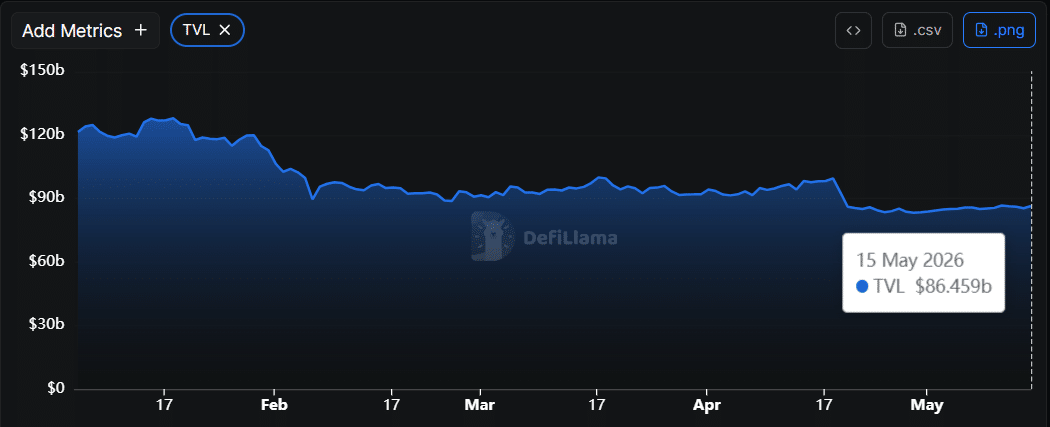
These numbers explain why regulators care. DeFi is no longer a niche curiosity.
Ethereum remains the largest DeFi chain, but its dominance is no longer absolute. As of May 2026 per DeFiLlama, Ethereum’s share of DeFi TVL has slipped to approximately 54%, down from higher levels earlier in the year as newer chains and application-specific ecosystems absorb more liquidity. DeFi risk, yield, and regulatory impact are now spread across more platforms.
Stablecoin yield: The regulatory map in full
The U.S. stablecoin yield debate has three overlapping legal frameworks in play simultaneously as of May 2026.
| Activity | Example | Regulatory Status (May 2026) | Key Detail |
|---|---|---|---|
| Stablecoin issuer paying yield directly | e.g. Circle paying USDC holders interest | Prohibited by GENIUS Act (Section 4(a)(11)) | Hard ban – no exceptions for payment stablecoin issuers |
| Exchange / platform paying yield | e.g. Coinbase rewards programme on USDC | Currently permitted – the ‘loophole’ | GENIUS Act bans issuers, not third-party platforms; banks lobbying to close this gap |
| Pooled vault with active capital allocation | Yield aggregators directing strategy + promising returns | Potential Investment Advisers Act exposure | Fact-specific: pooling + active management + return promises = investment vehicle territory |
| Protocol staking (PoS validation) | ETH staking, SOL staking, liquid staking | Explicitly NOT a securities transaction | March 2026 joint release: staking, liquid staking, and staking receipt tokens are not securities |
| Wrapping a non-security asset | wBTC, stETH | NOT a securities transaction | Joint release confirms redeemable wrapped tokens do not involve securities transactions |
| Transaction-based stablecoin rewards | Merchant cashback, payment incentives | Permitted under CLARITY draft language | Activity-linked rewards survive the CLARITY Act’s yield restriction (as of May 2026 text) |
The GENIUS Act (Signed July 18, 2025)
President Donald Trump signed the Guiding and Establishing National Innovation for U.S. Stablecoins Act into law on July 18, 2025, the first major federal crypto legislation in U.S. history. The Act establishes a licensing and regulatory framework for ‘payment stablecoins,’ defines permissible reserves (1:1 backing in U.S. dollars or short-term Treasuries), and requires monthly reserve disclosures examined by a registered public accounting firm.
The Act’s yield prohibition (Section 4(a)(11)) bans permitted payment stablecoin issuers and foreign permitted issuers from paying any form of interest or yield to the holder of a payment stablecoin solely in connection with the holding, use, or retention of that stablecoin. However, the prohibition applies to issuers, not to third-party exchanges or platforms that hold stablecoins in custody.
Exchanges can currently offer yield-style programs funded by the issuer’s marketing budget or their own revenues. Banking associations, led by the American Bankers Association, have lobbied to extend the ban to affiliates and exchanges to close this gap.
The CLARITY Act (Awaits full Senate vote)
The Digital Asset Market Clarity Act passed the House of Representatives in July 2025 with 294 votes. As of May 15, 2026, it is the Senate’s most important pending crypto legislation, now awaiting a Senate floor vote in June, with a White House target of House reconciliation before July 4, 2026. The Senate Banking Committee approved the CLARITY Act on May 14, 2026, in a 15-9 vote, sending the crypto market structure bill to the full Senate.
The bill’s most contentious provision, stablecoin yield treatment, was partially resolved by the Tillis-Alsobrooks compromise (text published May 1, 2026), which brokered a deal between banks and crypto firms that both sides described as equally unsatisfying. The remaining major obstacles as of May 15, 2026:
| Issue | Status (May 2026) | Context |
|---|---|---|
| Stablecoin yield (issuer-level) | Prohibited: issuers cannot pay interest or yield to holders | Mirrors GENIUS Act; closes issuer-level loophole |
| Idle-balance passive rewards | Banned for payment stablecoins; no passive yield on holdings | Banks lobbied hard for this restriction |
| Transaction-based rewards | Permitted: rewards tied to payments, merchant activity, or onboarding | Tillis-Alsobrooks compromise (text published May 1, 2026) |
| Ethics provision (Gillibrand) | Disputed: Senator Gillibrand demands no-crypto rules for senior officials; White House resists | Remaining major obstacle as of May 15, 2026 |
| Developer / non-custodial protection | Disputed: law-enforcement provision objected to | Still unresolved in Senate as of publication |
The White House Council of Economic Advisers published a formal analysis in April 2026 examining the GENIUS Act’s yield prohibition. The baseline model found that a full yield ban would increase bank lending by only approximately $2.1 billion, a figure the report described as negligible relative to the welfare cost imposed on consumers who would lose access to attractive yield options.
Even under worst-case assumptions, the model produced only $531 billion in additional aggregate lending (a 4.4% increase in bank loans), requiring conditions the report characterized as implausible.
How this is changing the user experience
For ordinary users, these regulatory shifts rarely show up as a headline inside an app. They show up as softer changes: a vault that once called itself ‘High-Yield’ appears as a ‘Liquidity-Optimization Module’; a stablecoin app talks about ‘rewards tied to payments’ instead of ‘passive yield’; a front-end hides certain pools from U.S. IP addresses.
The distinction between protocol and interface is becoming the real battleground. The underlying smart contracts may still be open and permissionless. But the way ordinary people interact with them is increasingly shaped by compliance, KYC gates, jurisdiction selectors, and product re-labelling. DeFi yield in the U.S. is not disappearing. It is being filtered.
This is also producing a bifurcation. One layer is open, global, and fast-moving, the permissionless DeFi that builders recognize. The other is permissioned, KYC-enabled, and increasingly aligned with traditional finance. The second layer is more likely to attract institutional capital and survive regulatory scrutiny. Neither layer is going away.
The rise of institutional-grade DeFi
Against this backdrop, 2026 is seeing the emergence of what institutional analysts are calling ‘institutional-grade DeFi,’ which includes vaults and liquidity-management tools designed for banks, asset managers, and corporate treasurers rather than retail users. Firms including Zodia Custody have published outlooks describing DeFi as moving ‘from open experiment to institutional yield rail.’
The design principles of these products are explicitly aligned with traditional finance compliance needs:
- KYC-enabled and private liquidity pools that keep borrowers and lenders within verified, permissioned networks.
- On-chain identity attestation and AML-style checks that mirror banking compliance requirements.
- Risk analytics dashboards tracking exposure, collateral, and counterparty risk in ways that resemble bank risk systems rather than DeFi dashboards.
- Tokenized Treasuries, money-market funds, and RWAs used as collateral to generate compounded yield, a structure that regulators find easier to engage with than novel crypto instruments.
In this context, the U.S. regulatory push is not only a constraint. It is also an opening. If DeFi can demonstrate yield delivery with transparency, auditability, and compliance, it becomes a logical extension of the institutional finance stack. The DTCC-Chainlink Collateral AppChain partnership, announced on May 12, 2026, which will use Chainlink’s Runtime Environment to enable 24/7 near real-time collateral management across traditional and blockchain markets, is one concrete example of this convergence.
Yet even institutional DeFi faces friction. The global regulatory map remains patchy. The U.S. GENIUS Act, the EU’s MiCA regime, and other regional frameworks create a patchwork of different standards. Platforms must build jurisdiction-specific wrappers around the same core contracts, adding cost and complexity to the ‘permissionless’ premise.
Where on-chain yield goes from here
The most likely path is not the end of DeFi yield but its transformation into something more structured. The probable outcomes:
- Permissioned vaults requiring KYC and sitting behind custodial-style interfaces will become the dominant institutional entry point into DeFi yield.
- Institution-only rails, where banks and asset managers plug into DeFi-style liquidity without direct retail exposure, will grow as a parallel market.
- Stablecoin-linked products will increasingly emphasize payments, utility, and transaction-based rewards rather than passive balance yield, in compliance with both the GENIUS Act and the CLARITY Act’s expected yield restrictions.
- Hybrid products, with DeFi rails underneath and traditional financial product branding and regulation on top, will become the bridge between the two worlds.
The regulatory outcomes in the coming months hinge on three variables: whether the CLARITY Act clears the Senate before July 4 (including whether the ethics provision is resolved), whether the White House’s CEA analysis persuades policymakers that yield restrictions impose net welfare costs, and whether institutional adoption of DeFi rails (DTCC, major custodians, RWA platforms) proceeds fast enough to give regulators a compliant ecosystem to engage with rather than a permissionless one to suppress.
Conclusion: Yield with limits, and with clarity
The 2026 U.S. regulatory environment is not the hostile crackdown some early commentary suggested. The March 2026 joint interpretive release is, in its dominant message, a clarifying and largely permissive document. Staking is not a security. Wrapping is not a security. Most tokens are not securities. The investment contract analysis applies to structure and representations, not to tokens in isolation.
The genuine tightening falls where it always should have: on products that pool money, direct strategy, and promise returns while hiding that structure behind software language. These products are, by any reasonable analysis, investment vehicles, and the SEC’s position that securities law applies to them is defensible under existing doctrine.
The stablecoin yield debate is messier and more politically charged. The GENIUS Act’s issuer-level ban has a loophole that Congress may close. The CLARITY Act’s transaction-reward compromise is real but incomplete. The White House’s own analysis suggests the consumer welfare cost of stricter yield restrictions outweighs the banking-stability benefit, a finding that may yet influence the final legislative text.
For builders and users, the central tension is no longer whether U.S. regulators will engage with DeFi yield. They already have. The more important question is whether DeFi can hold enough of its openness while adapting to rules that increasingly treat on-chain yield as a serious financial product. The answer, in 2026, is probably yes, but in a form that looks more structured, more segmented, and more regulated than the early DeFi vision imagined.
Also Read: CLARITY Act Timeline: From 15-9 Senate Win to July 4 Signing, Here Is Every Step Ahead
Disclaimer:
Some elements of this content may have been enhanced with the help of our artificial intelligence (AI) assistants for purposes such as basic refinement, review, image generation, and translation to deliver high-quality news in a shorter time frame. However, all AI-assisted content is reviewed and approved by our team to ensure accuracy, fairness, and editorial integrity.