For years, crypto enthusiasts asked for “regulatory clarity.” In July 2025, they finally got it—and it came with a catch.
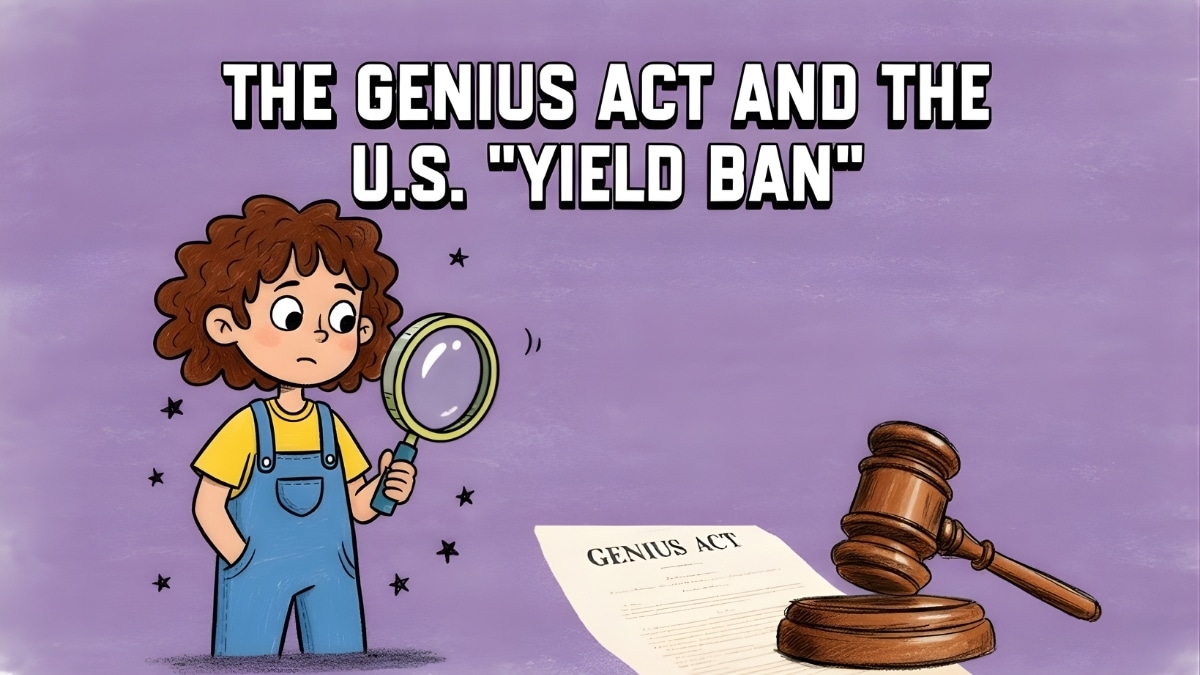
The United States passed the Guiding and Establishing National Innovation for U.S. Stablecoins Act, commonly known as the GENIUS Act. This legislation is the single most important set of rules for the digital dollar. It legitimized stablecoins as a permanent part of the financial system, but it also fundamentally changed how they work.
If you have ever wondered why your USDC or PayPal USD pays 0% interest while your savings account pays 4% or 5%, the answer lies in this specific law.
Here is a deep dive into the GENIUS Act, the controversial “Yield Ban,” and what it means for your money.
What is the GENIUS Act?
Before 2025, stablecoins existed in a legal gray area. Companies like Tether and Circle operated under state money transmitter licenses (the same licenses used by Western Union), which were never designed for billion-dollar digital banks.
The GENIUS Act changed that by creating a federal framework. It basically said: “If you want to issue a digital dollar in the U.S., you must follow following rules.act like a serious financial institution.”
The 3 Core Rules:
- 1:1 Reserves: Issuers must hold at least $1.00 in cash or short-term U.S. Treasury bills for every 1 token they issue. No risky corporate debt, no crypto collateral.
- Bankruptcy Protection: Your money must be kept separate from the company’s money. If the issuer goes bankrupt, creditors cannot touch the user reserves.
- No Algorithmic Coins: The Act effectively banned “endogenous” algorithmic stablecoins (like the failed Terra/Luna) from being marketed as payment stablecoins.
The “Yield Ban”: Why Your Stablecoin Pays 0%
The most controversial part of the GENIUS Act is the prohibition on interest. The law explicitly forbids issuers of “payment stablecoins” (like Circle or PayPal) from paying interest or yield to the end-users holding the tokens.
Why would the government do this?
To protect the banks.
Imagine if Circle could issue a digital dollar that was:
- Safer than a bank account (backed 100% by Treasuries, unlike banks which lend your money out).
- Faster than a bank account (moves globally in seconds).
- Paid 5% interest (passing on the Treasury yield to you).
If that existed, nobody would keep their money in a Wells Fargo or Chase checking account paying 0.01%. Everyone would move their deposits to stablecoins. This scenario, known as Deposit Flight, terrified the banking lobby and regulators. To save the traditional banking model, Congress simply banned stablecoins from paying interest.
The Consequence: The “Bifurcation” of Money
This law has split the crypto world into two distinct buckets.
Bucket A: Payment Coins (0% Yield)
- Examples: USDC, PYUSD.
- Status: Fully regulated under the GENIUS Act.
- Use Case: These are for spending. You use them to buy coffee, send money to friends, or trade on exchanges. They are safe, boring, and don’t grow.
Bucket B: Investment Coins & “Shadow Banks” (High Yield)
- Examples: BlackRock BUIDL, Ondo USDY, Ethena USDe.
- Status: These are technically not “payment stablecoins” under the Act. They are structured as securities or offshore synthetic dollars.
- Use Case: These are for saving. They pay 5% to 15% yield, but they are harder to use. You often can’t send them to a friend or use them to buy a pizza because they are restricted securities or unregulated offshore assets.
The Rise of the “Shadow Banks”
The unintended consequence of the GENIUS Act is that it pushed the yield-seeking market into the shadows. Because regulated U.S. companies can’t pay you interest, users are flocking to:
- Offshore Issuers: Companies outside the U.S. that ignore the ban.
- Synthetic Dollars: Protocols like Ethena that use complex trading strategies (derivatives) to generate yield, rather than just holding cash. This introduces higher risks.
Summary: What This Means for You
As a U.S. user, the GENIUS Act has made your stablecoins safer but less profitable.
- The Good: You no longer have to worry if your USDC is backed by real money. The law guarantees it.
- The Bad: You are losing money to inflation by holding them. To earn yield, you must move your funds out of “Payment Coins” and into more complex “Investment Tokens” or DeFi protocols.
The era of the “high-yield savings account on the blockchain” is over for the regulated U.S. market—replaced by a strict division between money for moving and money for growing.
Disclaimer:
Some elements of this content may have been enhanced with the help of our artificial intelligence (AI) assistants for purposes such as basic refinement, review, image generation, and translation to deliver high-quality news in a shorter time frame. However, all AI-assisted content is reviewed and approved by our team to ensure accuracy, fairness, and editorial integrity.