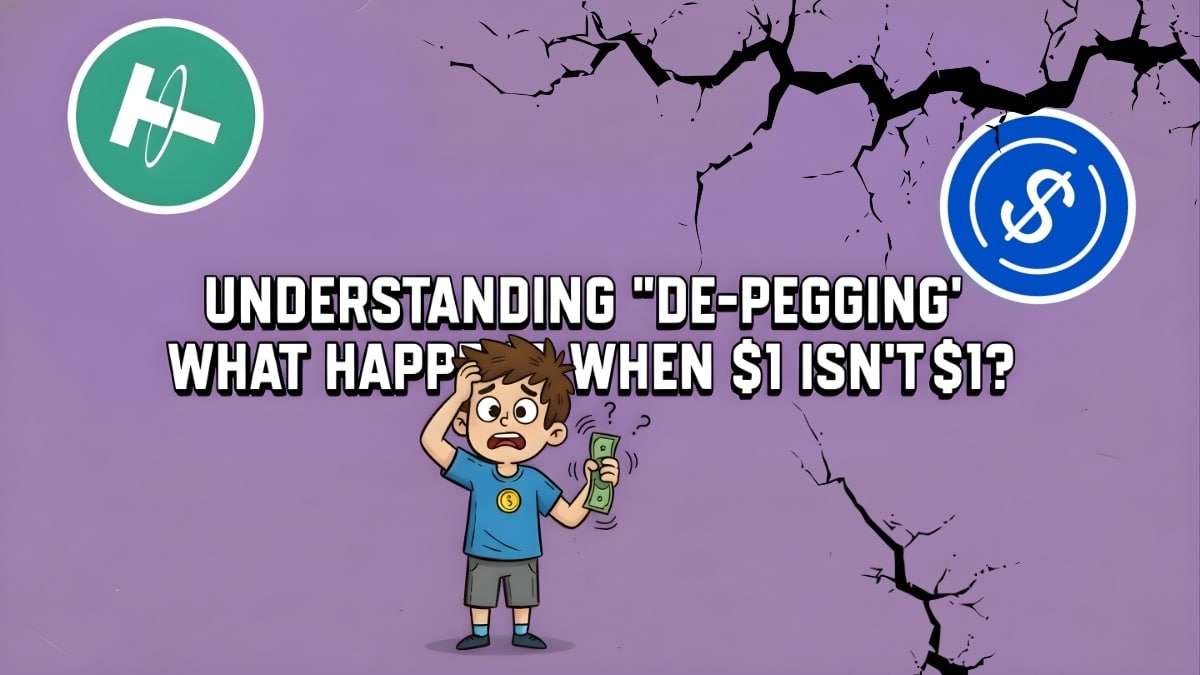
You open your crypto wallet on a Tuesday morning. You expect to see your $1,000 USDC worth exactly $1,000. Instead, you see $900. The price of your “stable” coin has dropped to $0.90.
Panic sets in. Is it a glitch? Is the company bankrupt? Should you sell now and take a $100 loss, or wait and pray it goes back up?
This phenomenon is called De-Pegging, and it is the single scariest event in the stablecoin world. While stablecoins are designed to be boring, de-pegging events are chaotic, financial hurricanes that can wipe out billions of dollars in hours.
In this guide, we will explain why stablecoins sometimes break their promise, what happened in the biggest crashes in history, and—most importantly—what you should do if it happens to you.
What is De-Pegging?
A stablecoin is “pegged” when its market price is exactly $1.00.
- Normal Fluctuation: It is normal for a stablecoin to trade at $0.999 or $1.001. This is just market noise.
- De-Peg: A de-peg happens when the price drops significantly, usually below $0.98 or $0.97, and refuses to bounce back immediately.
When a stablecoin de-pegs, it means the market has lost confidence. Traders are saying, “I don’t believe this token is worth a real dollar anymore,” and they are willing to sell it at a discount just to get out.
Why Do Stablecoins Break? (The 3 Main Causes)
Stablecoins don’t just break randomly. They break for specific reasons.
1. The “Empty Vault” (Reserve Failure)
If rumors spread that the company issuing the stablecoin doesn’t actually have the money, a Bank Run begins. Everyone rushes to redeem their tokens for cash at once. If the company runs out of cash, the stablecoin collapses.
- Analogy: Imagine a coat check at a club. You give them a coat, they give you a ticket. If you hear a rumor that the coat check guy sold half the coats and ran away, you (and everyone else) will rush to get your coat back. If there aren’t enough coats, the value of your ticket drops to zero.
2. The “Broken Machine” (Algorithmic Failure)
Algorithmic stablecoins use code to print and burn money to keep the price at $1.00. Sometimes, the math fails. If the price drops too fast, the algorithm might print too many tokens trying to fix it, causing hyperinflation. This is called a Death Spiral.
3. The “Trapped Money” (Liquidity Crisis)
Sometimes, the money is safe, but it’s stuck. This happens when reserves are held in banks that are closed or bankrupt. The money exists, but you can’t get to it right now.
Tale of Two Crises: The Good, The Bad, and The Ugly
To understand the risk, we must look at the two most famous de-pegging events in history. One survived; the other died.
The Ugly: Terra (UST) Collapse (May 2022)
- Type: Algorithmic Stablecoin.
- The Event: TerraUSD (UST) was an algorithmic coin backed by a sister token called LUNA. When UST dropped to $0.98, the algorithm started printing billions of LUNA tokens to buy back UST and push the price up.
- The Result: It didn’t work. The market panicked. The algorithm went haywire, printing trillions of LUNA tokens in days. LUNA crashed from $80 to $0.00001. UST fell from $1.00 to $0.02.
- Lesson: Algorithmic stablecoins can fail completely. If the math breaks, the money is gone forever.
The Good(ish): USDC De-Peg (March 2023)
- Type: Fiat-Backed Stablecoin.
- The Event: In March 2023, Silicon Valley Bank (SVB) collapsed. Circle (the issuer of USDC) revealed that $3.3 billion of its cash reserves were stuck in that bank.
- The Panic: Traders terrified that USDC was not fully backed sold it aggressively. The price dropped to $0.87.
- The Recovery: Over the weekend, the U.S. government announced it would guarantee the bank deposits. Circle regained access to the money. By Monday, USDC was back at $1.00.
- Lesson: Fiat-backed coins are safer. Even in a crisis, if the reserves exist, the price usually recovers.
Also Read: USDC Faces De-peg after disclosing $3.3B Deposit in SVB
Survival Guide: What To Do If Your Coin De-Pegs?
Imagine you wake up and your stablecoin is trading at $0.90. Here is your decision tree:
1. Identify the Type of Coin
- Is it Fiat-Backed (USDC, USDT)? The odds of recovery are high. These companies usually have assets to cover the hole.
- Is it Algorithmic? The risk is extreme. History shows these often go to zero.
2. Check the News (The “Why”)
- Is the money gone (stolen/lost)? -> Sell immediately. A small loss is better than a total loss.
- Is the money stuck (bank holiday/frozen)? -> Hold. If the assets are real, arbitrage traders will eventually buy the discounted coins and restore the peg.
3. Watch the “Redemption Window”
- The peg is restored when big traders can take the token to the issuer and swap it for $1.00 cash. If the issuer (like Tether or Circle) says “Redemptions are open,” the peg will heal. If they pause redemptions, panic.
Summary: How to Stay Safe
You can’t predict a de-peg, but you can prepare for it.
- Diversify: Don’t hold 100% of your savings in one stablecoin. Split it between USDC, USDT, and PYUSD. If one breaks, you don’t lose everything.
- Avoid “High Yield” Traps: If a stablecoin platform offers you 20% interest, ask yourself why. High yield often means they are taking high risks with your money (like the Terra example).
- Stick to the Giants: For beginners, the safest bets are the largest, most regulated coins (USDC, USDT, PYUSD). They have the resources to survive a crisis that would kill a smaller project.
Conclusion: $1 is usually $1, but in crypto, trust is earned. Understanding why a coin is stable helps you not panic when the market gets shaky.
Disclaimer:
Some elements of this content may have been enhanced with the help of our artificial intelligence (AI) assistants for purposes such as basic refinement, review, image generation, and translation to deliver high-quality news in a shorter time frame. However, all AI-assisted content is reviewed and approved by our team to ensure accuracy, fairness, and editorial integrity.