For years, the deal with stablecoins was simple: you get a stable digital dollar to trade or send, and the issuer (like Circle or Tether) keeps the interest earned on the money you gave them. In a low-interest-rate world, nobody cared. But when interest rates rose to 5%, that deal started to look like a rip-off.
While stablecoin holders had to find third party protocols to earn yield, the issuers themselves were enjoying profits using treasury bonds. Getting into the numbers, Tether, issuer of largest stablecoin by market share, reported $1b profit in Q4 2023, from T-Bill interest.
Why let a stablecoin company keep the profit on your money when you could earn the “risk-free” rate yourself?
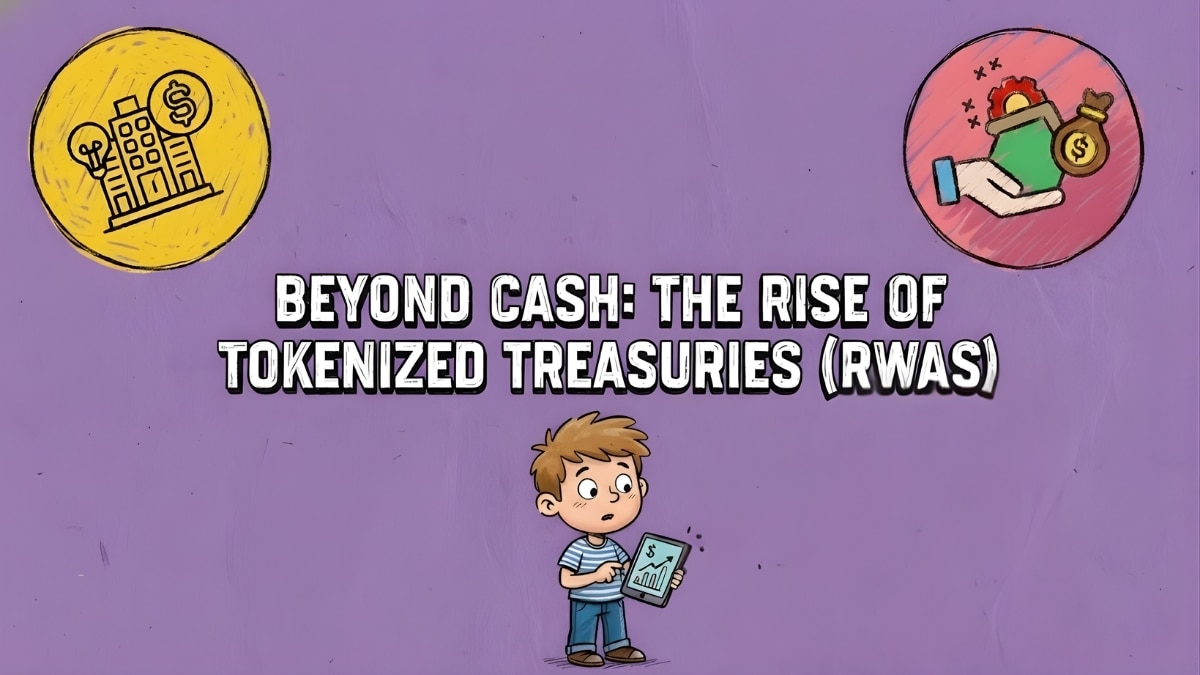
This question sparked one of the biggest trends in crypto for 2024 and 2025: Tokenized Treasuries. This sector, a subset of Real-World Assets (RWAs), is moving billions of dollars on-chain, led not by crypto startups, but by Wall Street giants like BlackRock and Franklin Templeton.
Here is your guide to the new asset class that is making “lazy money” obsolete.
What Are Tokenized Treasuries?
To understand this, we need to understand the underlying asset. Let’s take the example of the U.S. Treasury Bill (T-Bill).
A T-Bill is essentially a short-term loan you make to the U.S. government. It’s a debt security issued by the Treasury with a maturity period of 4 to 52 weeks. When you buy a T-Bill, you are essentially lending money to the U.S. government for a fixed period.
Because these securities are backed by the full faith and credit of the U.S. government, one of the most reliable borrowers in the world, they are widely considered among the safest assets in global finance. T-Bills do not pay periodic interest; instead, they are sold at a discount and mature at face value, with the difference representing the investor’s return (yield).
Tokenized Treasuries take these traditional instruments and issue them as digital tokens on a blockchain, typically Ethereum. These tokens are:
- Legally securities, not cryptocurrencies
- Fully collateralized by real T-bills
- Issued by regulated financial institutions
- Represented on-chain for settlement, transfer, and composability.
Crucially, the blockchain does not replace financial law. It replaces the settlement layer.
The difference becomes clear when comparing processes:
- Old World: You buy a T-Bill through a brokerage. It sits in a database. You can only trade it Monday to Friday, 9-5.
- New World: You buy a Tokenized T-Bill (like BUIDL or USDY). It sits in your crypto wallet. You can transfer it 24/7/365, use it as collateral in DeFi, and watch the interest accrue in real-time.
The “Lazy Money” Problem
Before tokenized treasuries, most on-chain liquidity lived in 0%-yielding stablecoins like USDT and USDC. These products are convenient and globally liquid but financially inefficient as they pay the bearer nothing in return.
Meanwhile, the issuers of those coins take your cash, buy T-Bills, earn ~5%, and keep the profit. In 2024 alone, Tether made more profit than many global banks, largely by pocketing this yield.
Tokenized Treasuries provide a new investment option that has benefits of crypto and traditional finance at the same time.
The Titans: Who is Building This?
This isn’t just a niche crypto experiment. The world’s largest asset managers are running the show.
1. BlackRock (BUIDL)
Understanding this gap, BlackRock, the world’s largest asset manager, launched the BlackRock USD Institutional Digital Liquidity Fund (BUIDL) in 2024. It is structured as a tokenized money-market fund available to institutions and qualified investors, subject to U.S. securities rules.
- How it works: BUIDL tokens are pegged to $1.00. The interest earned from the underlying T-Bills is paid out monthly as new tokens sent directly to the holder’s crypto wallet.
- The Game Changer: In late 2025, Binance (the world’s largest crypto exchange) began accepting BUIDL as collateral. This means big traders can now trade crypto while earning 5% on their idle cash, rather than earning 0% in USDT.
2. Franklin Templeton (BENJI)
Franklin Templeton was early to the party. Their OnChain U.S. Government Money Fund (FOBXX) uses the BENJI token to track ownership. It was the first U.S.-registered mutual fund to use a public blockchain to process transactions and record share ownership.
3. Ondo Finance (USDY)
While BlackRock and Franklin Templeton mostly target institutions (you need $5M+ to enter BUIDL), Ondo Finance democratized access.
- Product: USDY (US Dollar Yield).
- How it works: Ondo takes institutional-grade assets and wraps them in a token accessible to non-U.S. individuals. It offers a stablecoin-like experience but with a yield (typically around 5% APY) that accumulates by the token price increasing over time.
How Do You Actually Earn? (The Mechanism)
There are two main ways these tokens pay you:
- Rebasing (The Dividend Model): The price stays at $1.00. If you hold 1,000 tokens and the yield is 5%, at the end of the year you will have 1,050 tokens. The protocol simply “prints” your interest into your wallet. (Example: USDM by Mountain Protocol, BUIDL).
- Accumulating (The Growth Model): The number of tokens stays the same, but the price goes up. You buy 1 token at $1.00. A year later, it is worth $1.05. (Example: USDY).
The Risks: Why Isn’t Everyone Doing This?
If you can earn 5% risk-free, why hold USDT or USDC at 0%?
- It’s Not “Cash”: Legally, these are investments/securities, not cash. They are not FDIC insured (though they are backed by government debt, which is generally safer than bank deposits).
- The Liquidity Mismatch: You can trade the token 24/7, but the underlying T-Bills only trade when Wall Street is open. If everyone tries to sell their BUIDL tokens on a Sunday night during a panic, the issuer can’t sell the T-Bills until Monday morning to pay them back. This creates a “liquidity window” risk.
- KYC/Regulatory Friction: Unlike USDT, which you can send anonymously, almost all Tokenized Treasuries require KYC (Know Your Customer). You have to upload your passport and pass a background check to hold or trade them. If you are on a sanctions list, the issuer can freeze your wallet instantly.
Summary
Tokenized Treasuries are the bridge between the old financial world and the new. They are a preview of how capital markets may operate in a world where traditional assets move at internet speed
For the average user, this means the days of holding 0% stablecoins for long periods are numbered. In the future, your “savings” will live in Tokenized Treasuries (earning yield), and you will only swap into “Payment Stablecoins” (like USDC) the moment you need to spend.
Also Read: The Stablecoin Shift: How Institutions Are Diving In
Disclaimer:
Some elements of this content may have been enhanced with the help of our artificial intelligence (AI) assistants for purposes such as basic refinement, review, image generation, and translation to deliver high-quality news in a shorter time frame. However, all AI-assisted content is reviewed and approved by our team to ensure accuracy, fairness, and editorial integrity.