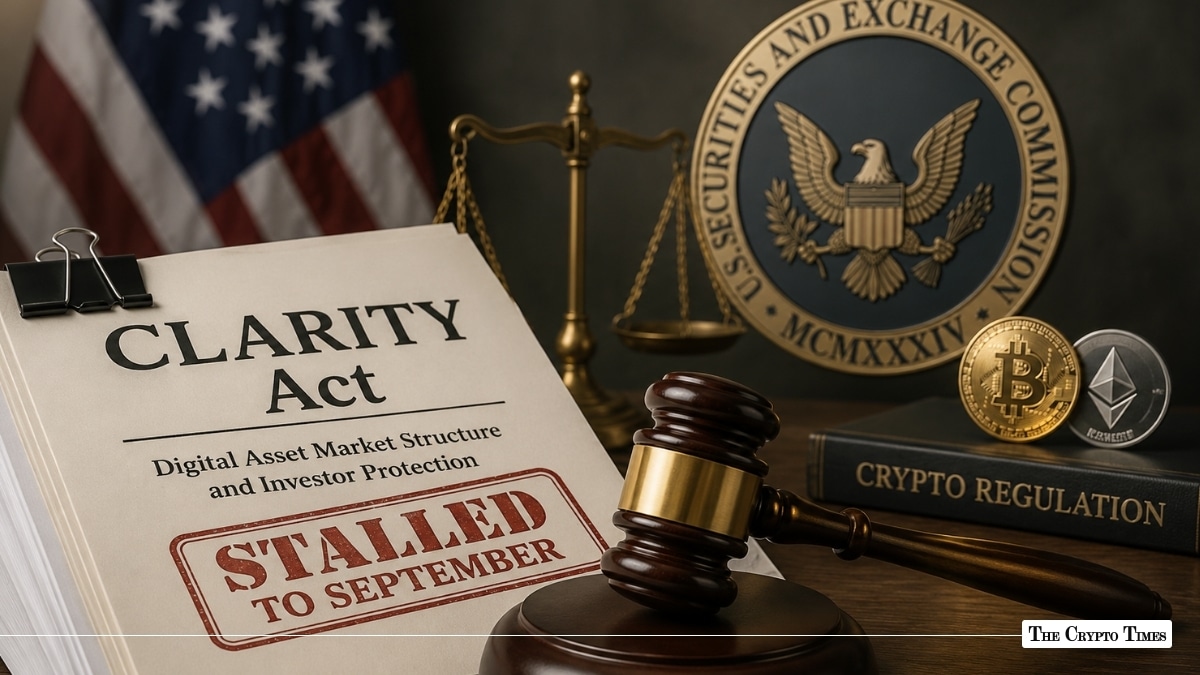
The delay of the crypto industry’s flagship bill has not paused the push for U.S. crypto rules, it has shifted the action from Congress to the regulators. Days after the Senate declined to hold a pre-recess vote on the Digital Asset Market CLARITY Act, the Securities and Exchange Commission (SEC) announced it will hold an open meeting on Friday, August 14, at 10 a.m. ET to consider proposing what its notice calls a tailored offering regime for certain investment contracts involving crypto assets. A vote at that meeting would formally begin the rulemaking process.
The move underscores a growing theme in Washington: the SEC under Chair Paul Atkins is prepared to use its existing authority to create crypto rules whether or not lawmakers pass legislation. As The Crypto Times reported, the Senate has set up a possible procedural vote on CLARITY for September 15, the day after it returns from recess, but with the bill’s path still uncertain, regulators are moving in parallel.
What the SEC Is Proposing
According to the SEC’s meeting notice, the commission will consider whether to issue a release proposing new rules to create a tailored offering regime for certain investment contracts involving crypto assets. The agency issued the notice on short notice Monday night, though the item has been on its agenda for some time.
The notice does not name the proposal, but its description lines up with the initiative the SEC has been calling Regulation Crypto Assets, one of Atkins’s top crypto priorities. As previewed by the chair earlier this year, that framework is expected to create registration exemptions and safe harbors so that early-stage and other crypto projects can raise funds without going through the SEC’s full securities-registration process. In March, Atkins outlined three pathways under the plan: a time-limited “startup exemption” for projects still building toward network maturity, a fundraising exemption, and an investment-contract safe harbor. Under those proposals, tokens could still be treated as part of an investment contract, but their offerings would be exempt from full registration under defined conditions.
The rulemaking would build on a joint interpretation the SEC and CFTC issued in March, which established a five-category token taxonomy, four of which the agencies said are not securities, and clarified when an investment contract involving a crypto asset begins and ends. A vote on Friday would open the proposal for public comment, the first formal step in a process that can take months and that may change the rule before it is finalized.
Why the Timing Matters
The meeting lands directly in the space left by Congress. The CLARITY Act, which would divide oversight of digital assets between the SEC and the CFTC, stalled in the Senate before the August recess when Majority Leader John Thune declined to schedule a cloture vote, then filed the motion in the early hours of Saturday to tee one up for September 15. Analysts have framed the SEC’s move as the first of what could be several rulemakings the agency pursues to provide regulatory certainty after the legislative delay.
That the SEC is proceeding at all marks a notable shift. Atkins and fellow Republican commissioners Hester Peirce and Mark Uyeda have repeatedly said they did not want to “front-run” Congress while the CLARITY Act was in play. With the bill’s prospects now uncertain, that calculus appears to be changing. Coinbase Chief Policy Officer Faryar Shirzad captured the industry’s read, writing that the work of bringing clear rules to digital assets “isn’t waiting on Congress” and that the administration’s financial regulators are using the authorities they already have. The SEC did not immediately respond to a request for comment.
The SEC is not moving alone. The CFTC announced that its new Innovation Advisory Committee, whose members include leaders from Coinbase, Ripple, Robinhood, Kraken, Gemini, Polymarket, Kalshi, CME and Nasdaq, will hold its inaugural meeting on August 20.
The Limits of the Regulatory Route
It is worth being clear about what agency rulemaking can and cannot do, because the two tracks are not interchangeable. A tailored offering regime from the SEC could give crypto issuers clearer, lower-friction paths to raise capital, but it operates within the bounds of existing securities law and can be challenged in court, revised by a future commission, or narrowed during the comment process. Legislation like the CLARITY Act, by contrast, would set a durable statutory framework and resolve the jurisdictional split between the SEC and CFTC in a way a single agency cannot. Atkins himself has said repeatedly that a law from Congress setting the guardrails would be preferable. In other words, the SEC’s move is a meaningful stopgap and a signal of intent, not a substitute for the market-structure bill the industry has been pursuing.
The Politics Still Hanging Over CLARITY
The legislative path, meanwhile, remains tangled in the same dispute that stalled it. According to Crypto in America, the delay set off a round of finger-pointing, Republicans blaming Democrats for refusing to compromise, Democrats blaming the White House for not negotiating a stronger ethics deal, and the White House blaming Democrats for rejecting its offer. Banks have added pressure of their own, arguing the bill’s safeguards against stablecoin-driven deposit flight are insufficient, a campaign that has reportedly given at least two Republican senators pause.
The central obstacle remains the ethics provisions tied to President Trump’s crypto dealings. A bipartisan counteroffer from Senators Thom Tillis and Ruben Gallego would give state attorneys general a role in enforcement and, require the president to divest from crypto-related interests. Trump has stated that he did not oppose placing his family’s crypto businesses in a blind trust but objected to being “singled out” by the language. Tillis, for his part, warned that the bill’s odds would “drop precipitously” as the midterm elections approach, a reminder of why regulators may be reluctant to wait.
The Bottom Line
The August 14 meeting reframes the state of U.S. crypto regulation: even with the CLARITY Act delayed, the machinery of rulemaking is moving. If the SEC votes to propose its offering regime, it would mark the most concrete step yet toward the “Regulation Crypto Assets” framework, and a signal that the agency intends to act on its own authority in the gap Congress has left. Whether that eases pressure on lawmakers or simply runs alongside them will become clearer in September, when the Senate returns, the CLARITY vote comes into view, and the two tracks of U.S. crypto policy meet. This report makes no prediction on the outcome of either.
Also Read: CLARITY Act Timeline Update: Missed August Deadline, September Window, Ethics Compromise