Kalshi and Polymarket are no longer just competing to host bets on elections, inflation, or crypto headlines. They are now racing to bring crypto perpetual futures to American traders, a move that could reshape how the US handles one of crypto’s biggest and most profitable products.
With Polymarket saying it rolled out perpetual futures on April 21 and Kalshi preparing its “Timeless” launch in New York on April 27, the fight has moved beyond prediction markets and into the core of crypto derivatives.
A new chapter for prediction markets
Prediction markets built their audience on a simple promise: trade on what will happen next. Users could buy and sell contracts tied to elections, policy outcomes, sports, or the future price of Bitcoin, and the markets would aggregate information into a live price. The model worked because it felt more useful than a poll and more immediate than traditional commentary.
Over the past year, this simple model turned into a large and fast-growing category. Dune-tracked prediction-market transactions rose past 138 million in April 2026, an all-time high that showed the sector had moved far beyond niche status. The category was already growing before the latest product launches, which is one reason the timing of this derivatives push matters so much.
But event contracts have limits. They are powerful at capturing a single outcome, yet they do not provide traders with the continuous exposure that drives high-frequency activity. A market tied to an election eventually settles and disappears. A perpetual futures contract does not. This difference is why Kalshi and Polymarket are now chasing the same prize: a product that can keep traders active every day, not just around major headlines.
This is the real shift at the heart of the story. Prediction markets are trying to become something larger than prediction markets. They are moving from being places where people express opinions on events to becoming full trading venues where users can take leveraged positions around the clock.
Why perpetual futures matter so much
Perpetual futures, or perps, are one of the most important products in crypto trading. Unlike regular futures contracts, they do not expire on a set date. Traders can stay long or short for as long as they want, provided they have enough margin to support the position.
This simple design changed crypto trading over the past several years. Traders liked perps because they were easy to understand and always available. If Bitcoin moved sharply at 2 a.m., there was no need to wait for a market open or a new contract cycle. A trader could react immediately.
The appeal is clear. A trader who wants to bet on Bitcoin rising does not need to buy the asset outright. Instead, the trader can open a long position using leverage. If the market moves in the right direction, gains are magnified. If the move goes the wrong way, losses are magnified too, and the position can be liquidated quickly.
The last part is important. Perps are popular not just because they are flexible, but because they are intense. They create more activity, more frequent repositioning, and more revenue opportunities for platforms. For exchanges, they are attractive because they generate steady engagement. For traders, they are attractive because they offer speed, leverage, and 24/7 access.
Regulatory signal that changed everything
The single biggest reason this race is happening now is regulation. In early March, CFTC Chair Michael Selig said the agency was working toward bringing “true perpetual futures” to the US within roughly a month, according to a Bloomberg report, a remark that gave the clearest public timeline yet for an onshore version of the product.
The statement landed differently because it was not simply theoretical. It was tied to a broader shift in how regulators were approaching crypto market structure. Reporting on Selig’s remarks linked the push to a joint SEC-CFTC initiative called Project Crypto, launched in late January 2026 with SEC Chair Paul Atkins to align oversight and support compliant onshore trading. The language mattered: instead of seeing perp trading as something to push out, regulators appeared to be framing it as something to supervise and formalize.
The policy change gave market operators a reason to move quickly. A product that had long been seen as offshore, aggressive, and somewhat out of reach for US venues suddenly looked like an approved growth lane. Once that happened, the race began in earnest.
This is the deeper story behind Kalshi and Polymarket. They are not just launching because the market is hot. They are launching because the regulatory tone changed enough to make the opportunity real. In a business where timing is everything, this kind of signal matters more than any teaser video or product countdown.
Polymarket moves first
Polymarket was the first to seize the moment publicly. On April 21, the company said it had introduced perpetual futures trading, allowing users to take long or short positions continuously instead of waiting for a contract to resolve. In its own words, the product lets traders “go long or short on the markets you know 24/7,” a phrase that captures what the platform is trying to do: blend the logic of prediction markets with the mechanics of crypto derivatives.
The move fits Polymarket’s reputation. The platform built its profile by moving quickly, leaning into internet-native culture, and giving traders a direct way to express views on politics, policy, and crypto. It has always felt closer to the rhythm of crypto markets than to the slower, more procedural tone of regulated financial platforms.
By launching first, Polymarket gained an obvious advantage: attention. In a market shaped by narrative almost as much as by order books, being first helps frame the story. It lets the company claim momentum and show traders that it is serious about expanding beyond event-based contracts.
Still, speed alone will not decide the outcome. Moving first is useful only if the product holds up under volume, volatility, and scrutiny. Polymarket’s challenge now is to prove that an early launch can translate into durable trust, deep liquidity, and a user experience strong enough to compete once rivals come online.
Kalshi’s “Timeless” bet
Meanwhile, Kalshi is taking a different route. The CFTC-regulated prediction market, valued at roughly $22 billion, is set to launch crypto perpetual futures on April 27 in New York under the working name “Timeless.” The brand is deliberate. A perpetual contract has no expiry date, and Kalshi appears to be using that idea as the core of its product identity.
Unlike Polymarket, Kalshi comes into this moment with a stronger regulated-US image. Its core advantage is not speed but legitimacy. For traders and institutions that want a cleaner compliance story, Kalshi may feel like the more familiar choice. Reports say the initial collateral will be US dollars, with Bitcoin and other cryptocurrencies expected at launch. This gives the platform a slightly different tone from crypto-native rivals that are more closely associated with stablecoin-based trading.
Kalshi’s strategy appears designed to attract a wider audience than just crypto veterans. The firm can sell perpetual futures as something that belongs within a broader, regulated American trading system, not just as another aggressive crypto product. This could matter in a market where trust and accessibility are as important as technical features.
The company also benefits from timing in a different way. Even though Polymarket announced first, Kalshi’s launch has been widely framed as a notable milestone precisely because it involves a US-regulated platform introducing a product that had long lived offshore. In other words, Kalshi’s importance is not only commercial. It is symbolic.
Two platforms, two models
The easiest way to understand this race is to see that Kalshi and Polymarket are not offering the same vision of the future, even if they are moving toward the same product.
| Category | Kalshi | Polymarket |
|---|---|---|
| Perps timing | Launch set for April 27 | Rolled out perps on April 21 |
| Product feel | Compliance-first, mainstream, institution-friendly | Faster, trader-focused, crypto-native |
| Initial collateral signal | US dollars at launch | Crypto-style structure and access |
| Likely early users | US retail and institutions | Active crypto traders and speculators |
This distinction matters because it shapes who shows up first. Kalshi may appeal more to users who want a platform that fits within US rules and reporting norms. Polymarket may appeal more to traders who care most about speed, market feel, and crypto-native execution. The market could support both, but the split between those audiences will determine a lot about early adoption.
Business logic behind the push
Why are these firms doing this now, beyond the regulatory shift? The answer is straightforward: perpetual futures are a better business.
Event contracts produce bursts of activity around big moments, but they do not always create repeat daily engagement. Perps do. They can support constant trading, tighter market-making loops, and a stronger reason for users to keep balances on-platform.
This matters for growth. In crypto, the most valuable trading venues tend to be the ones that become part of a trader’s routine. A user may visit an election market when a headline breaks, but a user trading perps is likely to come back several times a day. This kind of repetition deepens liquidity and makes a platform harder to replace.
It also expands the addressable market. A platform limited to event contracts is competing in a niche. A platform offering perps is stepping into the wider world of derivatives, where trading volumes, fee opportunities, and institutional relevance are all much larger.
This is why the move feels so significant. Kalshi and Polymarket are not simply adding one more product line. They are trying to change the kind of companies they are.
Data already points to a bigger market
Even before these launches, the underlying category had momentum. Prediction-market transactions rose above 138 million in April 2026, according to Dune-tracked figures. This matters because it shows users were already active at scale before continuous leveraged trading entered the picture.
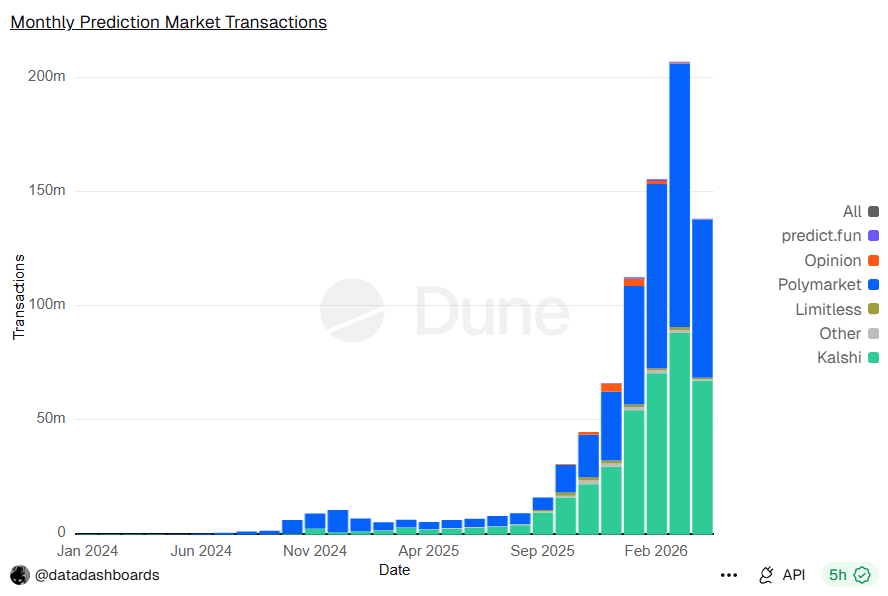
The numbers do not tell the full story by themselves, but they do show a market with enough baseline demand to support experimentation. If prediction markets were still a niche side product, the leap into perps would look premature. Instead, the opposite is true: the sector appears large enough for its biggest players to look for the next layer of growth.
This growth story also helps explain why investors and market observers are paying attention. A platform moving from episodic event contracts into always-on derivatives is not just launching a feature. It is making a claim about future market structure. It is saying that the next generation of crypto trading in the US might sit closer to prediction markets than many people expected.
What traders stand to gain
For traders, the appeal is clear. A US-based path into perpetual futures means fewer reasons to go offshore, fewer workarounds, and potentially better alignment with domestic reporting and compliance expectations. That alone could draw in a group of users who wanted access to the product but were not comfortable with the platforms that previously dominated it.
Retail users may be drawn by flexibility. Perps let them express short-term views quickly and stay active in real time. Institutional users may care more about regulated access, a clearer legal footing, and a market infrastructure that can fit within a formal compliance framework.
But there is a trade-off. The same leverage that makes perps attractive also makes them dangerous. Traders can scale exposure quickly, and losses can build just as fast. That is one reason the arrival of onshore perps may widen access while also increasing the need for clearer user education and tighter risk controls.
What happens next
The next phase of this story will be decided by market quality, not headlines. Launch announcements can generate buzz, but sustained success depends on tighter spreads, reliable uptime, strong liquidity, and evidence that users keep coming back after the first week.
The first indicators to watch are simple:
- Trading volume after launch.
- Number of active users.
- Range of assets offered.
- Spread quality during volatile periods.
- Whether institutions show up, not just retail traders.
If those numbers look healthy, the implications widen quickly. More assets could follow. Stablecoin or alternative collateral structures could deepen. Other US venues may feel pressure to launch competing products. And regulators may see the category not as a fringe corner of crypto, but as a serious test case for domestic digital-asset market structure.
If the launches struggle, the interpretation changes. A weak response would suggest that product access alone is not enough, and that users still prefer entrenched offshore venues. But right now, the momentum is leaning the other way. The product is familiar, the user base is already active, and the policy mood is more supportive than it has been in years.
The bigger meaning of Kalshi-Polymarket race
At one level, this is a straightforward competition story. Two platforms saw the same opening and rushed toward it. One moved first. The other arrives with a stronger, regulated US identity. Both want to define the next chapter of crypto trading in America.
At a deeper level, though, this is a market-structure story. It is about what happens when prediction markets stop being a niche product and start behaving like exchanges. It is about whether the US can build a credible home for one of crypto’s most important derivatives. And it is about how quickly regulatory clarity can turn a distant possibility into a live commercial race.
This is what makes this moment worth watching. Kalshi and Polymarket are not merely adding new buttons to their platforms. They are testing whether the future of US crypto derivatives could begin in a corner of the market that, until recently, many people still dismissed as a novelty.
If they are right, April 2026 may be remembered as the month prediction markets stopped looking like side bets and started looking like the front edge of the next American crypto trading stack.
Also Read: Polymarket USD, CTF V2: How Prediction Markets Turn Institutional