Crypto Times Logo Black
Google News Follow Banner
  • News
    • Market
    • Bitcoin
    • Ethereum
    • Altcoins
    • Regulations & Policies
    • DeFi News
    • Blockchain News
    • Industry
  • Exclusive
    ExclusiveShow More
    GENIUS Deadline Missed, CLARITY Act Stalls on Ethics: USA’s 2 Crypto Laws Stuck
    GENIUS Deadline Missed, CLARITY Act Stalls on Ethics: USA’s 2 Crypto Laws Stuck
    2 Years of the ₹2,000 Cr WazirX Hack: The Money Never Came Back. Neither Did the Founder
    2 Years of the ₹2,000 Cr WazirX Hack: The Money Never Came Back. Neither Did the Founder
    The Robinhood Chain Paradox Built for Tokenized Stocks, Dominated by Memecoins
    The Robinhood Chain Paradox: Built for Tokenized Stocks, Dominated by Memecoins
    Senators to Brief Trump on CLARITY Act Path - Here's What to Expect
    Senators to Brief Trump on CLARITY Act Path – Here’s What to Expect
    CLARITY Act 5 Fights Still Unresolved Before the Merged Draft Drops
    CLARITY Act: 5 Fights Still Unresolved Before the Merged Draft Drops
  • Opinion
    OpinionShow More
    The Execution Gap: Why the Next Breakthrough in Financial AI is Human Behavior
    The Execution Gap: Why the Next Breakthrough in Financial AI is Human Behavior
    The Bitcoin Treasury Blueprint What Stress Testing on Strategy Inc.’s MSTR-STRC Reveals
    The Bitcoin Treasury Blueprint: What Stress Testing on Strategy Inc.’s MSTR-STRC Reveals
    Why Wall Street is Divided Michael Saylor’s Scarcity vs. Tom Lee’s Staking Empire
    Why Wall Street is Divided: Michael Saylor’s Scarcity vs. Tom Lee’s Staking Empire
    The Arthur Hayes Paradox Macro Prophet or Market Opportunist
    The Arthur Hayes Paradox: Macro Prophet or Market Opportunist?
    RBI Denies Gold Sale Amid Oil Crisis: Could It Speed Up India's Digital Rupee Push?
    RBI Denies Gold Sale Amid Oil Crisis: Could It Speed Up India’s Digital Rupee Push?
  • Learn
    • Explained
    • How To
    • Insights
  • Videos
  • More
    • About Us
    • Our Authors
    • Contact Us
    • Editorial Policy
The Crypto TimesThe Crypto Times
  • All News
  • Market
  • Bitcoin
  • Ethereum
  • Altcoins
  • Regulations & Policies
  • Blockchain
  • DeFi
  • Industry
  • Exclusive
  • Opinion
Search
  • News
    • Market
    • Bitcoin
    • Ethereum
    • Altcoins
    • Regulations & Policies
    • Blockchain
    • DeFi
    • Industry
    • Exclusive
    • Opinion
  • Learn
    • Explained
    • How To
    • Insights
  • Quick Links
    • About Us
    • Our Authors
    • Contact Us
    • Editorial Policy
    • AI Policy
    • Sponsored & Advertorial Policy
  • Videos
  • Glossary
Follow US
© 2026 By Crypto Times. All Rights Reserved.
Industry

NIA Reveals How Crypto, Telegram & VPNs Power New Terror Strategy in India

Following nationwide NIA raids, officials say terror groups targeting India are increasingly using a "three-app model" involving social media, encrypted messaging platforms and cryptocurrency for recruitment, coordination and funding.

Written By Dishita Malvania
Published 1 hour ago
Make The Crypto Times preferred on GoogleGoogle
Share
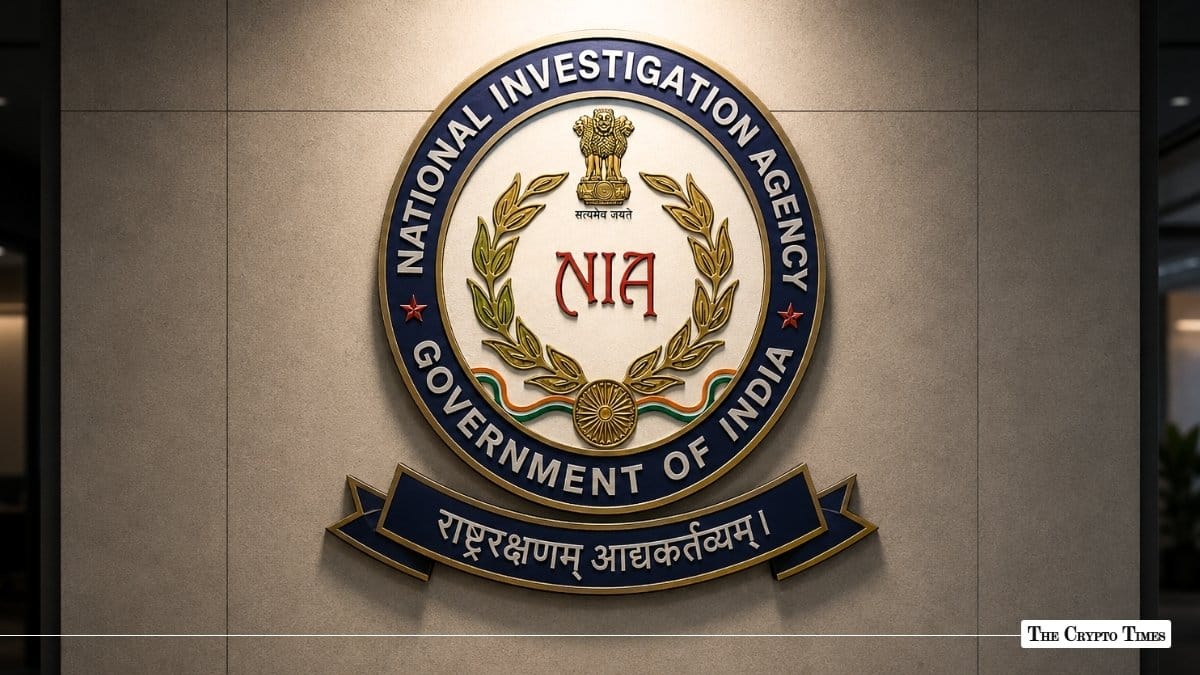
NIA Reveals How Crypto, Telegram & VPNs Power New Terror Strategy in India

Terrorist organisations targeting India are shifting the core of their recruitment, radicalisation and financing operations into the digital layer, relying on encrypted messengers, virtual private networks, anonymous social accounts and cryptocurrency to stay a step ahead of investigators. 

That assessment, from senior security officials cited by ETV Bharat, comes after a fresh round of National Investigation Agency (NIA) raids and arrests across the country.

AI Summary
Show
Terror groups are shifting operations online, using encrypted apps and crypto to evade investigators
India’s security agencies are upgrading cyber counter-terror capabilities to track dark web and encrypted channels
Crypto emerges as key funding rail for terror groups, with Indian agencies cracking down on crypto-terror financing networks

The ‘Three-App Model’ Emerging From NIA Probes

A series of NIA searches at 20 locations in July, along with recent arrests, has revealed what officials describe as a three-app pipeline of terror. In the pattern investigators are mapping, vulnerable youths are first approached on open platforms such as Instagram, then moved into encrypted spaces such as Telegram for ideological grooming and operational planning, and finally onboarded to cryptocurrency channels for funding.

Recruits are gradually added to closed Telegram groups, exposed to graded ideological material, and later handed violent extremist content, the report said. Some are then instructed to build fake identities, source weapons and, in a few instances, travel to Pakistan or Afghanistan for training under foreign handlers.

This pattern resurfaced in cases in Tamil Nadu, Vijayawada and Mangaluru, where the accused are alleged to have used WhatsApp, Telegram and Viber along with crypto rails to communicate with and radicalise recruits. Officials added that terror groups are also tapping AI-enabled tools, multi-layer virtual networks and foreign-hosted infrastructure to stay outside investigators’ reach.

Post-Pahalgam Surge and the Push Toward Anonymity

“It has come to notice that after the Pahalgam terror attack and India’s response through Operation Sindoor, terrorist organisations across the border have stepped up recruitment of youths using virtual private networks,” a senior security establishment official told the source. VPNs, encrypted channels and burner social accounts, the official said, let handlers hide identities, exploit jurisdictional gaps and push extremist content with a wider reach and a lower risk of detection.

Historically, radicalisation happened through physical gatherings and closed ideological sessions. Officials say that model has now largely migrated online, with end-to-end encrypted apps and VPNs used to plan illicit activity including recruitment into extremist networks.

Crypto Emerges as the Preferred Funding Rail

The financial leg of the pipeline is the piece that has drawn the sharpest attention from Indian agencies over the past year. The Ministry of Home Affairs’ PRAHAAR counter-terrorism strategy, released in February 2026, flagged that terror outfits are increasingly moving money through crypto wallets that skip standard AML and KYC checks.

That warning has been reinforced by a run of recent cases. In March 2026, Uttar Pradesh ATS arrested a 19-year-old dental student from Moradabad for allegedly running an ISIS-linked digital module and dealing in cryptocurrency with contacts in Pakistan, Afghanistan and Turkey using encrypted apps such as Session and Discord.

In May, the Gujarat Cyber Centre of Excellence dismantled a Rs 226 crore crypto-terror financing network, with investigators tracing suspicious flows through USDT and privacy coin Monero across Ahmedabad, Mumbai and Karnal.

In the Jaish-e-Mohammed sleeper cell case in Jaipur, Rajasthan ATS is examining whether the accused received funds via cryptocurrency while staying in touch with Pakistan-based operatives on WhatsApp and other encrypted platforms. Blockchain analytics firm TRM Labs has separately tracked hundreds of ISKP-linked transactions ranging from $100 to $15,000, most routed through Tether on the Tron network.

NIA’s Cyber Counter-Terror Upgrade

To keep pace, the NIA has expanded its cyber counter-terror stack. Its Anti-Cyber Terrorism Division (ACTD) now anchors dark web monitoring, tracking of encrypted channels, cyber threat intelligence and digital forensic work, in close coordination with the Intelligence Bureau and R&AW. State police forces, often the first responders on the ground, have been put through specialised capacity-building programmes.

Officials say the agency also maintains a running database of encrypted apps exploited by terror groups and uses DRDO-developed tools including metadata analysis, IP Detail Record (IPDR) analysis and the NETRA network traffic platform to trace suspicious digital footprints.

On the takedown side, MeitY has already blocked more than 9,845 URLs carrying radical content, with continuous cyber patrolling identifying extremist propaganda for removal. Alongside, the Financial Intelligence Unit has been asking exchanges to tighten monitoring of transactions originating from sensitive border regions, particularly private wallets and peer-to-peer transfers that bypass centralised oversight.

The July NIA action itself, at 20 locations across roughly ten states including Uttar Pradesh, Andhra Pradesh, Maharashtra, Delhi, Bihar, Rajasthan, Karnataka, Gujarat, Telangana and West Bengal, was tied to an online radicalisation case (RC-01/2026/NIA/VSKP) originally registered by Vijayawada Police, where investigators recovered material linked to banned outfits AQIS and ISIS. Eleven accused and one juvenile have been arrested in that probe so far.

For the crypto industry in India, the signal from the disclosures is consistent with what agencies have been messaging through PRAHAAR, ED enforcement and FIU-IND circulars over the past year. Compliance around KYC, on-chain monitoring for high-risk wallets and cooperation with law enforcement on trace requests is fast becoming a baseline expectation, not a differentiator.

Also Read: India’s ED Probes $35M (₹337 crore) Crypto Scam Run by Self-Styled ‘Key Opinion Leaders’


Disclaimer: The information researched and reported by The Crypto Times is for informational purposes only and is not a substitute for professional financial advice. Investing in crypto assets involves significant risk due to market volatility. Always Do Your Own Research (DYOR) and consult with a qualified Financial Advisor before making any investment decisions.

Follow The Crypto Times on Google News to Stay Updated!      Google News

TAGGED:India
Share This Article
Whatsapp Whatsapp LinkedIn Telegram Copy Link

Latest News

Coinbase CEO Brian Armstrong Says Crypto Clarity Act Is at the ‘One-Yard Line’
DeXe Token’s 90% Price Crash Sparks Rug Pull Accusations
Lummis Uses Terra’s $40B Crash to Push CLARITY Act’s Section 701
Talos Builds Institutional Plumbing for Prediction Markets in Kalshi Deal
XRP Whales Add 2.8% More Tokens As Price Moves Above $1.16

Find Us on Socials

You may also like

UN Warns Crypto Is Fueling $114B Southeast Asia Crime Economy

UN Warns Crypto Is Fueling $114B Southeast Asia Crime Economy

Crypto Industry Sues Illinois to Kill First-Ever US Digital Asset Tax

Crypto Industry Sues Illinois to Kill First-Ever US Digital Asset Tax

From a $3B Valuation to Bankruptcy Movement Labs Files Chapter 11

From a $3B Valuation to Bankruptcy: Movement Labs Files Chapter 11

Solana Co-Founder Defends AI Training on Public Online Content

Solana Co-Founder Defends AI Training on Public Online Content

The Crypto Times Logo PNG

Providing real-time, accurate Crypto reporting. Your trusted source for Crypto News and Research.

Stay Updated

All News
Exclusive
Opinions
Learn
Videos
Glossary

Company

About Us
Our Authors
Editorial Policy
AI Policy
Advertorial Policy

Get In Touch

Contact Us
Career

Find Us on Socials

X-twitter Linkedin Telegram Youtube Instagram

© 2026 The Crypto Times | A BITROCK TECHNOLOGIES L.L.C. Company.

DMCA.com Protection Status
  • Terms and Conditions
  • Disclaimer
  • Privacy Policy
  • Cookie policy
Do Not Sell or Share My Personal Information