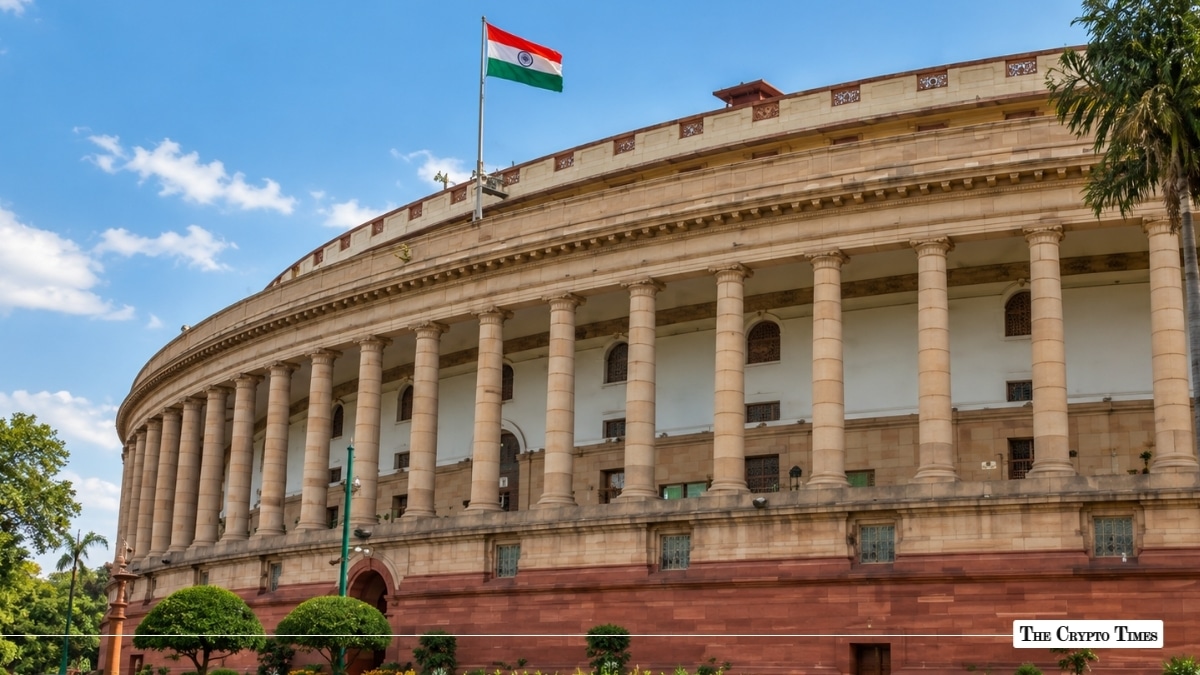
India’s Standing Committee on Finance has fixed Wednesday, 16 September 2026, for the Department of Economic Affairs (DEA) to give oral evidence on Virtual Digital Assets (VDAs), according to a Lok Sabha Secretariat notice dated 3 September 2026, reviving a hearing that had been listed and then cancelled in late August and putting the country’s long-delayed crypto framework back on the parliamentary calendar.
The sitting is scheduled for 1100 hours in Committee Room D of the Parliament House Annexe (PHA) in New Delhi, and forms part of the panel’s ongoing study titled “A Study on Virtual Digital Assets (VDAs) and Way Forward.” This is the round of evidence most closely watched by India’s crypto industry, because the DEA is the arm of the Ministry of Finance that will shape the eventual policy line the government adopts.
(Lok Sabha Standing Committee on Finance notice: sittings 9 & 16 Sept 2026 on ISI Bill 2026 and Virtual Digital Assets) Source: Sansad
The notice dated 3 September 2026, issued by the Lok Sabha Secretariat’s Standing Committee on Finance Branch under File No. LAFEAS-SCF015(11)/13/2026-SCF, is signed by Director Bharti Sanjeev Tuteja. Agenda papers will be circulated through the Members’ Portal before the sitting. Bhartruhari Mahtab chairs the committee.
Why This Sitting Carries More Weight Than Any Before It
The DEA’s appearance is a remaining piece of institutional evidence the committee has sought on record before locking in its standalone VDA report. An earlier DEA hearing fixed for 27 August on the same subject was cancelled without a fresh date, pushing the ministry’s testimony by close to three weeks and stalling a study the panel has been running since 2024-25.
The DEA is not just another witness. It is the ministry wing whose long-awaited discussion paper on VDAs has been announced, deferred, and re-deferred through multiple cycles since September 2024, most recently reported as deferred again in April 2026 amid reported opposition from the Reserve Bank of India (RBI).
Whatever DEA officials place on record on 16 September will therefore be read by the market as the closest signal it has received in years on how New Delhi intends to treat crypto.
Where India’s Crypto Stance Stands Right Now
Cryptocurrency is not banned in India, but it is not legal tender either. Under Section 115BBH of the Income Tax Act, 1961, gains from the transfer of any VDA are taxed at a flat 30%, plus applicable cess. A 1% Tax Deducted at Source (TDS) applies on specified transfers. Losses cannot be set off against any other income and cannot be carried forward. The Union Budget 2026 retained these rules unchanged.
Trading through platforms registered with the Financial Intelligence Unit-India (FIU-IND) is legal. As of mid-2026, 54 Virtual Digital Asset Service Providers (VDASPs) are registered with FIU-IND under the Prevention of Money Laundering Act (PMLA), a mix of domestic exchanges and select offshore platforms. Domestic exchanges on the list include CoinDCX, CoinSwitch, WazirX, ZebPay, and Mudrex. Offshore exchanges that have obtained FIU-IND registration include Binance, Coinbase, KuCoin, and Bybit.
Enforcement has tightened in parallel. During FY 2024-25, FIU-IND imposed aggregate penalties of about ₹28 crore on non-compliant platforms. In October 2025, show-cause notices were issued to 25 offshore exchanges operating without registration, including BingX, LBank, CoinW, CEX.IO, and Poloniex.
The Offshore Trading Problem the DEA Will Have to Answer For
The bigger anxiety inside Parliament is not what happens on registered exchanges. It is what happens outside them. Industry data cited by policy researchers indicates that as of October 2025, roughly 91.5% of Indian crypto trading volume sat on offshore platforms, with only about 8.5% remaining on registered domestic venues.
Between December 2023 and October 2024, Indian users are estimated to have traded over ₹2.63 lakh crore on offshore platforms, with an estimated ₹2,634 crore in TDS owed but not collected during that window alone.
Those estimates have featured in public debate around the committee’s study. Members have publicly and in committee proceedings raised questions about how a tax-plus-PMLA framework can hold when the bulk of the activity has already migrated to venues the framework does not effectively reach. The DEA will be pressed on this on 16 September.
The Policy Split Already on Record
The committee has already heard the two ends of the argument.
The RBI has told the panel that VDAs pose systemic risks to emerging economies and has opposed legalisation. Government documents reviewed by Reuters earlier this year confirmed that the central bank’s preferred position is a policy leaning toward prohibition, with banks and regulated financial institutions kept fully insulated from crypto exposure.
The central bank has also warned that privately issued stablecoins, whether rupee-backed or foreign-currency-backed, threaten monetary sovereignty and fiscal stability.
The Institute of Chartered Accountants of India (ICAI) has taken the opposite line, backing a comprehensive legal and accounting framework rather than continued grey-zone treatment. In its July 2026 report on the Securities Markets Code, 2025, the same finance panel recorded that VDAs fall outside that Code’s definition of securities and remain in a regulatory grey area.
It asked the government to examine a dedicated statutory framework and, until one is enacted, floated an interim route: recognised Self-Regulatory Organisations (SROs) operating under a designated regulator such as the Securities and Exchange Board of India (SEBI) or the RBI.
Adding a global dimension, Economic Affairs Secretary Ajay Seth confirmed earlier in 2026 that India is reviewing its crypto stance in light of shifting policy in other jurisdictions, particularly the more permissive direction taken by the United States under the current administration. He noted that crypto assets “don’t believe in borders” and that India’s stance cannot be unilateral. That review is one of the reasons the DEA discussion paper has kept slipping.
What Will Actually Be Decided on 16 September
Nothing legislative. The sitting is oral evidence, not a vote. But the questions the ministry answers will steer the committee’s final recommendations. Three lines of questioning are likely, based on the panel’s published work so far.
First, on the choice of regulator. Will the DEA back SEBI, the RBI, a new statutory authority, or an SRO structure as an interim bridge?
Second, on definition. Will the ministry accept the current Income Tax Act definition as the working definition, or move toward a broader classification that separates payment tokens, security tokens, and utility tokens?
Third, on offshore leakage. What operational tools will the ministry support to bring the 91.5% offshore volume back into the reporting perimeter, beyond the URL blocking and show-cause notice cycle currently in use?
The same notice schedules a separate briefing on 9 September in Committee Room B, where representatives of the Ministry of Statistics and Programme Implementation will brief members on the Indian Statistical Institute Bill, 2026. That bill is not a VDA file. It shares the same circular only because both subjects fall under the committee’s remit.
The Bottom Line for India’s Crypto Market
Until the committee finishes its VDA report, India’s crypto market remains in the same legal box it has occupied since 2022: taxed at 30% on gains, subject to 1% TDS, brought under PMLA reporting, accessible through FIU-IND registered venues, but not recognised as legal tender and not written into any dedicated statute.
No date has been announced for the tabling of the standalone VDA report. What the DEA places on record on 16 September will decide how close the country is to changing that.
Also Read: India Sets Up Darknet-Crypto Cell to Trace Drug Money Trail: Amit Shah