Leading cryptocurrencies are holding a tight range as traders wait for the last major U.S. inflation readings before the Federal Reserve’s mid-September policy meeting.
The Producer Price Index for August is due at 8:30 a.m. Eastern Time on Thursday, September 10. The Consumer Price Index and real earnings follow at the same time on Friday, September 11.
The timing is what gives the week its weight. The Federal Open Market Committee (FOMC) meets September 15–16 and will publish its rate decision and a new Summary of Economic Projections on the 16th. Those two inflation reports are the final official price snapshots most policymakers will have in hand.
Ahead of these key consumer price index data, Bitcoin, Ether, and XRP are trading in a narrow band as investors weigh whether August inflation will keep a September rate increase in play or give the Federal Reserve room to hold.
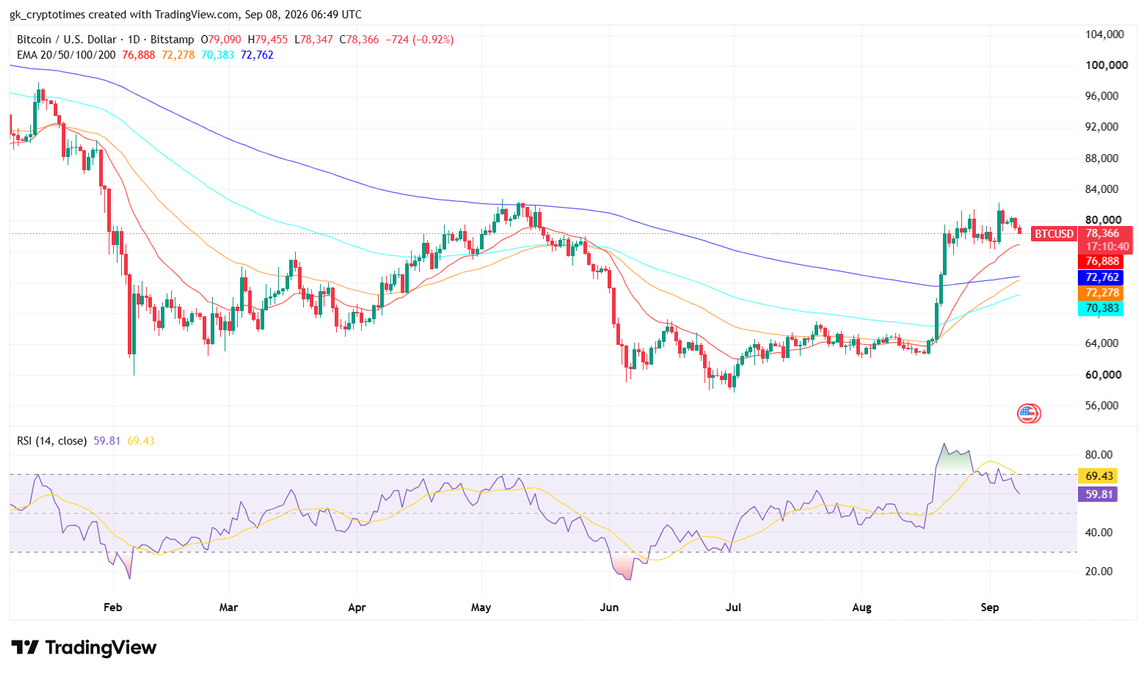
As of 6:45 AM UTC, September 8, Bitcoin was trading near $78,500, ETH hovering near $2,470, and XRP was priced at $1.39, as per aggregated market data from CoinGecko.
Why this week’s inflation reports sit in front of the Fed
The policy backdrop is already split. At its July 28–29 meeting the Committee held the federal funds target at 3½ to 3¾% on a 9–3 vote. Three members preferred a tighter setting. The next scheduled gathering is the September session.
Incoming labor data has not taken a hike off the table. The August Employment Situation showed nonfarm payrolls up 162,000, well above the 31,000 average monthly gain of the prior year, while the unemployment rate stayed at 4.1%. Average hourly earnings rose 0.3% on the month and 3.1% over the year.
Inflation is still above the Fed’s 2% longer-run goal. In July the CPI rose 0.1% on the month and 3.4% over 12 months. Core CPI, which excludes food and energy, was up 0.2% and 2.5% year over year. Energy remained the loudest headline driver, up 14.7% over the year, with gasoline up 24.6%.
Wholesale prices tell a related story. The July PPI for final demand was unchanged on the month and up 4.7% over the year. Goods prices fell 0.7% in July; services rose 0.2%. The Bureau of Labor Statistics has already scheduled the August PPI for September 10.
Governor Christopher Waller has been explicit about the sequence. In a September 3 speech he said that if disinflation continues in the data due over the following two weeks, he would be inclined to support a hold. If August inflation “comes in hot,” he said he would consider a hike. He also said his vote would be “heavily influenced by what we learn about August inflation,” because the labor report was less likely, in his view, to change the picture.
Futures markets translate that uncertainty into probabilities through Fed funds contracts. After the payrolls print, pricing implied a live chance of a 25-basis-point increase at the September meeting rather than a settled hold. That is the channel through which Thursday and Friday’s numbers can move risk assets: not the raw inflation level alone, but whether the prints reprice the path of policy, real yields, and the dollar.
How leading cryptocurrencies have traded into the data
Price action into the holiday-shortened week has been consolidation, not collapse. Bitcoin’s year-to-date (YTD) chart from TradingView shows that the largest cryptocurrency pulled back from last week’s move above $82,000 after the jobs report and has since hovered near the high-$79,000s to low-$80,000s.
Similarly, CoinGecko data shows Ether has held around $2,480–$2,515 after an August advance. XRP has stayed near $1.39–$1.42, after a late-August spike that briefly approached $1.70 before fading.
The common feature is a pause under recent local highs. As The Crypto Times reported earlier, Bitcoin failed to hold above $80,000 after Friday’s labor data lifted yields. Following BTC, Ether has not given back the bulk of its August breakout, but it has stopped extending it. XRP remains above its mid-August base near $1.00, yet it has spent several sessions inside a $1.35–$1.48 band rather than trending.
That pattern fits a market waiting for a catalyst. Crypto does not pay a yield. When expected policy rates and Treasury yields rise, the opportunity cost of holding BTC, Ether, and XRP increases and the dollar often firms.
Historically, when inflation undershoots and hike odds fall, those same assets have tended to catch a bid. Spot demand and derivatives positioning can mute or amplify the first hour, but they have not erased the rates link on weeks when the Fed’s next meeting is close and contested.
U.S. cash equity and Treasury markets were closed Monday for Labor Day, which left crypto trading through a thinner traditional-market tape. That often produces quieter Asian and European sessions and a larger reaction once New York hours and the 8:30 a.m. data window arrive.
What past inflation surprises have meant for crypto
History is clearer on surprises than on headline levels. From 2022 onward, hotter-than-expected CPI prints have more often coincided with same-day pressure on Bitcoin, because they raised the odds of tighter policy.
Cooler-than-expected prints have more often coincided with relief rallies. The size of the move has tracked how much the number changed near-term rate pricing, not whether inflation was simply “high” or “low.”
The 2022 tightening cycle remains the extreme case. As consumer prices peaked near 9% and the Committee lifted the funds rate from near zero toward 5%, Bitcoin fell from the high-$60,000s in late 2021 to the mid-teens by year’s end. That was a cycle, not a single release.
This year’s record has been mixed. Dual soft readings in mid-July helped knock a then-live July hike out of futures pricing and pushed bitcoin through $65,000 as shorts covered. A cooler mid-July CPI popped the market by several percent before much of the gain faded. The July CPI, released August 12 at 3.4% year over year and in line with forecasts, barely moved Bitcoin over the following hours. When a print is fully priced, the first reaction can be noise.
That is the relevant precedent for this week. PPI on Thursday is the first look at August wholesale prices and can start a move. Friday’s CPI, especially the core reading, is the higher-impact event because it is closer to household inflation and to the price index the Fed emphasizes in its mandate. Ether and XRP have historically swung more than bitcoin in both directions on those mornings.
None of that makes the outcome certain. An in-line core print may leave the $80,000 bitcoin area and the ether and XRP ranges intact into next week’s FOMC. A clear hot surprise would likely lift front-end yields and test those ranges. A clear soft surprise would likely do the opposite. The data, not the calendar itself, will decide which path the three tokens take.
Also read: XRP Price Prediction September 2026: Can XRP Break $1.50?