Key Highlights
- Big global pitch, weak local pull: The RBI is pushing CBDC integration across BRICS, but India’s own banks and users haven’t shown real interest in the digital rupee.
- A rise, then a reality check: Digital rupee transactions briefly crossed 1 million a day before falling sharply—highlighting forced adoption, not organic demand.
- Tax clarity, policy vacuum: Over 44,000 tax notices have been sent, but India’s long-promised crypto framework remains stalled, leaving the industry in limbo.
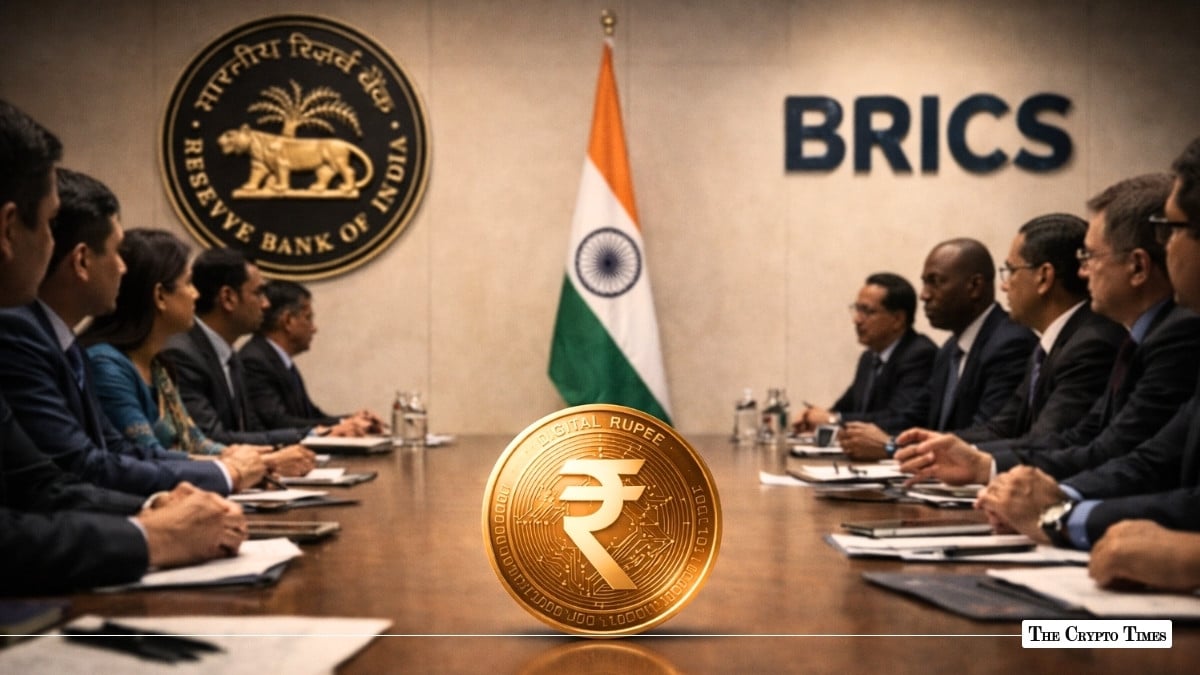
There is something almost poetic about the Reserve Bank of India’s (RBI) latest ambition. The same institution that cannot get its own banks to seriously use the digital rupee at home now wants to link it with the central bank digital currencies of Brazil, Russia, China, South Africa, and the rest of the BRICS bloc. The pitch sounds bold on paper. The reality on the ground tells a very different story.
According to a Reuters report from January, the RBI has quietly recommended to the Indian government that the linking of BRICS central bank digital currencies be placed on the agenda of the 2026 BRICS summit, which India will host later this year. The idea is to use sovereign digital currencies to settle cross-border trade and tourism payments, cut transaction costs, and reduce the bloc’s dependence on the US dollar.
India took over the BRICS presidency on January 1, 2026, and the central bank clearly wants to use that chair to push its own rails.
Before we get into why this is a strange flex for the RBI, let’s understand what BRICS even is and why the central bank thinks it matters.
Also Read: India’s RBI Suggests Linking BRICS CBDCs for Payments
What is BRICS, and why is the RBI obsessed with it
BRICS started in 2009 as a loose grouping of Brazil, Russia, India, China, and South Africa. The original idea was simple. These were large emerging economies that felt the global financial system, dominated by the US dollar and Western institutions like the International Monetary Fund (IMF) and World Bank, did not represent them.
Over the years, the bloc has expanded to include Egypt, Ethiopia, Iran, the UAE, and Indonesia, with more countries lining up to join.
BRICS is not the G20, which is a much wider economic forum that includes the US, the EU, the UK, Japan, and most major economies. The G20 is where global financial standards get coordinated. BRICS is something different. It is increasingly becoming the place where countries that feel squeezed by Western financial dominance try to build alternatives.
A BRICS bank exists. A BRICS payment task force exists. A BRICS cross-border payments initiative was endorsed at the 2025 Rio summit. And now, if the RBI gets its way, a BRICS CBDC linkage could be the next big experiment.
The timing is not accidental. US President Donald Trump has repeatedly called BRICS “anti-American” and threatened 100% tariffs on member nations that try to bypass the dollar. The RBI insists its CBDC plan is not about de-dollarization, but everyone knows what is actually being discussed in those rooms.
The awkward part: Nobody at home is using the e-rupee
Here is where the story gets uncomfortable for the RBI. The digital rupee, or e-rupee, was launched in December 2022. Three and a half years later, the project has about 7 million retail users. For context, UPI processes more transactions in a single afternoon than the e-rupee has seen in its entire lifetime.
By December 2023, after the RBI told banks to push the e-rupee aggressively, daily transactions briefly crossed 1 million. Banks were paying parts of employee salaries in CBDC just to hit the number. But by mid-2024, daily retail CBDC transactions had crashed to roughly 100,000, according to a Reuters report citing internal data.
The wholesale digital rupee, designed for interbank settlements, has been even quieter, with circulation falling to a tiny fraction of where it began.
The reason is obvious to anyone who has used UPI. It is free. It is instant. And it easily works on every phone. So why would a merchant or a customer switch to a parallel system that does the same thing, only with fewer wallets, fewer apps, and zero incentive? Even the banks that the RBI is leaning on are not interested.
CBDC wallets are still not available through PhonePe or Google Pay, the two apps that actually run India’s digital payments. Banks did the bare minimum to comply with RBI directions and then quietly moved on.
This is the central problem the BRICS proposal walks straight into. The RBI is trying to export a product that its own ecosystem has not adopted.
Four years of conflicting signals
To understand how India ended up here, you have to look at the years of contradictory messaging from the people running this policy. The statements speak for themselves.
Let’s start with India’s Finance Minister Nirmala Sitharaman; she introduced the 30% tax on virtual digital assets in the Union Budget 2022. Speaking in the Lok Sabha on February 1, 2022, she said, “There has been a phenomenal increase in transactions in virtual digital assets. The magnitude and frequency of these transactions have made it imperative to provide for a specific tax regime. Accordingly, for the taxation of virtual digital assets, I propose to provide that any income from transfer of any virtual digital asset shall be taxed at the rate of 30 percent.”
The same day, at her post-Budget press conference, she added, “Currency rests only with the RBI, everything else is crypto assets and will see 30% tax.” That one sentence has shaped Indian crypto policy for four years.
Asked at the same press conference how the government could tax crypto without a regulatory framework, she said, “We are collecting inputs on regulation for crypto assets. I don’t wait till regulation comes in for taxing people who are making profits.” The honesty was refreshing. It also told you exactly where this was going. Tax first, regulate maybe never.
Fast forward to October 2025, while speaking at the Kautilya Economic Conclave, Sitharaman had a softer tone on stablecoins. “Innovations like stablecoins are transforming the landscape of money and capital flows. These shifts may force nations to make binary choices: adapt to new monetary architectures or risk exclusion,” she said. It was the first time a senior Indian official publicly acknowledged that ignoring stablecoins might cost the country.
Then comes the RBI side, and this is where the contradictions get loud.
Former RBI Governor Shaktikanta Das was the central bank’s most aggressive crypto critic. He repeatedly compared crypto trading to gambling and pushed for an outright ban, arguing it could destabilize monetary policy and create a parallel unregulated financial system. His successor, Sanjay Malhotra, has carried the same position, albeit with slightly less aggression.
At his post-monetary policy press conference on June 6, 2025, Malhotra said, “There is no new development as far as crypto is concerned. A committee of the government is looking after this. Of course, as you are aware, we are concerned about crypto because that can hamper financial stability and monetary policy.” That statement was made at the RBI’s own MPC briefing in Mumbai and is on the record.
In November 2025, speaking at the Delhi School of Economics during a memorial lecture, Malhotra was even clearer. “Stablecoins, cryptos, they have a huge risk and so we are adopting a very cautious approach towards it,” he said, before contrasting this with the central bank’s enthusiasm for state-backed innovation.
“When it comes to digital innovations like UPI or digital lending, our stance has been very accommodative and very enabling.” The message was simple. State-built equals safe. Anything private equals dangerous.
Then there is Deputy Governor T. Rabi Sankar, who has been the RBI’s loudest voice on the topic for years. At the Mint Annual BFSI Conclave 2025 on December 1, Sankar said, “Cryptocurrencies have no intrinsic value. They are not backed by a promise to pay, and they have no issuer.” He went on to call crypto trading a “pure gamble based on mathematical bets” and compared it to the 17th-century tulip mania.
On stablecoins, his words were even sharper. He warned that they raise “significant concerns for monetary stability, fiscal policy, banking intermediation and systemic resilience.” That line has since been repeated almost word for word in the RBI’s December 2025 Financial Stability Report, which urged that countries “should prioritize central bank digital currencies over privately issued stablecoins to maintain trust in money, preserve financial stability and design next generation payments infrastructure that is faster, cheaper and secure.”
At the IMF and World Bank annual meetings in Washington in October 2025, Malhotra made the case for CBDCs to the global central banking community. “Unless other countries also adopt CBDC, we are not going to see the benefits of CBDC insofar as cross-border payments are concerned. So, I would urge all those present from central banks and other jurisdictions that we need to promote the CBDC, because this has huge advantages over stablecoins,” he said.
He also added, “We believe in India it is the CBDC and not crypto, because [crypto] has huge implications for monetary policy, for controls on the capital account, and for money laundering. We would rather promote CBDC than any other form of crypto, because CBDC has all the advantages.”
That is the entire BRICS pitch in one paragraph. The RBI is trying to convince other central banks of something Indian banks themselves have not bought into.
The discussion paper that refuses to arrive
While all this was happening, the one document that could actually bring some clarity to India’s crypto industry has been quietly killed for at least the fifth time this month. The long-promised crypto policy discussion paper has been shelved again. The reason, as always, is the RBI.
The paper has been pending since 2023. It was supposed to lay out India’s regulatory thinking on crypto, invite public comments, and finally give the industry some basis on which to plan. It was promised in 2024. It was promised in June 2025. It was promised again later that year. Each time, it was pushed back. A government source said, “There are differences of opinion in the group. The RBI is clear on the risks, while other agencies are more open to exploring segmented regulation.”
In September 2025, Reuters reported, citing an internal government document, that India was actively leaning against introducing comprehensive crypto legislation because doing so could grant the sector “legitimacy” and risk it becoming “systemic.”
That line came directly from the RBI’s playbook. The same document noted that Indians held about 4.5 billion dollars in digital assets but said the exposure was not yet systemic. Now, as of April 2026, the paper is back in cold storage. No timeline. No commitment. Just a blank space where a regulatory framework should be.
The Finance Ministry and SEBI have both signalled openness to a more structured approach. The Economic Survey 2025 to 2026 hinted at possible regulatory backing for stablecoins. SEBI has reportedly proposed a multi-regulator model. None of it matters as long as the RBI has a veto.
And yet, the tax net keeps expanding
This is the part that should make every Indian crypto investor pay attention. While there is no regulation, there is plenty of taxation. The 30% flat tax on crypto gains and the 1% TDS on every transaction, both introduced in 2022, remain unchanged. The Union Budget 2026, presented by Sitharaman on February 1, did not offer any relief.
What it did add was new penalties. From April 1, 2026, reporting entities that fail to file crypto transaction statements under Section 509 of the Income Tax Act face a penalty of ₹200 per day for as long as the default continues. Incorrect reporting attracts a flat ₹50,000 penalty.
The Finance Bill 2025 also expanded the definition of Virtual Digital Assets from April 1 to include any crypto-asset that relies on a cryptographically secured distributed ledger or similar technology, bringing India in line with the OECD’s Crypto Asset Reporting Framework.
The Income Tax Department has already identified undisclosed crypto holdings worth ₹888.82 crore and sent more than 44,000 notices to taxpayers flagged for non-disclosure. Total onshore crypto tax collection between 2022 and 2025 has been roughly ₹437 crore, a number that suggests most of India’s actual crypto trading has already moved offshore.
Industry estimates put the share of Indian crypto trading volume that has migrated to foreign exchanges at around 72%. The tax meant to track the industry has effectively pushed it out of regulatory sight.
The traditional market angle
It is worth pointing out that the BRICS CBDC proposal is not happening in a vacuum. The Indian rupee has been under serious pressure. It has depreciated steadily against the US dollar through 2025 and into 2026, prompting the RBI to intervene heavily in the forex market. Foreign investors have been pulling money out of Indian equities and bonds.
This is the macro backdrop against which the BRICS plan makes sense. If you are worried about dollar strength and tariff pressure from Washington, building an alternative settlement rail with friendly central banks looks attractive. If you can convince Brazil, China, and Russia to settle bilateral trade in linked CBDCs, you reduce your need to hold dollars and your exposure to dollar-denominated payment systems. The strategic logic is real.
The execution logic is where it falls apart.
Why this matters for crypto
Step back and look at the picture. The RBI wants the world to believe that CBDCs are the answer to cross-border payments and that private crypto and stablecoins are dangerous. But the evidence does not support that confidence. India’s own retail CBDC has stagnated at around 7 million users. Wholesale CBDC adoption is even worse. None of the BRICS members has launched their CBDCs at full scale.
China, which runs the most advanced CBDC programme in the world, processes most of its cross-border CBDC volume through the mBridge project in a way that the rest of the BRICS bloc has not been able to replicate. Brazil, Russia, and South Africa are still at the pilot stage.
Meanwhile, the very thing the RBI is trying to keep out of India is the thing solving the cross-border payment problem everywhere else. Stablecoins moved trillions of dollars across borders in 2025. They settle in seconds. They cost almost nothing. They work without the permission of any central bank. But they are not perfect, and the RBI is not entirely wrong about the risks they pose to monetary sovereignty.
And pretending that a CBDC linkage between five large economies, none of which have figured out their own CBDCs, will somehow leapfrog the stablecoin economy is a stretch.
The contradiction sits at the heart of every Indian government statement on this topic. Sitharaman acknowledges that stablecoins are reshaping global money and that countries that ignore them risk exclusion. The RBI insists that the same stablecoins are a systemic threat. The Finance Ministry has been quietly working on a discussion paper for two years. The RBI has blocked its release five times. The government taxes crypto at one of the highest rates in the world. It refuses to give the industry a single page of regulatory clarity.
And in the middle of all this, the same central bank that cannot get its own banks to push the e-rupee at home is going to walk into the BRICS summit later this year and ask Brazil, Russia, China, and South Africa to plug their CBDCs into India’s. It is a confident pitch from an institution whose own product has barely moved in three years.
The bottom line
There is nothing wrong with India having CBDC ambitions. There is nothing wrong with using the BRICS chair to push for cheaper, faster cross-border payments. There is nothing wrong with the RBI being cautious about private crypto. The problem is that all three of these positions cannot survive the same reality test.
If CBDCs are the future, the RBI needs to explain why its own version has not taken off. If stablecoins are too dangerous to regulate, the Finance Minister needs to explain why she herself called them a force that is reshaping global money. If the discussion paper has been ready for two years, the government needs to explain why it has been blocked five times.
And if the BRICS plan is really about making cross-border payments cheaper for ordinary Indians and businesses, then someone needs to explain how that works when none of the participating countries have a working retail CBDC at scale.
India’s crypto industry has been living in this fog for four years. Twelve crore Indians hold some form of digital asset. The country ranks first in grassroots crypto adoption, year after year, on Chainalysis’s global index. ETH DevCon is coming to Mumbai this November. The developers and users are here. The capital is here. The only thing missing is a government willing to say something definitive.
Until then, the RBI will keep making the case for the digital rupee abroad, the discussion paper will keep gathering dust, the Finance Ministry will keep collecting tax, and millions of Indians will keep trading on offshore exchanges that the regulator pretends do not exist. The BRICS pitch is a great headline. It is also a perfect mirror for everything that is wrong with how India thinks about money in 2026.
The world is moving. India is taxing. The RBI is talking. And the digital rupee is still waiting for someone to actually use it.