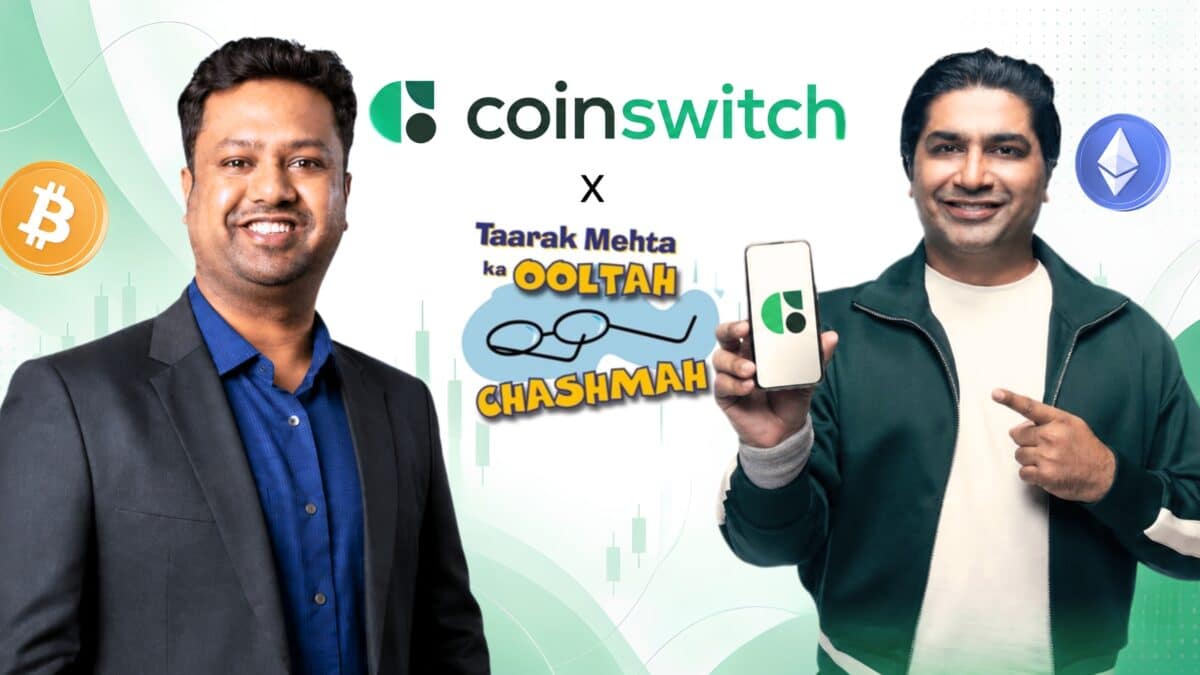
On May 17, 2026, CoinSwitch went on-air during Episode 4721 of Taarak Mehta Ka Ooltah Chashmah (TMKOC) on Sony SAB, becoming the first crypto exchange in India to secure a brand integration with the country’s longest-running family sitcom. This is a show that has been airing since July 2008 and functions less as television and more as a household ritual.
CoinSwitch called it a move towards “mainstream awareness and trust.” The media industry called it a bold cultural play.
But anyone who watched the episode would have noticed what it did not contain: an explanation of what cryptocurrency is, a walkthrough of the risks, or a disclaimer about the regulatory vacuum that still surrounds this asset class in India.
What appeared on screen was the app being promoted, the message that one can invest with just ₹100, and a character signalling willingness to start — a cue typically designed to nudge viewers towards doing the same.
Whether that constitutes education or advertisement is a distinction worth examining. It is also a distinction that matters most to the people it was aimed at: Indian families watching television after dinner, many of whom may have never encountered cryptocurrency before.
The Gujarat blueprint and the Malhar Thakar connection
This move did not come out of nowhere. CoinSwitch has been building in Gujarat for over a year.
In January 2026, the company announced a partnership with Malhar Thakar, one of the biggest names in Gujarati cinema. Within this state, Chhello Divas (2015) was a phenomenon, Love Ni Bhavai (2017) ran for over 100 days, and Thakar carries credibility that spans youth and family audiences alike. He also holds a connection with TMKOC, having appeared in an episode in 2013, long before his film career took off.
The campaign, titled “Navi Peedhi Ni Navi Reet,” was directed by Viral Shah and positioned CoinSwitch as a platform where crypto investments start at ₹100. In February 2026, CoinSwitch held its Partner Conclave in Ahmedabad with Thakar present. Traders Connect events covered Ahmedabad, Surat, Rajkot, and Vadodara, alongside national stops in Bangalore, Delhi, Mumbai, and other cities.
On being asked about why Gujarat is a specific focus area, Ashish Singhal, Co-Founder of CoinSwitch, told The Crypto Times: “Gujarat stands out because the culture of investing and entrepreneurship there is genuinely different. Financially active retail investors, strong awareness of markets, and real curiosity around newer asset classes. That combination does not exist in every state at the same level.”
Regarding choosing Thakar over a national celebrity, he said: “Malhar was a very deliberate call. Gujarat is a market that engages seriously with financial products and when the goal is to reach that audience in a meaningful way, cultural fit matters far more than reach numbers. A face the community genuinely trusts lands very differently from a national name with no real local connection.”
The data supports Gujarat’s significance. CoinSwitch’s 2025 year-end report showed Layer-1 assets dominating state preferences at 38.42%, Bitcoin leading as the most traded asset, and women accounting for 30.7% of Gujarat’s crypto investors.
In December 2024, the company’s “How India Invests in Crypto” report revealed that Botad, a small agricultural city in Saurashtra, ranked 10th nationally among crypto investor cities — ahead of Ahmedabad, Surat, and Rajkot. Business Standard reported the same finding, and The Crypto Times confirmed it through a ground-level report, finding an estimated 3.8 lakh largely young, first-time investors.
The connecting thread is hard to miss. Malhar Thakar is Gujarati. TMKOC is set in a Gujarati society based on Tarak Mehta’s (also a Gujarati) column “Duniya Ne Undha Chashmah.” CoinSwitch’s conclave launched in Ahmedabad. But while the show is culturally Gujarati, its audience is pan-Indian — making it a gateway to the entire Hindi-belt middle class.
As a marketing strategy, the architecture is very carefully built. What was delivered through it, on the screen that mattered most, is something each viewer and reader can assess.
What Appeared on Screen, and What Did Not
TMKOC is watched by children, grandparents, homemakers, and small business owners. Characters like Jethalal are cultural reference points. When a product is endorsed inside Gokuldham Society, it carries implicit trust — the audience processes it not as a banner ad but as a recommendation from someone they know.
In that context, the integration promoted the app, told viewers they could invest ₹100, and featured a character expressing willingness to start. What it did not include: an explanation of crypto itself, the flat 30% tax on gains with no loss offset, the 1% TDS on every transaction, the absence of a comprehensive regulatory framework, or the fact that the RBI has historically been skeptical of the asset class. It would be unreasonable to expect a sitcom placement to function as a financial literacy seminar.
But when a platform places itself inside arguably the most trusted entertainment space in Indian households, the question of what the audience received alongside the invitation is one that naturally follows.
There are related questions that have received little scrutiny. There is no public data on what percentage of TMKOC’s audience has prior crypto awareness. CoinSwitch’s own survey, cited by Singhal, found 88% of its users knew about India’s crypto tax framework — but that surveys existing users, not the millions of TMKOC viewers who have never engaged with crypto.
There is no public information on whether the TMKOC actors involved personally invest in crypto — the same information gap that existed when CoinSwitch onboarded Ranveer Singh in 2021, and CoinDCX roped in Amitabh Bachchan, both Bollywood superstars.
And the question of who benefits is worth laying out: CoinSwitch gains registrations, the production gains revenue, the actors gain fees. The viewer gains an invitation to invest. Had the integration included even basic information about what crypto is and what the risks are, the value exchange would look different.
What Singhal said, and the questions that remain
When The Crypto Times asked Singhal directly about education versus sign-ups, he said: “It is a fair question, and one we take seriously. In a sector like crypto, campaigns should absolutely be evaluated on whether they are encouraging informed participation rather than just driving sign-ups.”
He insisted: “The objective is to simplify conversations around crypto, answer user questions, and make the ecosystem easier to understand for everyday investors. Once people understand an asset class better, participation naturally follows, but direct onboarding has never been the core message of our campaigns.” He added, “In a volatile and evolving asset class like crypto, long-term trust matters far more than short-term acquisition.”
To CoinSwitch’s credit, the platform’s compliance infrastructure is comparatively above the industry baseline. It is registered with FIU-IND, wasthe first Indian exchange to publish proof of reserves in November 2022, has since published five editions confirmed by Business Today, holds ISO/IEC 27001:2022 certification, and reinvests 8–12% of annual revenue into security.
Singhal himself acknowledged the industry’s structural gap: “Currently, security standards across crypto exchanges are largely self-driven. Some platforms have the ability to invest deeply in security infrastructure, while others may not. That’s why the industry needs stronger baseline standards and frameworks that every platform should follow to better safeguard users.”
But there is a gap between stated intent and on-screen execution. The compliance infrastructure exists behind a door that the TMKOC integration does not open. The viewer sees an app and a ₹100 entry point. The presence or absence of educational framing alongside that invitation is something readers can evaluate for themselves.
₹100 to start, 100x to bet: What happens after the download
CoinSwitch positions itself as a platform where anyone can begin investing with as little as ₹100. The messaging throughout its campaigns has consistently emphasized accessibility and ease of entry, presenting crypto as something simple enough for everyday participation. But that simplicity does not stop at spot investing.
CoinSwitch PRO also offers crypto futures trading with leverage of up to 100x. The platform’s Google Play Store listing states: “Trade Crypto futures with 100x Leverage effortlessly in USDT & INR.”
At 100x leverage, a ₹1,000 deposit can control a ₹1,00,000 position. A 1% move against the trade is enough to wipe out the entire margin. CoinSwitch’s own educational material acknowledges this reality, noting that “the thinner your margin, the closer you stand to liquidation. That’s the trade-off professionals understand well.” The operative phrase there is “professionals.”
And that raises an obvious question: how many first-time users brought in through a TMKOC integration or a ₹100 entry-point campaign would realistically understand concepts like leverage, liquidation, margin requirements, or rapid capital loss before encountering them inside the app ecosystem?
In traditional financial markets, SEBI requires suitability assessments before retail investors are allowed access to certain derivatives products. Globally, major crypto exchanges have introduced additional friction around leveraged trading.
Binance, for instance, requires users to clear a mandatory futures quiz covering liquidation, margin, and maximum loss before access is granted, while also capping leverage at 20x for the first 60 days.
CoinSwitch does publish educational blogs around futures trading and provides a riskometer. But there is a meaningful distinction between information that users actively seek out and messaging that reaches them passively through mass entertainment. Educational blogs are a pull model. TMKOC is a push model. One requires intent from the user; the other enters millions of households unprompted.
That contrast matters. On one end, viewers are introduced to crypto through the language of accessibility and low entry barriers. On the other, the same platform ecosystem contains highly volatile leveraged products capable of liquidating positions within minutes.
India currently has no comprehensive framework governing leverage limits in crypto derivatives, no SEBI-equivalent oversight for crypto futures platforms, no mandatory suitability testing, and no industry-wide cooling-off period for new retail users. In practice, the safeguards are largely determined by the platforms themselves.
These are not allegations. They are structural realities of the current ecosystem, and they form an important part of the broader conversation around how crypto is being introduced to mass-market Indian audiences.
The real test
Singhal drew a parallel to earlier technology cycles: “During the Web 2.0 phase, many people underestimated the internet in its early days and later realized how big a shift it actually was. Crypto is now entering a similar phase with Web 3.0, where financial systems and ownership models are getting redefined.”
He pointed to Morgan Stanley’s shift: “Morgan Stanley in 2017 declared the value of BTC to be zero, but today, it has launched services in crypto, including major public banks, that shows the demand and adoption scale.”
He left us with: “Every new asset class has gone through this journey, equities and mutual funds included, before becoming mainstream in India.”
He may be right. And if that journey is any guide, the institutions that won long-term trust invested as heavily in investor education as in customer acquisition. AMFI’s “Mutual Funds Sahi Hai” campaign, launched in 2017 under SEBI’s guidance, did not tell people to download an app. It explained what a mutual fund is, how SIPs work, and why diversification matters. It ran for years before the industry saw mass adoption.
The parallel between the internet and crypto also carries a difference readers should weigh: using the early internet did not risk losing money in an unregulated market taxed at 30%.
The point of this piece is not to assign blame but to place facts, gaps, and questions in front of readers. CoinSwitch has the reach, the cultural entry points, and now primetime family television. The claim accompanying this campaign is education. The content that appeared on screen is available for anyone to watch. The gap between the two, if one exists, is for each reader to assess.
The first-timer in Botad or Vadodara who watches TMKOC after dinner is the person this integration reached. What that person received, and what they might have actually needed instead, is a conversation worth having openly.
The living room has been entered. What happens next is worth watching closely.
Also Read: CoinSwitch Posts ₹613 Cr Reserve Cushion Amid Crypto Recovery