Bitcoin gave traders almost nothing to work with this week. BTC slipped from an intraday high near $63,874 to around $61,500 on Monday, weighed down by Strategy’s sale disclosure and the risk-off jolt after the US-Iran memorandum was declared over at the NATO summit, then clawed its way back to close Friday’s equity session near $64,015.
BlackRock buying $250 million in Bitcoin after two weeks of selling, and Glassnode data pointing to a bottom building as ETF demand slowly returns, kept the floor intact without producing a rally.
With the anchor asset flat, everything else became a stock-picking and token-picking market. And the picks went in very different directions depending on which side of the exchange listing you were standing on. The S&P 500 rose 0.42% on Friday to 7,575.39, and the Nasdaq added 0.29% to 26,281.61, so none of the weakness in crypto equities can be blamed on the broader market.
Crypto Stocks This Week: MSTR, COIN, CRCL, and HOOD
Company-specific shocks, not the broader market, drove the week’s moves in crypto equities. A treasury pivot at Strategy, a leadership change at Coinbase, a regulatory milestone at Circle, and a valuation debate at Robinhood each played out in the tape, and three of the four names ended the week lower.
Strategy (MSTR) Stock Falls 6% After Its First Bitcoin Sale
Strategy took the biggest hit and inflicted it on itself. The company disclosed that it sold 3,588 BTC for about $216 million between June 29 and July 5 to fund preferred stock distributions and replenish its USD reserve, leaving it with 843,775 BTC. The stock opened at $95.12 on Monday, about 4.5% below its prior close of $100.77, and never saw $100 again all week.
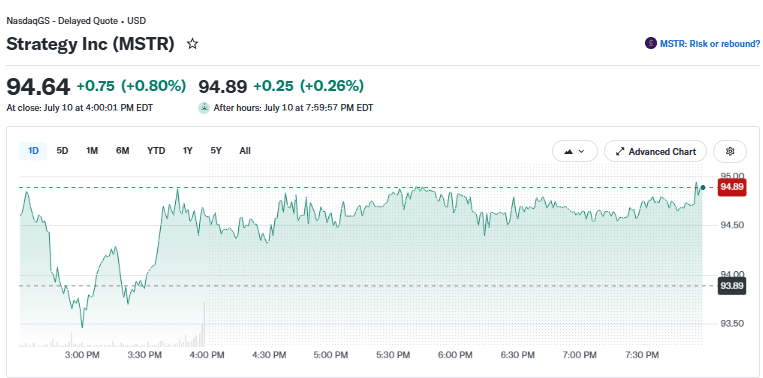
MSTR closed at $97.36 on Tuesday, $93.87 on Wednesday, $93.89 on Thursday, and finished Friday at $94.64, up 0.80% on the day but down about 6% for the week, at a market capitalization of roughly $33.86 billion.
The sale was tiny, under 0.5% of holdings, but the signal was not. A stock that traded for years as a one-way Bitcoin accumulation machine now belongs to a company that sells Bitcoin to pay dividends, backed by a framework of a $2.55 billion USD reserve, about $1.76 billion in annual dividend and interest obligations, and authorization for up to $1.25 billion in Bitcoin sales.
Critics like Peter Schiff piled on, and with the shares sitting far nearer their 52-week low of $81.81 than the high of $457.22, equity holders are now pricing two-way treasury risk.
STRC Preferred Gains 2.07% but Stays Below Par
The preferred side of Strategy’s capital structure fared better than the common stock. STRC, defended by a dividend raised to 12%, gained 2.07% on Friday to close at $87.48 and added another 0.31% after hours to $87.75.
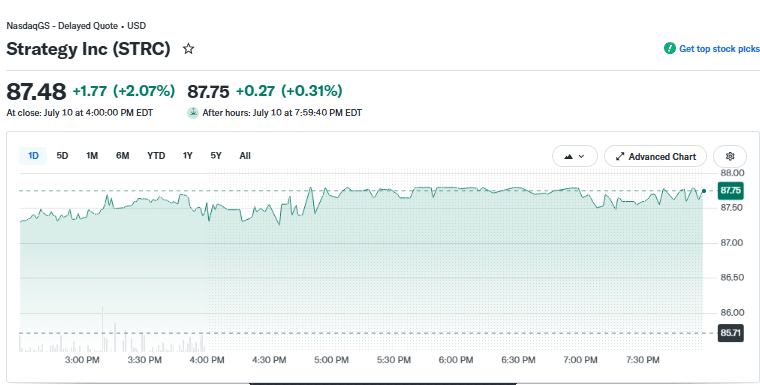
Even so, it remains below its $100 par value, within a 52-week range of $71.25 to $100.42, and Yahoo Finance data shows a forward payout of $10.15 per share for an 11.60% yield at Friday’s price.
The next ex-dividend date is July 15, an early test of whether income buyers trust the new funding approach.
Coinbase (COIN) Stock Slips as Paul Grewal Exits
Coinbase faded all week, from a Monday close of $168.87 through $163.51, $159.36, and $158.44, before a 0.40% Friday gain left COIN at $159.07, down about 3.9% from its July 2 close of $165.48.
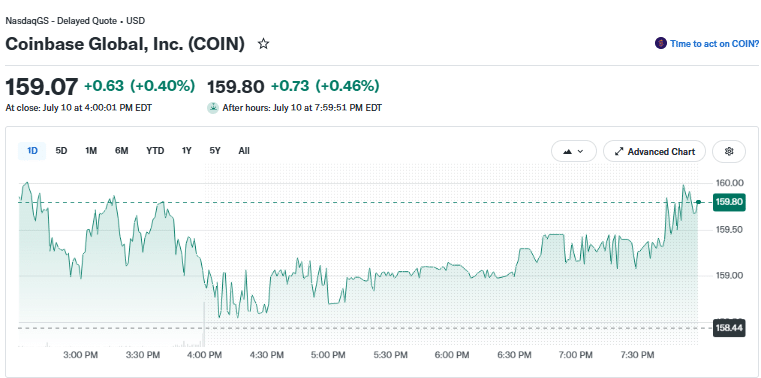
The headline was the exit of chief legal officer Paul Grewal, the man who beat the SEC in court, who is leaving for a still-unnamed startup effective July 31 with an advisory role through October.
Market Reaction: Succession, Not Crisis
Notably, investors treated the departure as an orderly handover rather than a shock. In the first full session after the news, COIN opened at $156.01, dipped to $154.78 intraday, and closed down just 0.58% at $158.44, on thin volume of about 4.68 million shares versus a 9.3 million daily average.
The stock still sits near the bottom of its 52-week range of $139.18 to $444.65, with a $41.9 billion market capitalization and Q2 earnings due July 30 as the first scorecard of the post-Grewal era.
Circle (CRCL) Stock Jumps 5% on Federal Regulatory Approval
Circle was the exception that proves what this market rewards. The USDC issuer closed Friday up 4.97% at $66.14 on 35.16 million shares, more than double its 15.05 million average, after opening at $70.66 and trading as high as $72.86 on reports that it won approval to become a federally regulated institution.
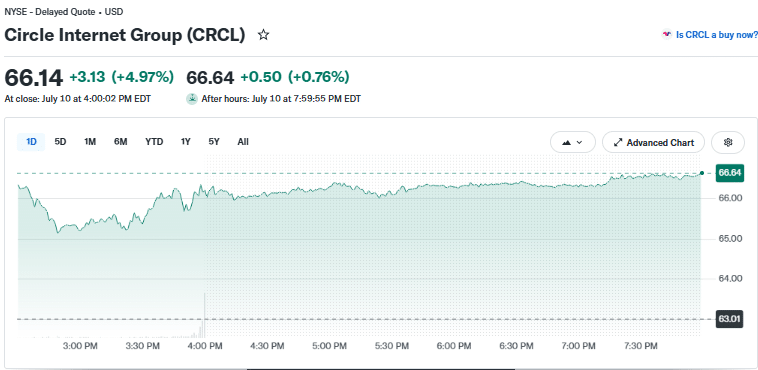
The rest of the week had been a slow bleed from Monday’s $68.65 close down to $63.01 on Thursday, so Friday’s regulatory pop turned a losing week into a gain of about 2.4%.
In a sector where the biggest story was a company selling its own thesis, the one stock that rallied hard was the one that got a stamp of approval from Washington. CRCL remains one of the most volatile large caps around, with a 52-week range of $49.90 to $262.97, a market capitalization of about $17.7 billion, and earnings estimated for August 11.
Robinhood (HOOD) Stock Drops 2.73% Despite Blockchain Push
Robinhood rounded out the losers, falling 2.73% on Friday to $111.97 after a violent session that ranged from $108.81 to $119.35. The stock had closed at $117.55 on Monday, so it surrendered close to 5% from the weekly peak, though it ended down less than 1% against its July 2 close of $112.73.
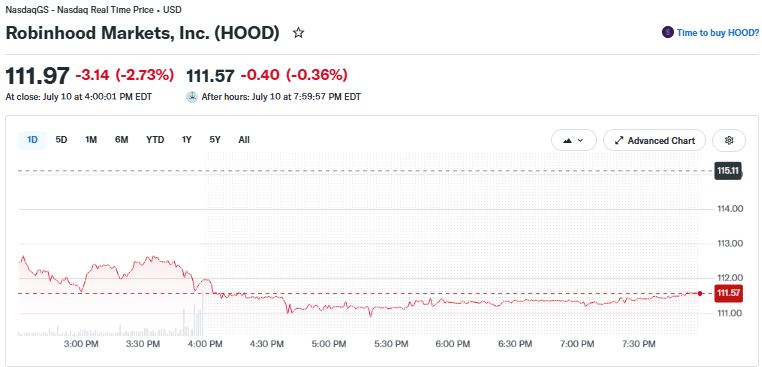
The tension in HOOD is between strong catalysts and stretched sentiment. The launch of its own blockchain and price target hikes from major banks keep the growth story alive, but at 54 times trailing earnings and a $100.83 billion market capitalization, with the Street’s average target at just $117.44, a lot of that future is already in the price. Earnings arrive July 29.
Crypto Tokens This Week: Altcoin Gainers and Losers
While Wall Street was marking down crypto corporations, capital inside crypto did not leave. It rotated, and the destinations were revealing: DeFi infrastructure and privacy coins soaked up the flows that the meme and retail complex bled out.
Top Altcoin Gainers: DEXE, ARB, PYTH, UNI, and ZEC
The weekly leaderboard on CoinMarketCap had a clear character, and it was not memecoins. The names that ran were protocols with visible usage, plus the privacy trade.
- DeXe (DEXE) led everything, up 86.99% on the week to $45.84 with a 23.41% jump in the final 24 hours alone, pushing its market capitalization to $3.83 billion on $161.79 million in daily volume.
- Arbitrum (ARB) gained 21.69% to $0.09565, with its market capitalization recovering to $608.62 million.
- Pyth Network (PYTH) rose 17.54% to $0.04705.
- Uniswap (UNI) added 15.92% to $3.62 for a $2.25 billion valuation.
- Zcash (ZEC) climbed 14.93% to $529.45 and an $8.87 billion market capitalization, extending the move that saw the privacy coin surge 13% above $500 after a bullish breakout on July 8.
Top Altcoin Losers: BONK, JUP, PI, ADA, and MemeCore
The other side of the board was almost a mirror image, dominated by the retail favorites that led earlier rotations this year.
- Bonk (BONK) fell 16.53% to $0.000004017 and a $353.53 million market capitalization in a week when BonkDAO was named among the protocols hit in exploits that cost the industry about $35 million.
- Jupiter (JUP) lost 15.68% to $0.2022.
- Pi (PI) dropped 14.39% to $0.09709, with its market capitalization at $1.06 billion.
- Cardano (ADA) gave back 12.87% to $0.1640, a sharp reversal just one week after it had reclaimed a top 15 ranking with an 18% gain. ADA’s market capitalization now stands at $5.98 billion.
- MemeCore (M) slipped 12.40% to $1.22, valuing the project at $1.61 billion.
Also Read: MARA Stock Jumps 11% After Texas Power Site Acquisition Deal
Ethereum Reclaims $1,800 While XRP and Solana Hold Steady
The majors sat between the two extremes. Ethereum spent most of the week under pressure before crossing back above $1,800 on Sunday, trading around $1,808 to $1,813. XRP held near $1.10, and Solana hovered around $77, neither participating in the altcoin breakouts nor joining the meme selloff.
LAB Token Crash: The 85% Collapse ZachXBT Predicted
And then there was LAB, the token that made every other loser look orderly. It crashed roughly 85%, from around $14 to just under $2 in 24 hours on July 8, wiping out billions in nominal value from a project whose fully diluted valuation once approached $14 billion.
The token then slid to $1.34 and a market capitalization of about $420.7 million as volume spiked 162% to nearly $317 million.
ZachXBT’s Warning and LAB’s Response
On-chain investigator ZachXBT, who alleged in May that insiders controlled more than 95% of the supply, called the crash vindication rather than a surprise, and criticized the exchanges that listed the token for taking no earlier action.
The LAB team broke its silence a day later, blaming heavy selling by large market participants and denying any hack or rug pull, while insisting its roadmap is unchanged. Investor unlocks are still scheduled to begin later this month, which keeps the token firmly on watchlists for all the wrong reasons.
Crypto Stocks vs Crypto Tokens: What Comes Next
Strip away the tickers, and both sides of the market spent the week answering the same question: who do you still trust? Equity investors punished Strategy for touching its Bitcoin, shrugged off a legal handover at Coinbase, and rewarded Circle for a federal blessing.
Token traders paid up for protocols with visible usage and a privacy narrative, dumped the meme complex, and watched an insider-heavy token trace exactly the arc an investigator had drawn for it two months in advance.
Key Dates for Crypto Stocks and Tokens
The near-term calendar will test both verdicts. STRC trades ex-dividend on July 15, Robinhood reports earnings on July 29, Coinbase and Strategy follow on July 30, and Circle’s results are estimated for August 11.
On the token side, LAB’s unlocks loom over the altcoin market, while traders watch whether DEXE and Zcash can hold their breakouts. Bitcoin holding the $61,500 to $64,000 zone made this divergence possible. Whether it holds decides which side turns out to be right.
Also Read: “110 Things More Dangerous Than Spam”: Saylor Says BIP-110 Could Invalidate Bitcoin Transactions