
The LAB token has collapsed roughly 85%, plunging from around $14 to just under $2 in 24 hours and erasing billions in nominal value—a crash that on-chain investigator ZachXBT had spent months warning was coming and one he now blames the exchanges that listed it for failing to prevent.
The crash, and the indictment
By CoinMarketCap data, LAB traded near $2.41 after falling more than 82% on the day, down from an intraday high near $13.79, with its market capitalization cratering to about $754 million from a fully diluted valuation that had once approached $14 billion. Trading volume spiked more than 340% as the token unwound.
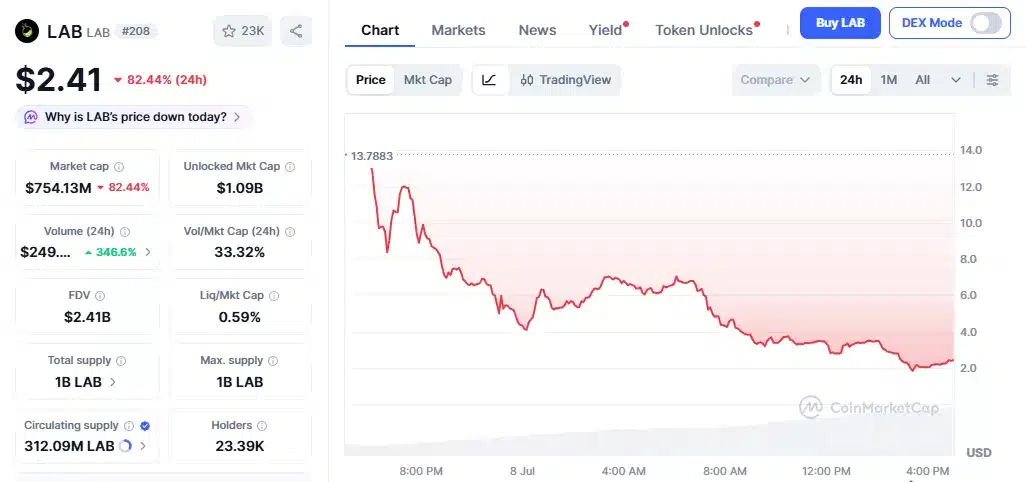
ZachXBT’s reaction was less surprise than grim vindication. “LAB dumped 85% down to just under $2 from $14 ($14B FDV) in past 24 hrs,” he wrote, before turning his fire on the venues that hosted it: “Disappointing to see how no action was taken by Binance, Bitget, & Gate earlier to prevent it. If CEXs cared profits from the accounts manipulating price would be distributed to users at a minimum.”
He reiterated the core of his monthslong thesis, “Insiders have controlled the entire float which lead to extreme price manipulation on CEXs via MM,” and closed with a warning he has repeated throughout: “I do not encourage trading LAB under any circumstances.”
ZachXBT also noted that investor unlocks were scheduled to begin later this month; however, multiple late vesting changes had already occurred in the past.
Months of red flags, ignored
The collapse is the culmination of a story that has been building since spring, one The Crypto Times has tracked since May. LAB launched its token in October 2025 as an AI-powered multi-chain trading terminal, founded by Vova Sadkov and a co-founder identified as Mark—the same team, ZachXBT noted, behind Eesee, an earlier project that he alleged left investors feeling abandoned.
After trading below $1 for months, LAB surged more than 500% in early May with no material product announcement to explain the move, briefly touching a $6 billion FDV. That unexplained pump is what drew ZachXBT’s scrutiny.
In a detailed investigation, he alleged that insiders controlled more than 95% of the token’s supply through a web of OTC deals, private allocations, and undisclosed team holdings, making genuine price discovery effectively impossible. He documented private loan contracts carrying rates as high as 7.5% a month signed on behalf of a BVI-registered shell, alleged that the team unilaterally changed some participants’ vesting cliffs from three months to nine without consent, and pointed to on-chain flows showing tens of millions of dollars in LAB tokens moving to exchange deposit addresses ahead of price spikes.
He also posted a $10,000 bounty for insider documents. Throughout, LAB’s founders issued no public rebuttal, and the manipulation allegations remain unproven claims rather than established findings, but the price action has now traced precisely the arc he described.
The pattern, and the accountability question
ZachXBT has been explicit that LAB is not an isolated case but one instance of a repeatable playbook. He has tied it to a string of similar collapses, including RAVE, RIVER, SIREN, MYX, SKYAI, and the 77% EDGE crash in June, which he attributes to an unknown market maker operating through a cluster of exchanges he has controversially labeled a “Chinese CEX cartel,” with Bitget as the primary venue and Binance and Gate as secondary channels.
The structure is consistent each time: a low-float, high-FDV token, big centralized-exchange listings that manufacture an illusion of legitimacy, retail traders drawn in by impressive market caps, and insiders exiting into that liquidity before the price collapses.
His central demand has been directed at the exchanges rather than the projects: when such manipulation is evident, venues should freeze the profits of the accounts responsible and redistribute them to affected users or delist the token outright, rather than continuing to collect trading fees from the activity. That “Chinese CEX cartel” framing has itself drawn criticism — one user accused him of racism, which ZachXBT rejected, arguing he has criticized Western exchanges like Coinbase in the past and that the label reflects conduct, not nationality.
Bitget, whose founder Shawn Liu he named directly, has not issued a substantive public response to the underlying allegations, and neither Binance nor Gate has addressed his call to claw back manipulator profits in the LAB case.
That silence is, in a sense, the unresolved core of the story. The LAB collapse cost retail holders heavily, while, by ZachXBT’s account, the insiders who controlled the float walked away with the proceeds—the exact outcome he forecast in May. Whether his prediction being borne out changes anything about how major exchanges vet and monitor the low-float tokens they list is the question the episode leaves open.
For now, LAB stands as another entry on a lengthening 2026 list of insider-controlled token implosions and as a case study in a warning that was issued loudly, in public, and in detail—and, retail losses suggest, went largely unheeded.