Robinhood Chain, an AI-native layer-2 blockchain built by Robinhood, has crossed $100 million in total value locked (TVL) barely a week after its debut, a fast start built almost entirely on decentralized lending and one that has already surfaced a tension in what the real-world asset (RWA) chain is actually being used for.
A $100M milestone, a week in
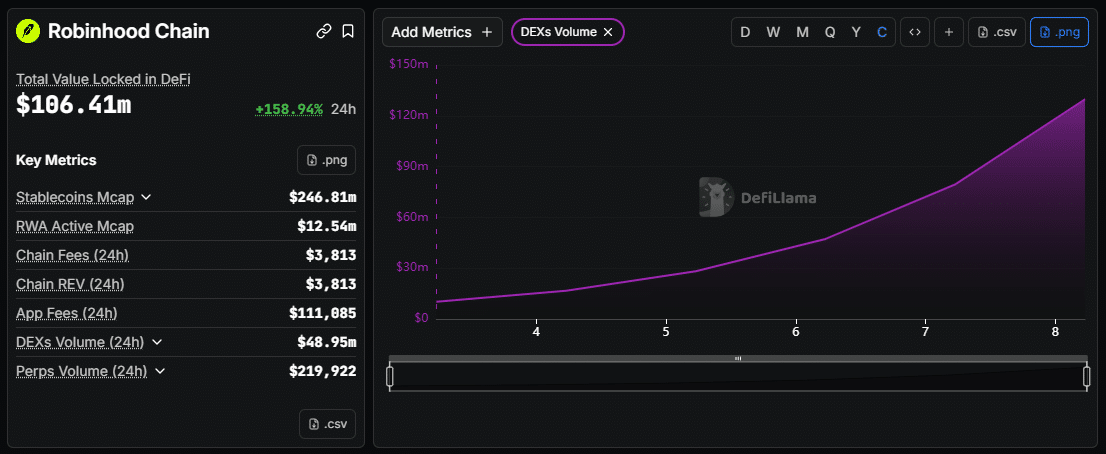
According to DeFiLlama data, Robinhood Chain’s TVL climbed past $100 million and sat near $106 million as of July 8, up roughly 159% in 24 hours, having gone live only on July 1. For a chain that is a week old, crossing nine figures that quickly is a genuine signal of traction and a notable data point for the broader thesis that traditional brokerages can pull mainstream users onto blockchain infrastructure.
The context matters, though. Robinhood Chain is built on Arbitrum’s Orbit stack and launched alongside 24/7 tokenized Stock Tokens in more than 120 countries; a Morpho-powered lending product called Robinhood Earn targeting an estimated 7% yield on the USDG stablecoin; and perpetual futures routed through the decentralized exchange Lighter.
The company brings nearly 28 million funded customers to the effort, giving it a distribution advantage few crypto-native projects can match. But $100 million, while a milestone, remains modest by DeFi standards; many established chains hold billions, and the way that sum is distributed tells the real story.
What’s actually driving it: Morpho, and a $50M vault seed
The overwhelming majority of Robinhood Chain’s TVL is not spread across a vibrant ecosystem; it is concentrated in a single protocol. Roughly $90 million sits in Morpho, the lending platform underpinning Robinhood Earn, with the decentralized exchange Uniswap a distant second at around $13 million and everything else—prediction markets, launchpads—trailing far behind.
That concentration reflects how the milestone was reached. The latest surge was driven largely by the DeFi protocol Ethena seeding roughly $50 million into a Steakhouse Financial USDG vault on Morpho, pushing fresh liquidity into the lending layer behind Robinhood’s yield product.
In other words, the jump past $100 million was powered less by 28 million retail users piling into on-chain finance than by institutional and DeFi-native capital flowing into a yield vault—the plumbing of decentralized lending doing what it does. That is not a criticism so much as a clarification: early TVL on a new chain is often bootstrapped by sophisticated players chasing yield and incentives, and Robinhood is covering gas fees for the first 90 days, which further flatters early activity. The test Robinhood itself faces is whether its actual customers convert to sustained on-chain usage once those incentives normalize.
An RWA chain that ‘works great for memes too’
The more revealing wrinkle is philosophical. Robinhood has positioned this chain squarely around real-world assets—tokenized equities, funds, and eventually private-company shares. Just days ago, CEO Vlad Tenev drew a hard line between that vision and speculation, saying that “the future of crypto is in real-world assets” and asking pointedly, “What’s the benefit of making a million different memecoins?”
This week, his tone shifted. “While we’re building robinhood chain to be the best chain for RWA,” Tenev posted, “it works great for memes too.” The remark is a wink at what the on-chain data already shows: alongside the tokenized stocks and lending vaults, Robinhood Chain’s early protocol rankings include memecoin launchpads like RobinFun and prediction markets such as Hoodbets and Meridian.
A permissionless chain, by design, hosts whatever builders deploy on it — and a network pitched as the serious home for tokenized finance is, in its first week, also a venue for exactly the speculative activity its CEO recently dismissed. Whether that is pragmatism or drift is a fair question; permissionless neutrality cuts both ways, and the “memes too” framing suggests Robinhood would rather capture the volume than fight it.
None of this settles the chain’s prospects, which rest on harder questions than launch-week TVL. Robinhood’s Stock Tokens are structured as tokenized debt securities that provide price exposure without conveying actual equity ownership or shareholder rights—a structure the SEC’s January 2026 guidance flagged for heightened scrutiny.
The chain currently runs on a single Robinhood-controlled sequencer, a centralization point at odds with decentralization ideals. And the parent company is navigating its own headwinds, with crypto revenue down 47% year-over-year in the first quarter and a recent 10% workforce cut. The $100 million milestone is real and fast, but it is a starting line, not a verdict. What it has already exposed is the gap between how Robinhood markets its chain and how the market is using it and a CEO increasingly willing to meet that market where it is.
Also Read: How to Buy Meme Coins on Robinhood Chain: A Complete Beginner’s Guide