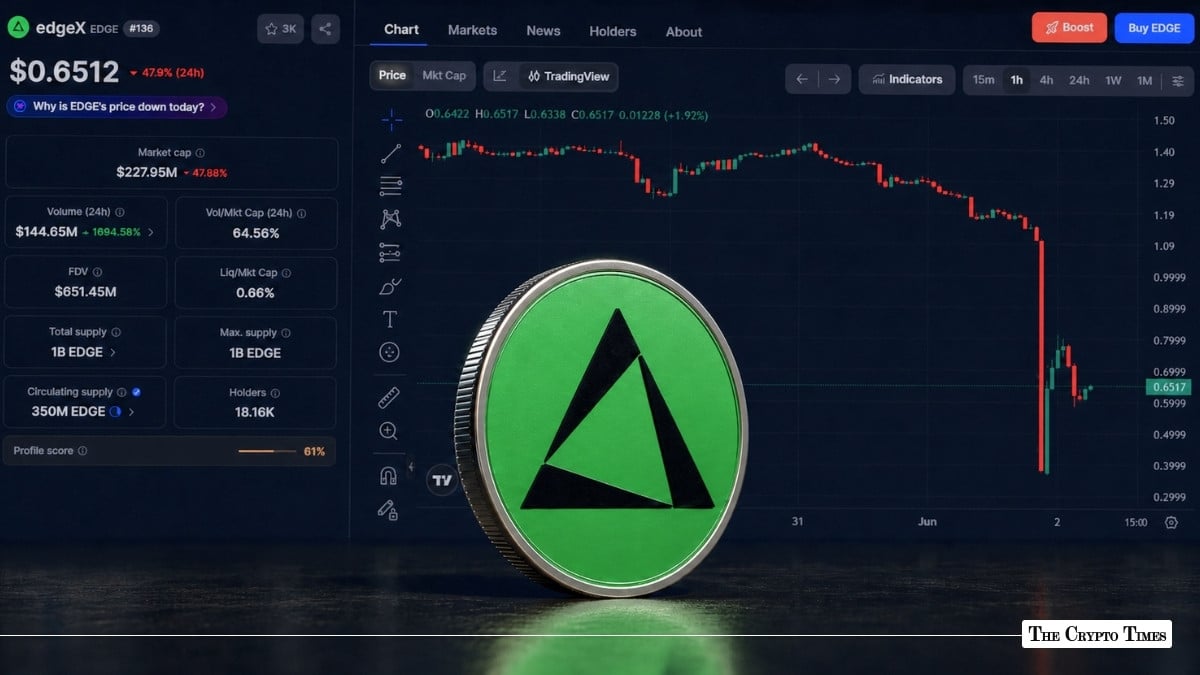
The native token of decentralized derivatives exchange edgeX suffered one of the most violent single-day crashes in recent memory late on June 1, collapsing more than 77% in a matter of hours. A brief recovery to the $0.72 range has since faded, with the token continuing to bleed lower.
The sell-off began around 9:00 p.m. UTC on June 1, with EDGE dropping from around $1.26 to a session low of $0.315 across major exchanges including Binance, OKX, Bybit, Bitget, and Gate.io.
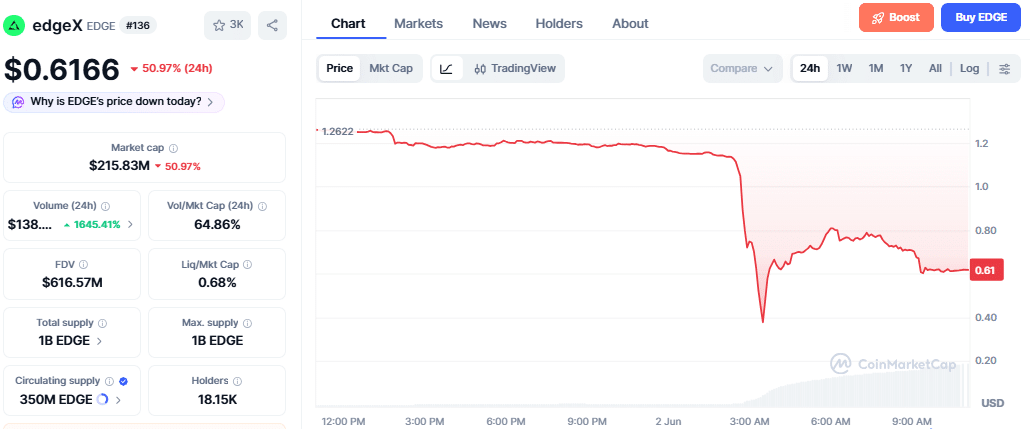
The token briefly recovered to the $0.72 range before resuming its slide. As of the latest update on June 2, EDGE was trading at $0.6166, down nearly 51% over 24 hours, with its market cap slashed to $215.83 million from over $440 million the day prior. The token has also slipped from rank #126 to #136 on CoinMarketCap.
edgeX says it wasn’t a hack
The edgeX team broke its silence in stages. In an initial statement posted on X at around 6:06 AM on June 2, the project acknowledged observing “a sudden and irregular price movement” of the EDGE token and said it was actively investigating. The team urged community members to rely only on official channels for updates and to avoid unverified speculation.
Roughly an hour later, edgeX followed up with a more detailed update, directly addressing security concerns. The team stated that the edgeX protocol “was not compromised in any way” and that the crash was “not a hack, exploit, or security breach.”
Instead, the project pointed the finger outward, stating that its preliminary findings suggest “deliberate attempts by certain external party to manipulate the market price of EDGE.” edgeX described the situation as a “market integrity issue” and said it is working with relevant exchanges and platforms to identify the responsible parties and pursue accountability.
In a separate post, edgeX also clarified that a specific Ethereum smart contract address (0x7f861a7db997b4f6e5ef9954a3b5d5b29c463cb2) is an official edgeX spot contract used solely for user deposits and withdrawals, an apparent move to counter any circulating claims about compromised wallets.
ZachXBT fires back, calls for transparency on market makers
Blockchain investigator ZachXBT, who has built a reputation for exposing insider manipulation schemes in crypto, was quick to challenge the edgeX narrative. In a reply posted roughly an hour after the edgeX statements, he pushed back directly:
“We all know edgeX supply was being controlled by a few insiders with a low float. If you care about transparency at all you will name the counterparties / MM agreements which lead to these events.”
The comment cuts to a recurring pattern ZachXBT has documented across multiple token projects in 2026. In recent months, the investigator has published detailed threads on tokens like LAB and RAVE, where he alleged that insider-controlled supply, opaque market-making agreements, and coordinated exchange activity were used to artificially inflate and then crash token prices at the expense of retail holders.
His demand for edgeX to publicly name its counterparties and market maker agreements puts the project in a difficult position. If the crash was truly caused by external manipulation as edgeX claims, disclosing the identities of its liquidity providers and the terms of those agreements would be the most straightforward way to prove it.
$2.81 million in liquidations, volume spikes over 1,600%
The crash triggered significant collateral damage across derivatives markets. CoinGlass data showed that EDGE-related liquidations reached $2.81 million in just the first four hours of the drop. Of that figure, $1.96 million came from long positions being wiped out, while roughly $849,000 came from short positions caught on the other side.
Trading volume over the past 24 hours exploded past $138 million, a spike of approximately 1,645% from the previous day, according to CoinMarketCap data. The volume-to-market-cap ratio hit a staggering 64.86%, a level that signals extreme distress and climactic selling rather than anything resembling healthy market activity.
On-chain analysts point to coordinated liquidity pull
Independent on-chain analysts began flagging suspicious patterns almost immediately. Analyst givenoxbt pointed out on X that approximately $1.6 million in liquidity was pulled from edgeX’s SpotVault alongside coordinated outflows across Bybit, OKX, Bitget, and Gate.io.
The pattern, described by several market watchers as a “market maker farewell treatment,” is consistent with what happens when one or more key liquidity providers simultaneously withdraw buy-side support from a low-float token. Without that support, even moderate sell pressure can cascade into a full-blown crash as bids evaporate and stop-losses trigger in rapid succession.
EDGE was already structurally vulnerable
The crash did not occur in a vacuum. EDGE has a total supply of 1 billion tokens, but only 350 million are currently in circulation, giving it a relatively thin public float. The fully diluted valuation still sits at around $616 million, nearly three times the current market cap, suggesting that a large majority of tokens remain locked or in the hands of early participants.
This low-float, high-FDV structure has been a recurring red flag across the 2026 token cycle. Many tokens launched through TGEs this year have followed a similar trajectory: initial price discovery, a run to all-time highs, followed by sharp corrections when liquidity conditions change.
EDGE itself experienced an earlier correction in April, dropping roughly 25% from its then all-time high of $1.17 after on-chain analysts identified patterns consistent with coordinated profit-taking. At the time, 24-hour trading volume represented nearly 60% of the token’s market cap.
What happens next
Notably, the tentative support zone in the $0.64 to $0.72 range that formed after the initial bounce has already started to crack. EDGE is now trading at $0.6166, suggesting that whatever buying interest emerged in the immediate aftermath of the crash is fading. Whether that floor holds will likely depend on what the edgeX team reveals in its promised “comprehensive update” once its investigation concludes.
If the project names the counterparties involved and provides verifiable on-chain evidence of external manipulation, it may be able to preserve some degree of community trust. If it doesn’t, the silence will likely be taken as confirmation of the insider dynamics ZachXBT has alleged.
For now, the token remains in a fragile state. A sustained break below $0.60 could open the door to a retest of the crash low near $0.32. The liquidity-to-market-cap ratio sitting at just 0.68% underscores how thin the order books remain, meaning further sharp moves in either direction are very much on the table.
Either way, the EDGE crash adds another entry to a growing list of 2026 token implosions where the line between external man.
Also Read: Gnosis Pay Pauses Bridge Following Active Zodiac Delay Module Exploit