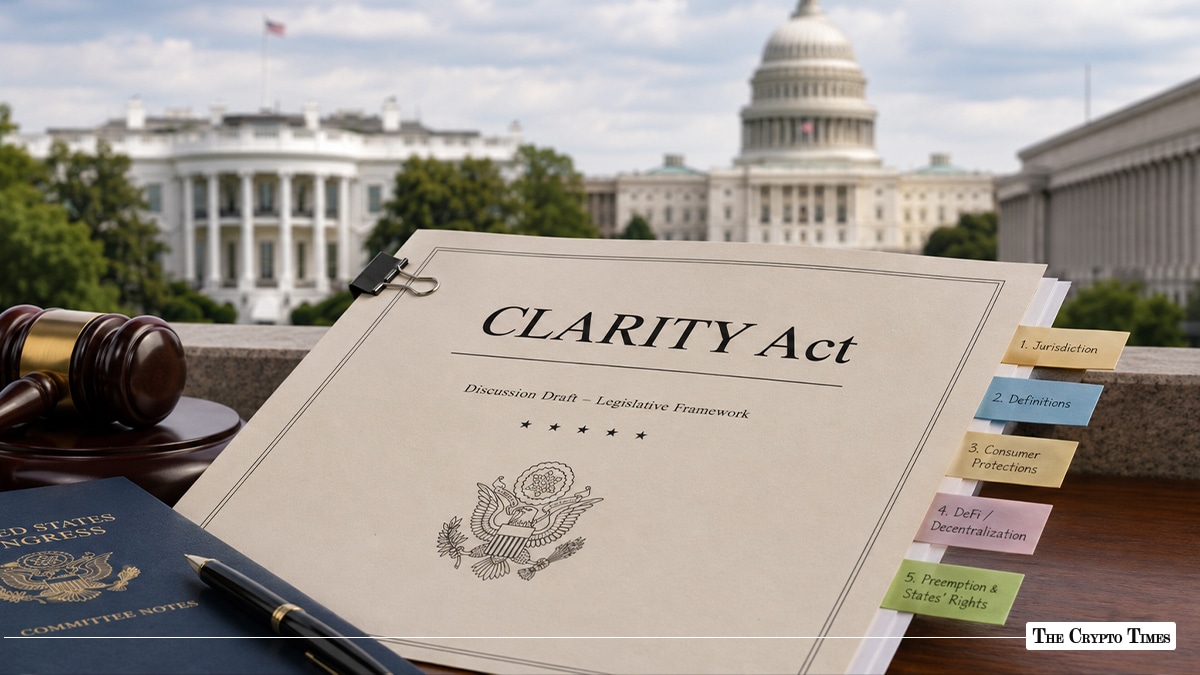
A merged version of the Digital Asset Market CLARITY Act is expected as early as this week, but none of the disputes that have stalled the bill since May have been settled.
The Draft, and the Math
The merged text combines the Senate Banking Committee’s market-structure work — the securities-versus-commodities line, oversight of digital asset service providers — with the Agriculture Committee’s version, which weighs the CFTC’s role and commodity provisions more heavily. Reconciling them means settling definitions, enforcement mechanisms and the SEC-CFTC jurisdictional boundary, the question the bill exists to answer. People familiar with the negotiations say progress has been made, but definitional and procedural gaps remain.
The product adds more than 70 pages of new material, weighted toward consumer protections. Backers want floor consideration the week of July 20. The White House has not signed off on it and skipped the last round of talks.
The arithmetic also moved. President Trump posted on Truth Social on Monday that the Senate should pass the bill in honor of Senator Lindsey Graham, who died on July 11 at 71, warning that China was seeking control of digital assets and AI. Graham’s death narrowed the Republican majority to 52-47 — meaning the bill needs eight Democratic votes for cloture, not seven. That assumes every Republican votes yes, which is not safe: Josh Hawley and Rand Paul both opposed the GENIUS Act, and Mitch McConnell remains absent.
1. Ethics and Conflict-of-Interest Rules
The largest obstacle and the one most likely to decide the bill. Democrats want language barring the president, vice president, senior officials, members of Congress, and their families from profiting from crypto while regulating it.
The dispute hardened after Trump’s disclosures showed roughly $1.4 billion in crypto-related gains, including $635 million from the TRUMP memecoin. Senator Elizabeth Warren wrote to Senate leaders, calling robust ethics rules non-negotiable. Senator Kirsten Gillibrand has said the provision will be in the bill or the bill will not move.
The White House position, that it will accept rules applying across the board but reject anything singling out a specific office, official, or family, was articulated by crypto adviser Patrick Witt. Witt will not be at the table to defend it. He begins months-long Army National Guard training on July 27, with his last day at the White House expected next Friday, handing the file to deputy director Harry Jung. Witt had already postponed the training once to stay through the negotiations; the Guard refused a second delay.
Senator Cynthia Lummis floated a middle path letting state attorneys general sue exchanges that list digital assets issued by public officials. Those talks have stalled. Industry participants warn that overly broad rules could impose compliance burdens or deter qualified people from taking government roles touching digital assets. Democrats regard them as essential to public trust in the legislation.
Senators Ruben Gallego and Angela Alsobrooks, the only Democrats who voted the bill out of committee, have both said their floor support depends on the ethics fix.
2. Developer Protections and DeFi Treatment
The Blockchain Regulatory Certainty Act provisions, carried as Section 604, would stop developers who do not control customer assets from being classified as money transmitters. The DeFi sector has made preserving that language its top priority.
Law enforcement groups resist, arguing the shield would obstruct investigations into on-chain crime. Senator Catherine Cortez Masto has led the Democratic negotiation and pushed back repeatedly on the liability protections. Her office is now working with the White House and Treasury on targeted revisions, according to The Hill.
There are signs of movement. The Major County Sheriffs of America, which raised concerns in May, went neutral last week, citing continued review. Senator Ron Wyden wrote to Senate leadership endorsing how the earlier text handled developer protections.
Negotiators are working on language distinguishing centralized intermediaries from genuinely decentralized systems. Without a shield, developers building protocols, wallets, and infrastructure face enforcement exposure for publishing code, which decides whether that infrastructure gets built onshore or offshore.
3. Stablecoin Yield and Rewards
The banks escalated on Monday. A coalition of 78 banking organizations, the American Bankers Association, the Independent Community Bankers of America, and 76 state banking associations, wrote a joint letter to Majority Leader John Thune and Minority Leader Chuck Schumer demanding revisions to Section 404, the provision governing whether platforms can pay yield or rewards on payment stablecoins.
Section 404 currently bars covered parties from paying interest or yield to restricted recipients for holding payment stablecoins but carves out activity-based rewards, subject to future joint rulemaking by the SEC, CFTC, and Treasury. That carve-out is the May compromise struck in the Banking Committee by Senators Thom Tillis and Angela Alsobrooks: ban yield paid purely for holding and permit narrowly defined rewards tied to usage.
The crypto industry wants clearer carve-outs for rewards tied to lending, staking, or platform usage, rather than a blanket ban on yield. Community banks fund mortgage lending, small-business credit, and agricultural loans from local deposits, and the groups warn that stablecoins paying balance-linked rewards would function as deposit substitutes and pull that funding out of the system. US banks fund roughly 80% of their lending through customer deposits.
Whether the Tillis-Alsobrooks language survived the merger has not been confirmed, and that uncertainty is the story. Tightening it to satisfy 78 banking groups risks alienating the exchange industry, which conditioned its support on the carve-out. The final wording lands directly on issuers including Circle and on any platform building competitive dollar-backed products.
4. SEC and CFTC Commissioner Vacancies
The CLARITY Act would hand the CFTC the largest mandate expansion in its history, making it the primary regulator for spot digital commodity markets. The agency currently has one sitting commissioner.
That is the crux. A commission designed for five members, about to inherit oversight of a multi-trillion-dollar asset class, is running on a single Republican vote. The SEC is only marginally better staffed, with three Republicans and no Democrats. Whoever fills those seats writes the rules the statute only sketches—which is why the vacancies stopped being a personnel matter and became a negotiating chip.
Democrats want two Democratic nominees at each agency before they supply votes. The White House wrote to Majority Leader John Thune and Minority Leader Chuck Schumer saying it had already solicited suitable Democratic names and that none had been put forward. Democrats counter that the administration has refused to engage on independent-agency nominations and appears content to leave the seats empty.
One person involved in the talks suggested Agriculture Committee Democrats could be satisfied if the full five-member CFTC were seated. That makes this the most tractable of the five — and the likeliest to be traded for something else.
5. Federal Preemption and State Authority
The quietest fight, and structurally the hardest. Preemption decides whether a federal registration displaces the state-by-state regime exchanges operate under today—money transmitter licenses in nearly every state, plus New York’s BitLicense—or whether platforms must satisfy both.
Industry wants federal registration to be the ceiling. State regulators and attorneys general want to keep their enforcement authority, and Democrats have treated state-level consumer protection as a condition of support. Lummis’s proposal letting state AGs sue exchanges that list officials’ tokens sits inside this same fight, which is why it stalled alongside the ethics talks.
Related threads remain open on conflict-of-interest rules for exchanges and on restrictions governing affiliate trading. The merged draft is expected to revisit preemption. Negotiators have not signaled where it lands.
What Comes Next
The procedural hurdle survives a merged draft. The bill needs 60 votes for cloture, and moderate Democrats signaling conditional support are tying their votes to ethics and consumer protections.
The calendar binds. GOP leadership wants the floor the week of July 20, but the National Defense Authorization Act competes for time, and the House Financial Services digital assets subcommittee holds a field hearing on the bill on July 17. Senate passage would not finish it—the House must still approve the revised text.
The betting markets have moved hard. Polymarket’s contract on the CLARITY Act being signed into law in 2026 fell to roughly 34% on Tuesday, an all-time low, after briefly touching 24% — a collapse that followed Witt’s departure and Warren’s ethics letter landing on the same day. Galaxy Research had already cut its odds to roughly 50%, down from 75% immediately after the May 14 Banking Committee markup, and Stifel’s Washington policy strategist Brian Gardner says the bill must clear the Senate by the end of July or its prospects deteriorate materially.
Miss the recess and the odds collapse. The post-recess calendar fills with election-year politics, and a new Congress restarts the process. Lummis has warned that failure in 2026 could push the next viable window to 2030.
Industry groups are lobbying both sides, and the White House is pressing for speed. How these five fights resolve determines not just whether the CLARITY Act passes this summer but also how durable the framework it leaves behind turns out to be.