Witnesses Urge Senate to Pass CLARITY Act as Hearing Ends
WisdomTree Chief Legal Officer Ryan Louvar said the United States had already lost companies and innovation to overseas markets and urged senators to pass the CLARITY Act to preserve the country’s leadership in capital markets.
Coin Center Policy Director Jason Somensatto said lawmakers do not need to support every part of the crypto industry to recognize that millions of Americans already use digital assets. Congress, he said, must create rules that protect participants while preserving their freedom to use and develop the technology.
Aberg warned that failing to pass the bill could force the United States to react to standards written abroad rather than setting rules that other countries follow. Subcommittee Chairman Bryan Steil closed the hearing by calling on the Senate to move the legislation across the finish line.
The hearing was then adjourned, with lawmakers given five legislative days to submit additional material and written questions. Witness responses are due by August 21. The official witness panel included Aberg, Abernethy, Louvar and Somensatto.
Hill Explores Tokenized Vehicle Registration and Taxation
Hill asked WisdomTree Chief Legal Officer Ryan Louvar whether governments could tokenize vehicle ownership records to streamline registration and taxation, particularly as electric and hydrogen-powered vehicles complicate traditional fuel-tax systems.
Louvar said blockchain could provide an immutable and transparent database for vehicle ownership, registration and tax records. He said the technology could make administrative processes faster and more seamless than systems that currently depend on separate agencies and extensive paperwork.
French Hill Says Tokenization Bill Could Follow CLARITY Act
House Financial Services Committee Chairman French Hill said Congress intends to continue developing digital asset legislation after the CLARITY Act, including a separate tokenization bill his team plans to introduce once the market-structure legislation advances.
Hill said the GENIUS Act established federal rules for stablecoins, while the CLARITY Act would provide the foundation for the broader digital asset market. The next legislative phase could address how blockchain infrastructure is used to represent and manage financial and physical assets.
SEC-CFTC Coordination Could Unlock Capital, Bullish Says
Abernethy also supported provisions allowing SEC-registered firms to offer digital commodities and enabling closer coordination between the SEC and CFTC.
She said the framework could support forms of dual registration where firms operate across securities and commodities markets, reducing uncertainty where the two regulatory systems overlap.
Abernethy highlighted portfolio margining as one area where coordination could improve risk management. She said more efficient treatment of positions across markets could reduce unnecessary capital requirements and release additional liquidity into the financial system.
Bullish Says Federal Crypto Rules Would Strengthen Consumer Protection
Bullish Head of Clearing and Group Risk Randi Abernethy said a federal digital asset framework would replace the current state-by-state licensing patchwork with consistent requirements across the United States.
She said exchanges would know which activities are permitted, which regulator oversees them and what compliance standards they must meet. A national framework would also ensure that consumers receive comparable protections regardless of the state in which they live.
Abernethy argued that federal licensing could help legitimate platforms scale across all 50 states while bringing capital, trading activity and liquidity back into regulated U.S. markets.
WisdomTree Says SEC-CFTC Uncertainty Delayed Tokenized Gold
Louvar said WisdomTree previously struggled to obtain regulatory certainty over whether its tokenized gold product should be treated as a commodity.
He described the product as a digital certificate of title to physical gold held in a vault, but said the company could not obtain a clear answer from regulators under the previous administration.
WisdomTree ultimately launched the product after concluding that it was operating within the law. Louvar said the CLARITY Act would replace that uncertainty with durable rules defining when an asset falls under SEC or CFTC jurisdiction.
CLARITY Act Keeps Crypto Firms Under AML Rules
Rep. Dan Meuser asked how the CLARITY Act could give legitimate businesses regulatory certainty without creating new gaps for illicit finance or market manipulation.
Coin Center Policy Director Jason Somensatto said the bill would define which intermediaries fall within the federal regulatory perimeter and keep those firms subject to Bank Secrecy Act and anti-money laundering requirements.
He said regulated entities would still be required to monitor transactions for illicit activity. Somensatto added that blockchain analytics can give firms additional tools to identify suspicious wallets, screen customers and detect bad actors operating across public networks.
Blockchain Projects Need Protection From Shifting SEC Policy
Rep. Tim Moore asked why market-structure rules matter for companies developing blockchain applications outside traditional finance.
Nova Labs Chief Legal Officer Sarah Aberg pointed to the SEC’s case against the company, which treated Helium hotspot rewards and optional mapping rewards as alleged securities transactions. She said Nova Labs was building network infrastructure rather than raising capital through public token sales.
Aberg said the CLARITY Act would place tokens powering functional networks under the appropriate CFTC framework, while preserving the regulator’s authority to pursue fraud, manipulation and abusive trading.
“Clarity is not a call for deregulation,” Aberg said. “It is a call for the right regulation by the right regulator.” She added that blockchain infrastructure projects need rules written into law rather than policies that can change with a new SEC chair or administration.
CLARITY Act Would Put Traditional Firms and Fintechs Under Equal Rules
Rep. Scott Fitzgerald asked how the CLARITY Act could create a level playing field between established financial institutions and crypto-native companies.
WisdomTree Chief Legal Officer Ryan Louvar said firms need clear governance, risk-management and compliance requirements, regardless of whether they are traditional asset managers or newer fintech businesses. The bill would also clarify whether an asset or activity falls under the SEC or CFTC.
Louvar said predictable rules would allow both types of companies to continue developing their businesses while giving them greater confidence to build and operate in the United States.
Bullish Says US Regulatory Gap Forced Exchange to Launch Abroad
Bullish Head of Clearing and Group Risk Randi Abernethy said the exchange initially established regulated operations in Gibraltar because the United States lacked an equivalent federal framework when the platform launched in 2021.
Abernethy said Bullish wanted to operate under rules that included investor protections, but only a limited number of jurisdictions offered a suitable regulatory structure at the time. The company later expanded under regulators in Germany and Hong Kong before obtaining a foothold in the United States.
Her response supported Stutzman’s argument that the absence of clear domestic rules has not stopped crypto markets from developing. Instead, it has pushed companies to seek licenses, build infrastructure and deploy capital in overseas jurisdictions.
Stutzman Says CLARITY Act Delay Is Costing US Innovation
Rep. Marlin Stutzman said businesses can plan around regulatory approval or rejection, but not prolonged uncertainty. He argued that the CLARITY Act remains stalled despite receiving strong bipartisan support in the House, leaving crypto companies waiting for a final federal rulebook. Stutzman is a member of the House Digital Assets Subcommittee.
“I can handle a ‘yes’ or a ‘no,’ but I can’t handle suspense,” Stutzman said. He pointed to delayed payment infrastructure, round-the-clock markets and companies establishing operations overseas as costs of Congress failing to complete the legislation.
Stutzman urged lawmakers to move the bill forward, saying the witnesses’ experiences showed how regulatory delays were affecting investment, technological development and the ability of companies to build in the United States.
CLARITY Could Bring Crypto Innovation Back to US
Coin Center Policy Director Jason Somensatto said unclear and shifting regulatory interpretations have pushed American developers and digital asset businesses to structure operations outside the United States.
He said the CLARITY Act would define which entities fall within the regulatory perimeter while protecting software developers and other participants who do not control customer funds. Clearer rules would also give regulators a defined set of companies to supervise for illicit finance, market manipulation and operational risks.
Somensatto argued that the framework could bring investment, talent and technological development back to the United States while preserving protections for individual innovation, open-source development and peer-to-peer technology.
Hill Calls CLARITY Act the Next Step in Bipartisan Crypto Work
Hill traced the House’s digital asset work from hearings on Meta’s Libra project and the collapse of FTX to the passage of FIT21 and the CLARITY Act. He said lawmakers from both parties had spent several years trying to create rules that distinguish functional blockchain tokens from securities investment contracts.
Hill compared the current debate to Congress’ approach to the internet in the 1990s, when lawmakers avoided regulating the underlying network and instead focused on activities conducted through it.
He also pointed to Helium as an example of blockchain technology being used outside traditional financial markets. Hill said statutory certainty was necessary to protect companies from shifting regulatory interpretations and allow innovators to build in the United States.
WisdomTree Says SEC Exemptions Cannot Replace CLARITY Act
House Financial Services Committee Chairman French Hill questioned whether the digital asset industry could rely on SEC exemptive relief if the Senate fails to pass the CLARITY Act.
WisdomTree Chief Legal Officer Ryan Louvar said the current SEC leadership had created a more pro-innovation environment and granted relief that allowed new tokenized products to reach the market. However, he said agency-level decisions could not provide the durable certainty offered by legislation.
“We really need durable rules that are embedded within what Congress has approved,” Louvar said. He added that digital asset classifications, the division of SEC and CFTC authority and regulatory modernization must be written into law so the framework survives changes between presidential administrations.
French Hill Questions Whether SEC Relief Can Replace CLARITY Act
House Financial Services Committee Chairman French Hill raised concerns that temporary regulatory relief cannot provide the same certainty as legislation passed by Congress.
Hill presented a scenario in which the Senate fails to advance the CLARITY Act and regulators instead attempt to support tokenized finance through individual exemptions. He noted that WisdomTree had benefited from SEC exemptive relief before asking why placing the framework in law would be more important for long-term regulatory and legal certainty.
His question highlighted a central argument behind the hearing: agency exemptions can allow individual products to operate, but they may not create consistent rules for the wider digital asset market or bind future regulators.
Tokenization Should Not Be Viewed as a new Asset Class
Louvar said tokenization should not be viewed as a new asset class, but as new infrastructure for holding, transferring and settling existing financial products.
He compared the shift to the growth of exchange-traded funds, which did not create stocks or bonds but made them more accessible, transparent and cost-efficient for investors.
Tokenization could deliver similar benefits by improving settlement speed and flexibility while supporting financial markets that increasingly operate around the clock, Louvar said.
Section 505 Preserves Core Identity of Tokenized Securities, Says Ryan Louvar
WisdomTree Chief Legal Officer Ryan Louvar highlighted Section 505, which would preserve the principle that a tokenized security remains the same security it represents while allowing regulators to modernize the operational rules applied to blockchain infrastructure.
Louvar also told lawmakers that the CLARITY Act could provide greater certainty around digital asset classification and the division of authority between the SEC and CFTC.
“Same regulatory substance, modernized operational mechanics,” Louvar said. He argued that the framework could allow tokenized products to scale without weakening the investor protections attached to traditional securities.
FTX Failure Supports CLARITY Act, Not Affiliate Ban
Abernethy told lawmakers that FTX should not be used to justify a blanket ban on exchange affiliates trading on affiliated platforms.
She said FTX collapsed because an unregulated offshore affiliate misappropriated customer assets, not simply because affiliated entities were allowed to trade. “A trading ban would not have stopped that,” Abernethy said, noting that the conduct was already illegal for federally registered firms.
Abernethy pointed to LedgerX, FTX’s CFTC-regulated exchange and clearinghouse, as evidence that federal supervision worked. Customer assets held there were protected, she said, while the broader offshore group failed.
“The lesson of FTX is to bring these markets inside the federal perimeter,” Abernethy said, arguing that the CLARITY Act would impose customer-asset segregation, capital requirements, surveillance and federal examinations across registered crypto platforms.
CLARITY Act Could Bring Crypto Markets Back Onshore: Randi Abernethy
Bullish Head of Clearing and Group Risk Randi Abernethy told lawmakers that the absence of a federal digital asset framework pushed the company to build under regulators in Germany, Hong Kong and Gibraltar.
She said Bullish entered the U.S. market after receiving a New York Department of Financial Services license last September and is now working with the CFTC and NFA on registrations for a federally regulated exchange, clearinghouse and intermediary.
“We are not asking to operate in the shadows; we are asking for a rulebook,” Abernethy said. She argued that the CLARITY Act would draw a clearer line between the SEC and CFTC and bring digital asset activity under American regulators and investor protections.
CLARITY Act Would End Costly Regulatory Ambiguity, Nova Labs Says
Nova Labs Chief Legal Officer Sarah Aberg told lawmakers that the company spent years and significant resources defending SEC claims that were ultimately dismissed with prejudice. The regulator had alleged that parts of the Helium ecosystem, including rewards offered to users helping map network coverage, amounted to unregistered securities offerings.
“Those were years not spent deploying hotspots, not building emergency communications capabilities, and not connecting underserved communities,” Aberg said. She argued that regulatory ambiguity does not protect investors, but instead delays companies trying to follow the rules while failing to stop bad actors.
Aberg said the CLARITY Act would distinguish digital assets functioning as securities from digital commodities used to operate decentralized networks and assign oversight between the SEC and CFTC accordingly. For Helium, she said that distinction could determine whether the network can expand its hotspot infrastructure and deliver broader emergency communications, broadband access and network resilience.
“Clarity is not a call for deregulation; it is a call for the right regulation,” Aberg said, urging lawmakers to move the bill toward enactment.
French Hill Opens Hearing With Call for US Crypto Leadership
House Financial Services Committee Chairman French Hill opened the CLARITY Act hearing at Federal Hall by returning to a warning he delivered in the same room seven years ago: the United States needed to lead in shaping the global digital asset economy or risk losing innovation and investment to overseas markets.
“Today, we are delivering on that mission,” Hill said, presenting the hearing as the next step in Congress’ effort to replace regulatory uncertainty with a defined market structure for digital assets.
The hearing comes one year to the day after the House passed the CLARITY Act alongside the GENIUS Act and the Anti-CBDC Surveillance State Act. Lawmakers are now examining how the framework could support domestic blockchain development, establish clearer oversight and keep digital asset businesses operating in the United States.
CLARITY Act Hearing Begins in New York
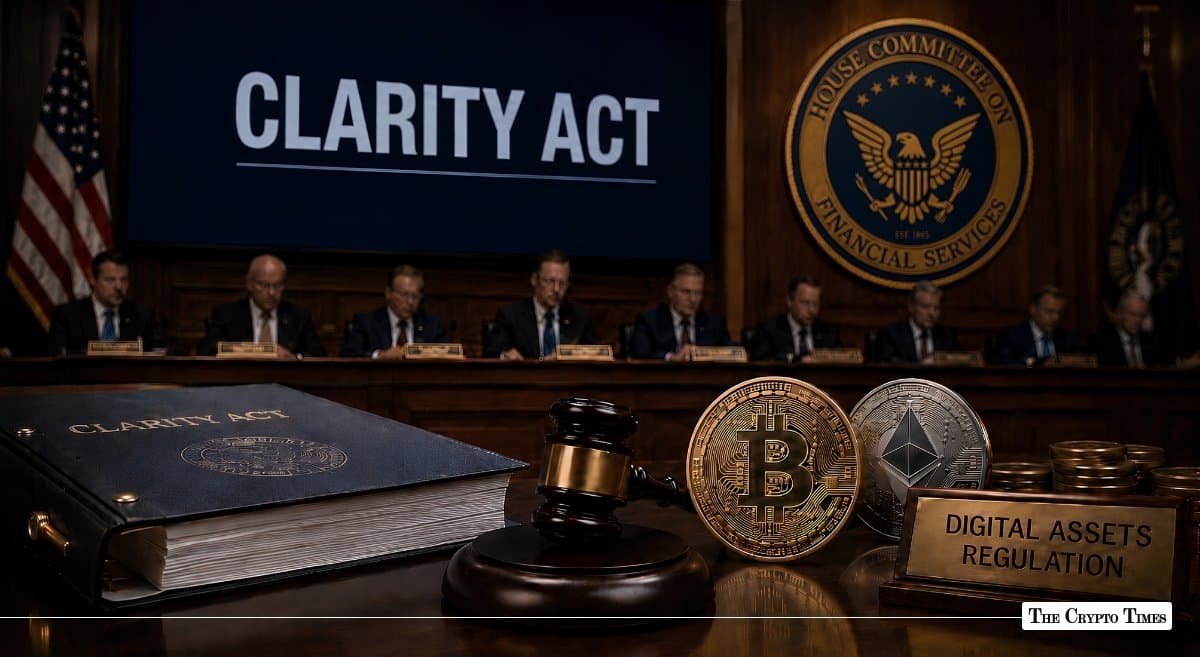
The House Financial Services Subcommittee hearing on the CLARITY Act is now underway at Federal Hall National Memorial in New York City. The session, titled “Building the Future of Finance: How the CLARITY Act Unlocks Innovation,” is examining how clearer federal rules could affect digital asset companies, developers and financial institutions operating in the United States.
Sarah Aberg of Nova Labs, Randi Abernethy of Bullish, Ryan Louvar of WisdomTree and Jason Somensatto of Coin Center are appearing before lawmakers. Their testimony is expected to cover blockchain infrastructure, crypto exchanges, tokenized financial products and protections for open-source developers.
The hearing will also consider H.Res. 111, which supports U.S. leadership in blockchain technology, and H.R. 8957, a proposal to establish a Strategic Bitcoin Reserve and Digital Asset Stockpile for federally held assets.
Crypto Stocks Trade Lower Ahead of CLARITY Act Hearing
Crypto-linked equities were broadly lower ahead of the House hearing. Coinbase shares fell 2.97% to $155.72, while Strategy declined 2.56% to $91.62 and Circle slipped 2.18% to $59.32.
Bitcoin mining stocks recorded steeper losses. Hut 8 dropped 7.75%, Cipher Mining fell 6.97%, TeraWulf lost 6.12%, Riot Platforms declined 6.11% and IREN traded 5.94% lower. BitMine was down 3.66%, while Robinhood fell 7.31% to $98.25.
The widespread losses left crypto equities under pressure as lawmakers prepared to debate the regulatory framework governing the sector.
Bitcoin Holds Near $62,655 Ahead of CLARITY Act Hearing
Bitcoin was trading near $62,655 ahead of the House Financial Services hearing, with its market capitalization at roughly $1.25 trillion. The cryptocurrency recorded about $24.65 billion in 24-hour trading volume, down 18.46%, indicating weaker market activity as lawmakers prepare to discuss the future of U.S. digital asset regulation.
Ethereum traded at $1,807.51 and was down 4% over the previous 24 hours, while its market capitalization stood at $218.13 billion. The price action showed that major cryptocurrencies remained under pressure before the hearing, although there was no clear indication that the declines were directly connected to the CLARITY Act proceedings.
Crypto and Finance Executives Prepare to Testify
Lawmakers are expected to hear testimony from Sarah Aberg, chief legal officer at Nova Labs; Randi Abernethy, head of clearing and group risk at Bullish; Ryan Louvar, chief legal officer at WisdomTree; and Jason Somensatto, director of policy at Coin Center.
The witnesses represent blockchain infrastructure, crypto trading, asset management and digital asset policy. Their testimony is expected to address how the CLARITY Act could affect token issuers, exchanges, investment products, open-source developers and other participants operating across the digital asset market.
CLARITY Act Hearing Set to Begin in New York
The House Financial Services Subcommittee on Digital Assets, Financial Technology, and Artificial Intelligence is scheduled to hold a hearing on the CLARITY Act at Federal Hall National Memorial in New York City. The session, titled “Building the Future of Finance: How the CLARITY Act Unlocks Innovation,” is set to begin at 10:00 a.m. ET on July 17.
The hearing will examine how the proposed legislation could create a federal regulatory framework for digital assets and encourage blockchain companies, developers and financial institutions to build and invest in the United States. The discussion is expected to focus on regulatory jurisdiction, market oversight and the country’s position in global financial innovation.