
VanEck’s Preferred Securities ex-Financials ETF (PFXF) has significantly expanded its exposure to Strategy Inc.’s Variable Rate Series A Perpetual Stretch Preferred Stock, known as STRC.
As of July 16, 2026 update, the holding reached approximately 2.42 million shares valued at $207 million, making it the ETF’s largest position at 8.63% of net assets. With PFXF’s total assets standing at roughly $2.40 billion, this move underscores growing institutional comfort with novel “digital credit” instruments tied to corporate Bitcoin treasuries.
The allocation arrives as Strategy Inc. continues pioneering financial structures that blend high-yield preferred securities with its massive Bitcoin holdings. STRC functions as perpetual preferred equity designed to trade near a $100 par value while delivering variable cash dividends.
The company recently adjusted the annualized dividend rate to 12%, paid on a semi-monthly schedule, aiming to stabilize the security’s price and appeal to income-focused investors seeking Bitcoin exposure without direct cryptocurrency volatility.
Institutional Momentum Builds for Digital Credit Products
This latest purchase by VanEck highlights a broader trend of traditional asset managers incorporating Strategy’s preferred offerings into fixed-income portfolios. PFXF, which deliberately excludes financial issuers to enhance diversification and historically capture higher yields from non-financial preferreds, now channels a meaningful portion of its capital into an instrument indirectly collateralized by one of the world’s largest corporate Bitcoin stacks.
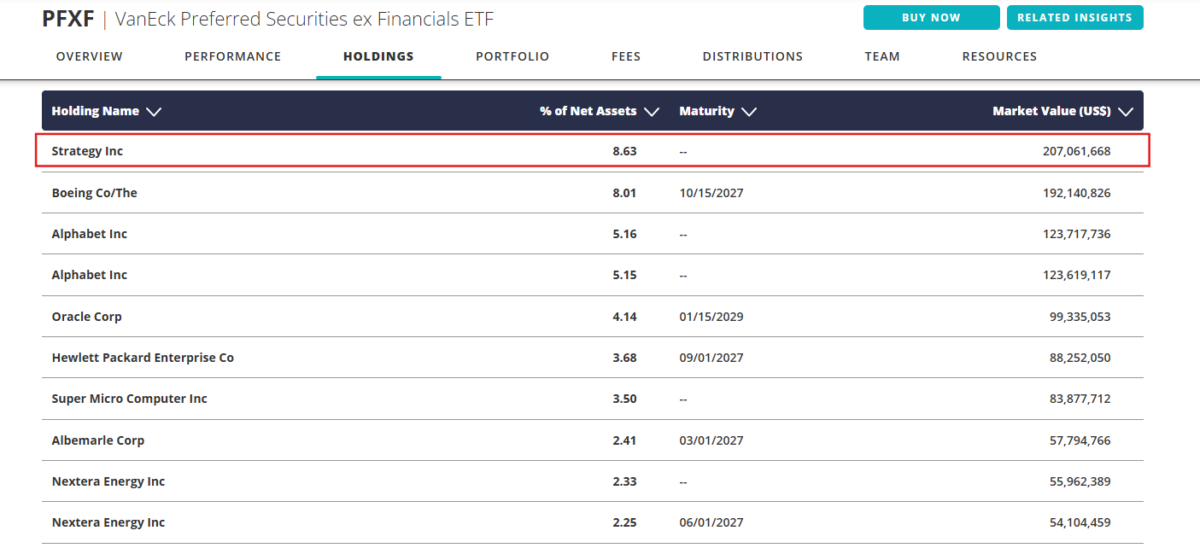
Such allocations reflect confidence in Strategy’s ability to manage its capital structure effectively. STRC and related series provide investors with bond-like characteristics—predictable cash flows and relatively low volatility—while participating in the upside potential of Bitcoin’s long-term appreciation through the issuing company’s treasury strategy.
The ETF’s decision to scale its position to over 8% signals that professional portfolio managers view the current yield and risk profile as competitive with traditional high-yield alternatives.
Other large managers, including BlackRock through its iShares Preferred and Income Securities ETF, have similarly built substantial stakes across Strategy’s preferred complex. These developments illustrate how Bitcoin treasury companies are creating new asset classes that bridge cryptocurrency markets with conventional income investing.
For income-oriented funds constrained by mandates that limit direct crypto holdings, vehicles like STRC offer a compliant pathway to gain exposure.
Market Scrutiny Intensifies as Strategy Navigates Financial Restructuring
Despite the institutional inflows, STRC and Strategy’s broader capital structure have faced notable headwinds recently. The preferred stock traded to multi-month lows earlier this summer, dipping well below its $100 par target amid concerns over sustainability and liquidity demands. Critics questioned whether the high dividend commitments could strain the company if Bitcoin prices stagnate or decline, especially given the perpetual nature of the securities and the lack of maturity dates.
Strategy responded with a comprehensive capital framework announced in late June. The plan includes a strengthened USD reserve policy, the 12% STRC dividend increase, authorization for up to $1 billion in repurchases of its digital credit securities, common stock buybacks, and a selective BTC monetization program to fund reserves if needed.
Executive Chairman Michael Saylor has repeatedly emphasized the company’s unwavering commitment to Bitcoin as its primary treasury asset, framing the preferred issuances as efficient, non-dilutive capital raises that fuel further BTC accumulation.
However, the restructuring efforts have drawn mixed reactions. Some observers praise the proactive adjustments and self-correcting dividend mechanism intended to keep STRC trading near par. Others highlight risks: the company must generate sufficient cash flows—largely through ongoing preferred issuance and occasional Bitcoin sales—to meet dividend obligations without eroding equity value.
STRC’s price recovery has been gradual following the dividend hike and buyback announcement, but it continues trading at a discount, reflecting lingering investor caution.
The scrutiny coincides with heightened volatility across Bitcoin-linked equities. Strategy’s common shares (MSTR) have also experienced pressure, amplifying debates about leverage levels and dependency on favorable capital market conditions. Regulatory filings and earnings discussions reveal ongoing board-level evaluations of dividend rates based on multiple factors, including BTC price action, market yields, and overall balance-sheet health.
While the firm maintains substantial Bitcoin coverage multiples relative to preferred obligations, skeptics argue the model remains untested in a prolonged bear market.
Read: What Stress Testing on Strategy Inc.’s MSTR-STRC Reveals
Broader Implications for Bitcoin Finance
VanEck’s increased allocation arrives at a pivotal moment for the evolving Bitcoin financial ecosystem. By allocating over $200 million to STRC, the ETF provider effectively endorses the viability of digital credit as an investable category. This validation could encourage more traditional capital to flow into similar structures, potentially lowering Strategy’s future cost of capital and accelerating its Bitcoin acquisition pace.
These developments offer a case study in financial innovation. STRC’s design—variable rate resets, semi-monthly payments, and priority claim in the capital stack—attempts to solve longstanding challenges in linking yield products to volatile assets. Success here could inspire other Bitcoin treasury operators to issue comparable securities, expanding the toolkit for corporate crypto adoption.
As of mid-July 2026, VanEck’s bold positioning suggests optimism prevails among sophisticated allocators. Whether this confidence proves well-founded will depend on Strategy’s execution of its restructuring roadmap and Bitcoin’s performance in the coming quarters.
The convergence of traditional preferred markets with Bitcoin collateral represents one of the most intriguing experiments in modern corporate finance, with ramifications extending far beyond a single ETF holding.
Also read: Bitcoin Japan Corp. Aims to Solidify its BTC Treasury with Fresh ¥1.5B in Capital Push