Europe’s crypto rulebook is producing a peculiar outcome: the deadline that was supposed to cull the market appears to be growing it, and the firms joining are not the ones anyone expected.Europe’s crypto rulebook is producing a peculiar outcome: the deadline that was supposed to cull the market appears to be growing it, and the firms joining are not the ones anyone expected.
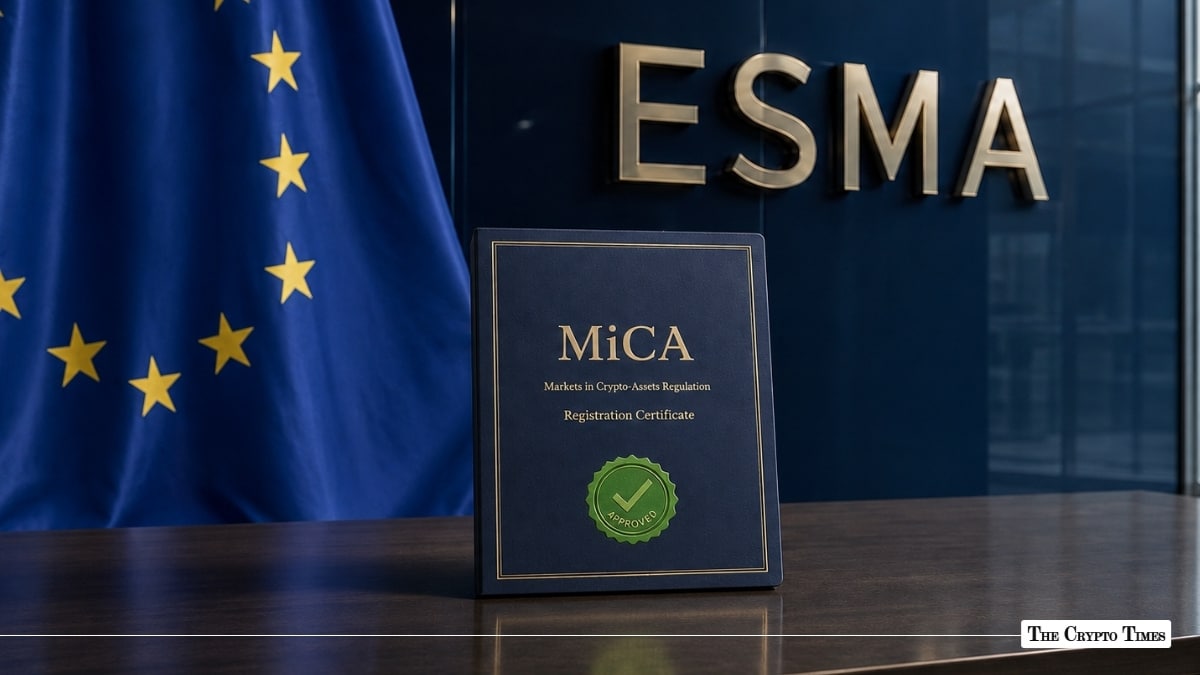
The European Securities and Markets Authority (ESMA) updated its interim MiCA register on July 16, adding 14 crypto-asset service providers and bringing the total number of authorised entities to 294. Among the additions are OSL EU GmbH in Austria, Ripple Payments Europe in Luxembourg, and several banks from Germany, Norway and Portugal.
The Trajectory: 243, Then 294
Follow the register week by week and the shape of the post-deadline market becomes clear.
On June 26, days before MiCA’s 18-month grandfathering period expired, the register listed ~244 authorized CASPs. That cutoff on July 1 forced any firm without full authorization out of the bloc, an attrition rate of roughly 80% against the pre-MiCA population.
Then the queue kept moving. The July 3 update, the first major one after the deadline, added 37 firms to reach 280, including Standard Chartered, prime broker FalconX, Sygnum Europe and Ronin EM. Two weeks later, 14 more brought it to 294.
That is 51 authorizations in three weeks, all after the gate supposedly closed. ESMA republishes the register weekly as national competent authorities feed approvals in, meaning Europe’s licensed market is being redrawn in near-real time rather than frozen at the deadline.
Ripple’s Entry, Confirmed On Paper
The appearance of Ripple Payments Europe formalizes what the company announced earlier this month, when Luxembourg’s Commission de Surveillance du Secteur Financier granted it full CASP authorization. Paired with Ripple’s EU Electronic Money Institution licence, it gives the firm a compliant route to offer both its RLUSD stablecoin and XRP-based payment services to institutions across all 30 EEA countries under MiCA’s passporting regime.
Ripple’s choice of jurisdiction is now a pattern rather than a coincidence. The CSSF has become the address of choice for compliance-first entrants: the register lists Coinbase Luxembourg S.A., authorised in June 2025, when the exchange made the Grand Duchy its European home, alongside Bitstamp, Clearstream, Zodia Custody, Swissquote Bank Europe, B2C2 and Banking Circle. Standard Chartered took the same route in July, naming Luxembourg as the hub for its European digital asset custody business, and it announced its offer to acquire Zodia Custody’s crypto unit in May this year, which sits on the register two lines away.
OSL EU GmbH’s Austrian licence points the other way: an Asian player coming in. OSL Group, listed in Hong Kong, joins a Vienna cohort that already includes Bitpanda, Bybit EU, KuCoin EU, and WhiteBIT EU, evidence that Austria’s FMA has quietly become a viable second door into the single market.
Traditional Banks Take the Field
MiCA’s most consequential effect is not that it disciplined crypto exchanges. It is that it gave conventional banks a licence to sell crypto.
The last two updates make the point. July 3 brought Standard Chartered, plus Crédit Agricole’s CACEIS, added as an e-money token issuer after launching EURXT, a MiCA-compliant euro stablecoin on Ethereum whose first issuance settled a subscription to a tokenized Amundi money market fund. July 16 brought lenders from Germany, Norway, and Portugal.
But the depth only shows in the register itself. The German section is remarkable: Commerzbank, DekaBank, DZ Bank, Deutsche WertpapierService Bank, Baader Bank, Berenberg, MLP Banking, Sutor Bank, V-Bank and Hauck Aufhäuser all hold BaFin CASP authorisations — and so does an entire rank of Germany’s cooperative banking network: Hannoversche Volksbank, Westerwald Bank, VR-Bank Rottal-Inn, VR Bank Südpfalz, Volksbank Raiffeisenbank Würzburg, Volksbank Mittlerer Schwarzwald, Volksbank Raiffeisenbank Bayern Mitte and VR TeilhaberBank Metropolregion Nürnberg. Most are licensed for a single service: execution of orders for crypto-assets on behalf of clients — which is to say, letting ordinary German savers buy Bitcoin through the bank they already use.
Spain tells the same story: BBVA, CaixaBank, Kutxabank, Openbank, Cecabank and Renta 4, mostly for custody, order execution and transfers. France has Société Générale-FORGE, Banque Delubac and CACEIS. Belgium has KBC. Liechtenstein has LGT Bank and Bank Frick. Estonia has LHV Pank. Neobanks are there too: N26, Trade Republic, Revolut’s Cypriot entity, Vivid Money.
This is what regulatory clarity actually buys. A bank cannot offer a product its supervisor considers legally ambiguous; once MiCA defined the perimeter and the licence, the ambiguity ended, and distribution followed. The crypto-native firms got a rulebook. The banks got permission.
Who Else Is On The List
The register doubles as the definitive scoreboard of who may legally serve Europe’s 450 million people: Coinbase, Kraken (via Ireland’s Payward entities), OKX, Crypto.com, Gemini, Gate, Bitstamp, Bitvavo, Blockchain.com, Bitpanda, Bybit, KuCoin, Bullish, MoonPay, Ramp Network, Robinhood Europe, eToro, Trading 212, XTB, capital.com, IG Europe, Interactive Brokers, StoneX, Virtu Financial, BitGo, Paysafe’s Skrill and NETELLER, SwissBorg, CoinShares — and Circle’s French entity, authorised by the AMF in April for custody and transfer services.
Conspicuously absent: Binance, which withdrew its Greek application in June after reports the regulator was set to reject it, and remains outside the regime, even as co-CEO Richard Teng says regulators have since invited the company to apply elsewhere.
The register also records exits. Cyprus-based Stratos Europe, trading as Tradu, carries an authorisation end date of 24 April 2026. Dutch firm Decubate’s entry notes a “voluntary request to revoke authorization by the entity.” Withdrawn licences stay published with the effective date attached, a permanent record rather than a deletion.
One caveat matters for users: MiCA protections attach to the specific authorised legal entity, not to affiliated companies or offshore arms. Being served by a brand on the register is not the same as being served by the entity on the register.
What To Watch
Two things. First, the gap between paper and practice. AMLA chair Bruna Szego told the European Parliament this week that the post-deadline migration is straining compliance at both ends, and reporting suggests unlicensed venues remain reachable by EU users regardless of what the register says. ESMA has drawn a hard line on unlicensed firms, but a licence list is only as good as the enforcement behind it.
Second, whether the bank cohort actually ships. Holding a CASP authorization for order execution is not the same as putting Bitcoin in front of customers, and several of these institutions have taken the licence without yet launching a product. But the direction is unmistakable. MiCA’s authors set out to protect consumers from crypto. The register suggests they may instead have handed crypto its most powerful distribution channel yet — the bank branch.