The European Union’s anti-money-laundering (AML) authority has delivered an uncomfortable verdict on the bloc’s own crypto rulebook: in the short term, MiCA may be making the laundering problem harder, not easier.
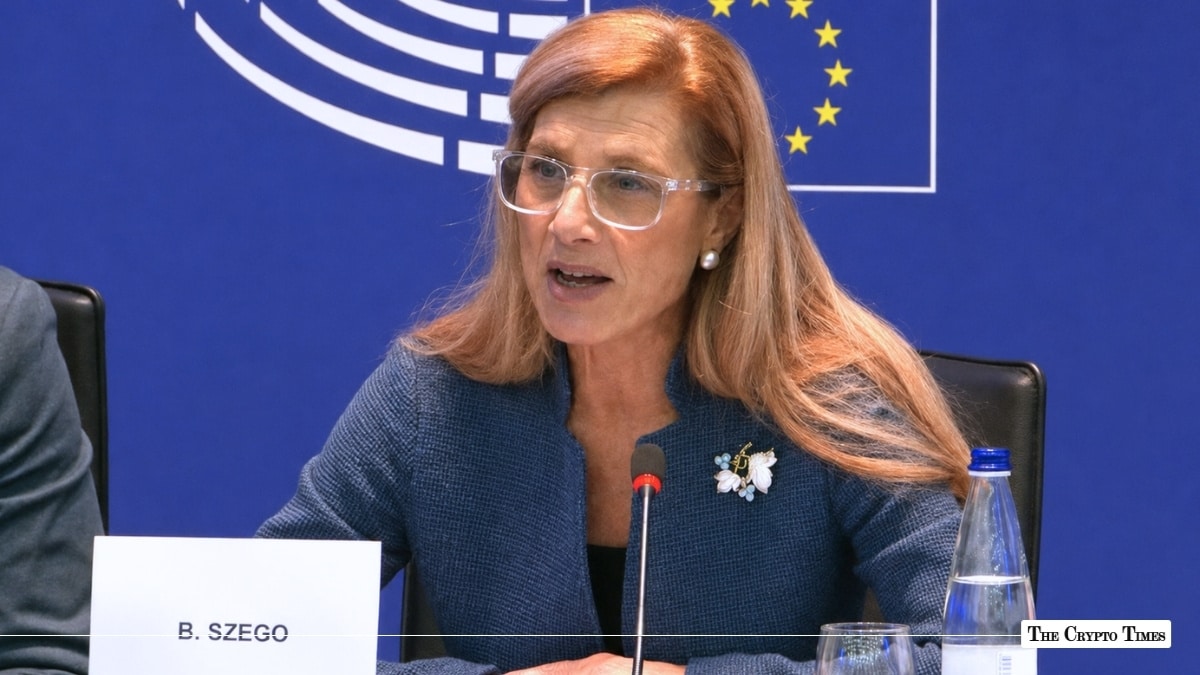
Speaking at a joint public hearing of the European Parliament’s Committee on Economic and Monetary Affairs (ECON) and Committee on Civil Liberties, Justice and Home Affairs (LIBE) on July 15, Bruna Szego, Chair of the Authority for Anti-Money Laundering and Countering the Financing of Terrorism (AMLA), presented the authority’s 2025 annual activity report and fielded MEP questions on crypto supervision. Her assessment of the post-deadline landscape was blunt.
A Migration Under Strain
Szego’s concern centres on the mass movement of users triggered when MiCA’s 18-month transitional period expired on July 1, forcing any crypto-asset service provider without authorization out of the EU market.
That deadline set off a migration in both directions, and Szego argued each side carries risk. Firms winding down face a surge of customers pulling funds out at once: “Because we know that customers will rush to withdraw, this will put additional pressure on these VASPs,” she said, referring to virtual-asset service providers. On the other side, licensed platforms absorbing that displaced business face an influx of new customers, and with it, mounting strain on know-your-customer and anti-money-laundering procedures that were never built for a sudden onboarding spike.
Her message to both groups was the same: maintain effective AML controls throughout the transition, whether you are exiting the market or inheriting its users. AMLA had already published an advisory note before the deadline setting out expectations for winding-down firms and for licensed providers taking on new clients.
Why This Echoes Binance’s Warning
The striking part is who else has been making a version of this argument. Days earlier, Binance Co-CEO Richard Teng stated that roughly 70% of the exchange’s departing European users moved their assets to self-hosted wallets rather than to MiCA-licensed competitors, pointedly noting that self-custody sits under far less regulatory oversight than a licensed exchange.
That claim was easy to read as self-serving, coming from a company locked out of the EU after its Greek licence bid collapsed. It is considerably harder to dismiss when the EU’s own anti-money-laundering chief independently flags compliance strain across the same migration. The two accounts describe the same phenomenon from opposite ends: an industry executive saying the deadline pushed users somewhere less supervised, and a regulator warning that the resulting flows are testing the controls meant to catch illicit money.
None of this vindicates non-compliance, and Szego did not suggest MiCA was a mistake; her framing is about a transitional risk to be managed, not a structural flaw. But it is a notable convergence, and one that sharpens the question of whether a hard cutoff was the right instrument.
The Enforcement Gap Nobody Planned For
There is a second problem running alongside it. The July 1 deadline was meant to settle definitively which firms may serve EU users. In practice, according to reporting from AML Intelligence, major exchanges including Binance, MEXC and HTX have remained accessible to EU users despite lacking MiCA licences, leaving MEPs pressing Szego on how CASP supervision will actually work.
That gap matters more than any single company’s status. MiCA’s promise was a single market with a single rulebook; if unlicensed venues remain reachable while compliant firms shoulder the full cost of authorization, the regime penalises exactly the behaviour it set out to reward. It is also, awkwardly, close to the criticism Teng levelled from the outside, that Europe’s leadership on crypto rules means little if implementation is uneven across the 27 member states.
What AMLA Is Doing About It
Szego used the hearing to set out a concrete response. AMLA will publish a report before the end of 2026 examining money-laundering risks across the crypto sector alongside the supervisory practices national authorities actually use, explicitly comparing how regulators oversee CASPs across member states and identifying divergences that require coordinated follow-up. In a bloc where MiCA licences passport across borders on the assumption that every regulator applies the same standard, that comparison is the most consequential document on AMLA’s calendar.
The authority is also expanding its blockchain analytics capabilities to strengthen oversight of crypto firms, a signal that Europe’s AML supervisor intends to read the chain itself rather than rely solely on the reports firms file. And the clock is running toward a bigger shift: AMLA takes on direct supervision of selected obliged entities from 2028, meaning the crypto sector will eventually answer to a single EU-level supervisor rather than a patchwork of national ones.
Why It Matters
The hearing captures the central tension of Europe’s crypto experiment at its most exposed moment. MiCA achieved what no other major jurisdiction has, a comprehensive, enforceable rulebook, and it did so by forcing roughly 80% of pre-MiCA firms to exit, geofence, or wind down, while a licensed cohort including Coinbase, Ripple, OKX, and Kraken inherits a market of some 450 million people.
But the transition itself has produced exactly the outcome regulators least wanted: a large, hurried movement of assets, some of it into self-custody and some of it, apparently, onto platforms that never got a licence at all. As The Crypto Times detailed in its MiCA guide, the deadline was always going to displace users; the open question was where they would land. Szego’s answer, in effect, is that nobody is yet sure, and that AMLA is building the tools to find out.
For an industry that has spent years arguing regulation would legitimize it, the EU’s experience is a useful corrective: writing the rulebook is the easy part. Enforcing it evenly, without pushing activity into the shadows, is the work that decides whether it succeeded.
Also Read: US Senate Unanimously Opposes Presidential Pardon for FTX’s Sam Bankman-Fried