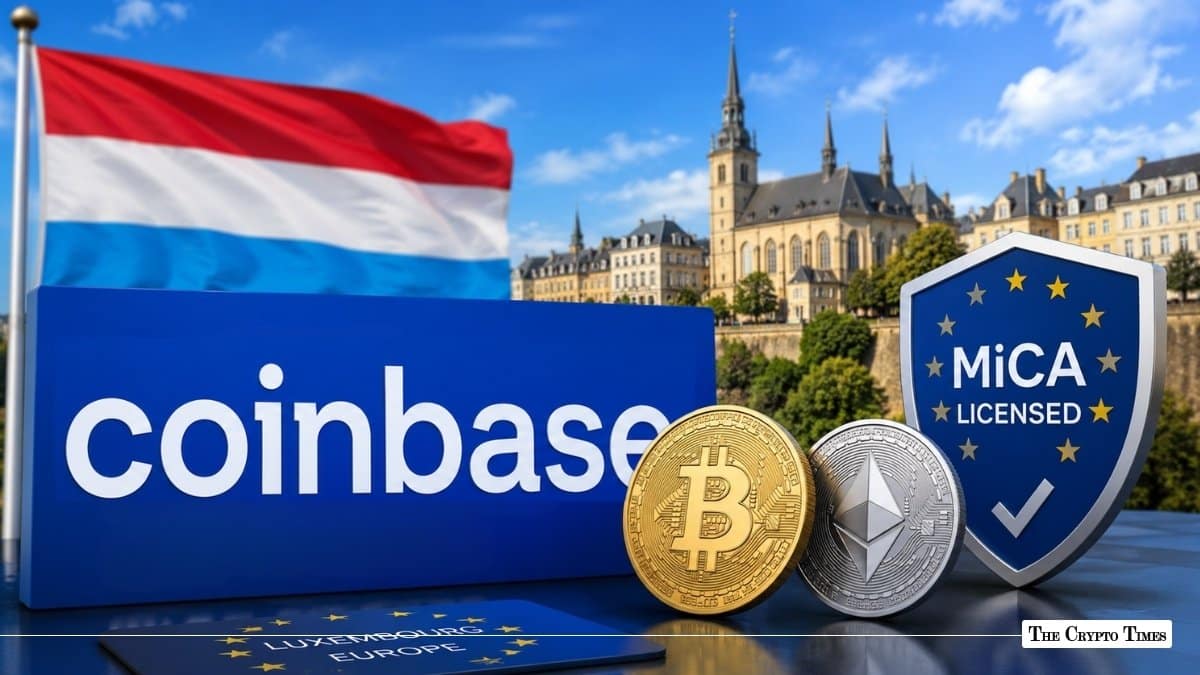
Coinbase has made it official: Luxembourg is its home in Europe. In an announcement marking the opening of its regional hub, the largest US-based crypto exchange declared “Luxembourg is officially our MiCA home” and said it is preparing to welcome users from across the European Union.
The milestone, celebrated as the bloc’s landmark crypto regulation reaches its decisive deadline, cements a regulatory-first strategy that is now paying visible dividends, even as the world’s largest exchange finds itself locked out.
Coinbase Chief Policy Officer Faryar Shirzad opened the Luxembourg office alongside the country’s Finance Minister, Gilles Roth, framing the choice as a strategic bet on the Grand Duchy’s standing in regulated digital finance.
“Today, I had the honor of officially opening our new Luxembourg office alongside Minister of Finance Gilles Roth,” Shirzad said, while also pointing to the country’s thoughtful, innovation-oriented approach to blockchain and digital assets. The opening converts a licence into a physical and operational European base, with Coinbase building out a local team to anchor its EU business.
What the licence unlocks
The foundation is Coinbase’s Markets in Crypto-Assets (MiCA) licence from Luxembourg’s financial regulator, the Commission de Surveillance du Secteur Financier (CSSF). Crucially, MiCA operates on a passporting model: a single licence from one member state authorizes a firm to serve all 27 EU countries, plus EEA members Iceland, Liechtenstein, and Norway, a combined market of roughly 450 million people. That lets Coinbase offer its full suite of trading, custody and crypto-payment services across the bloc under one unified framework, consolidating the patchwork of separate national licences it previously held in countries including Germany, France, Ireland, Italy, the Netherlands and Spain.
Notably, the move marked a reversal of Coinbase’s earlier plan to base its European operations in Ireland, where it had been headquartered since 2023. Frustrated by the slower pace of Irish crypto rulemaking, the exchange pivoted to Luxembourg, operating through a new entity, Coinbase Luxembourg S.A.
Why Luxembourg
Coinbase has been explicit about the appeal: regulatory clarity paired with a pro-innovation posture. Luxembourg has pursued a whole-of-government approach to blockchain and distributed-ledger technology, passing a series of blockchain laws, including its Blockchain Law IV, designed to accommodate digital securities and tokenization alongside MiCA.
For a company positioning itself as the regulated venue of choice for institutional capital, aligning with a jurisdiction that markets itself as the EU’s tokenization hub is a deliberate strategic fit.
The Binance contrast
The timing throws Coinbase’s win into sharp relief. In the same week, Binance, the world’s largest exchange by volume, confirmed that its bid for a MiCA licence in Greece had collapsed, leaving it absent from the European Securities and Markets Authority’s register of authorized providers. The exchange says it still meets MiCA standards, points to a compliance team of roughly 1,500 people, and now plans to seek authorization through another EU member state. But with MiCA’s transition period ending July 1, 2026, the clock is unforgiving: any exchange without a CASP licence cannot legally serve EU clients once the cutoff passes.
Binance’s regulatory baggage looms over the setback. In 2023, it pleaded guilty in the United States to anti-money-laundering and sanctions violations and paid more than $4.3 billion, one of the largest corporate penalties in US history, with Co-Founder Changpeng Zhao pleading guilty and stepping down as CEO. The split-screen is stark: one US-born exchange consolidating its EU access through a flagship licence, the other scrambling for a route to stay in the market at all. The dynamic echoes the recent broadside from OKX Founder Star Xu, who argued that compliance must be embedded in culture rather than measured by headcount.
The MiCA shakeout
Coinbase is far from alone in clearing the bar, rivals including OKX (via Malta), Kraken (via Ireland), Bybit, BitGo and eToro have all secured MiCA authorizations, and more than 200 firms now hold full CASP licences across the EEA. But the deadline is poised to thin the field dramatically; OKX’s own European chief has predicted that as many as 80% of crypto exchanges will not survive MiCA.
Luxembourg, Malta and Ireland have emerged as the licensing hubs of choice, and Coinbase’s hub opening stakes a claim to the institutional end of that consolidating market.
Why it matters
For Coinbase, the announcement is validation of a long-running thesis: that operating within clear rules, rather than around them, becomes a competitive moat once regulation arrives.
By cementing a compliant EU base just as MiCA forces a reckoning, Coinbase positions itself to capture users, institutional partnerships and euro liquidity that may be shaken loose from less-prepared competitors. The deadline that threatens to exile some of crypto’s biggest names from Europe is, for Coinbase, an open door, and Luxembourg is now the threshold.
Also Read: ESMA Draws the Line: Unlicensed Crypto Firms Must Exit EU