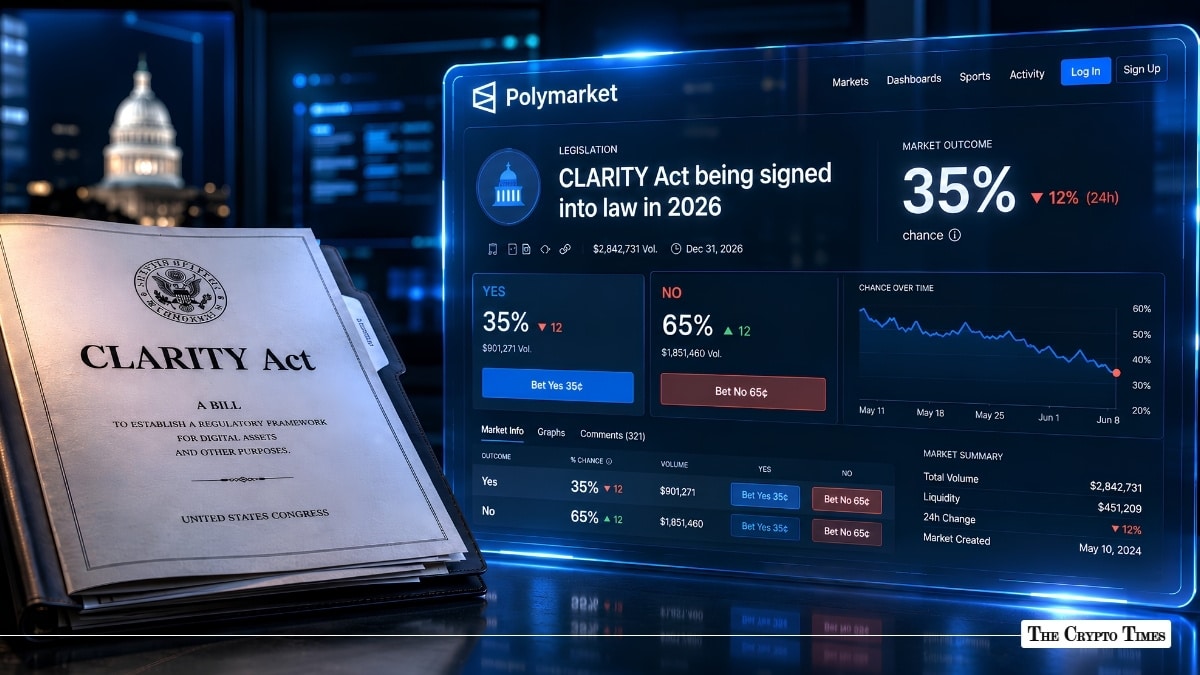
There is a certain irony in crypto’s legislative fate being priced by a crypto prediction market. But the number on Polymarket is doing something Washington’s press releases are not: telling the truth about the CLARITY Act’s chances.
Traders now put the probability of the Digital Asset Market Clarity Act being signed into law in 2026 at roughly 35%.
When The Crypto Times last checked this market on June 22, it sat at 48%, already down from near-70% highs weeks earlier, and already a coin toss. It has shed another 13 points since. The bill has not lost a single floor vote, because it has never reached the floor. The market has cut its chances by more than half anyway.
The Trajectory Tells The Story
The arc is worth laying out, because each turn maps to a specific event. The contract peaked above 80% in February. In early May it surged to 61% after Senators Thom Tillis and Angela Alsobrooks brokered the stablecoin-yield compromise that broke the deadlock, banning passive, bank-like interest on idle balances while protecting activity-based commercial rewards. It climbed further, to around 74%, when the Senate Banking Committee advanced the bill 15-9 on May 14.
Then it began sliding, and never stopped. By June 22 it was 48%. Today it is 35%. Notably, even at that June reading, adjacent prediction platforms priced the odds of a full Senate floor vote before late August at just 27%, traders were already skeptical the bill would get a vote at all, let alone win one.
What Broke This Month
The proximate cause is a document. Senate Banking and Agriculture Committee staff merged their competing versions into a single draft, reportedly adding more than 70 pages of new language with an emphasis on consumer protections; the text that was supposed to unlock floor action during the week of July 20.
Instead, it detonated the coalition. The merged draft omitted the ethics provision Democrats had demanded, language barring the president, vice president, senior officials, lawmakers and their families from profiting off the crypto industry. Senators Chris Murphy, Chris Van Hollen and Jeff Merkley responded by formally opposing the bill.
That is the arithmetic problem in a sentence. The bill needs 60 votes, meaning at least seven Democrats joining a united Republican caucus. The committee stage produced exactly two crossovers: Ruben Gallego and Angela Alsobrooks, both with caveats. The merged text was supposed to add Democrats. It subtracted them.
The Trump Paradox
The most revealing data point is what happened next. On July 13, President Trump took to Truth Social to press senators personally, asking them to pass the market-structure bill in honour of the late Senator Lindsey Graham, and warning that China and other countries want control of digital assets and artificial intelligence. “Don’t let China win on either subject,” he wrote.
The market did not budge upward. On the day of the president’s appeal, Polymarket pricing printed in the mid-20s before settling back into the 30s and 40s across the following sessions; a choppy range, but one that has drifted decisively down rather than up. Senators have since sought to brief Trump directly on the path forward.
For a bill the White House has loudly claimed as a priority, that is a remarkable verdict. Traders are effectively saying presidential enthusiasm is not the binding constraint, and may not even be a positive. The votes CLARITY needs belong to Democrats whose stated objection is that the bill would enrich the president. Disclosures released on June 30 showed Trump earned roughly $1.4 billion from crypto ventures in a single year, most of it from the $TRUMP memecoin and World Liberty Financial. Senator Elizabeth Warren has since written to Senate leaders arguing that any bill without ethics guardrails “would be a flagrant giveaway to the President and his family.”
Every time the president champions the bill personally, he strengthens that framing. His advocacy and the ethics objection are the same fact viewed from two directions.
The Fights That Never Closed
The ethics standoff is the loudest, but it was never the only one — as The Crypto Times detailed in its rundown of the five fights still unresolved before the merged draft dropped.
The yield compromise that lifted the market in May did not settle the question; it relocated it. Banning passive interest triggered a wave of banking-lobby pushback, and on July 13 the American Bankers Association, the Independent Community Bankers of America and roughly 70 state associations wrote to Senate leaders seeking further changes, warning of deposit flight from community banks.
Section 604, the developer shield modelled on the Blockchain Regulatory Certainty Act, has split law enforcement: four major police and prosecutor coalitions oppose it, while the National Organization of Black Law Enforcement Executives endorsed the bill and Senator Ron Wyden has defended the provision as codifying existing federal policy. And the SEC-CFTC jurisdictional seams between the Banking and Agriculture texts remain the technical work underneath it all.
Journalist Eleanor Terrett captured the shift back in June: the Capitol Hill conversation had moved “away from yield and toward securing an ethics deal, bridging gaps between the Banking and Agricultural Committee texts, and the bill’s approach to DeFi.” A month later, none of those three is closed.
The Margin and The Clock
The Republican side has quietly worsened, too. Sen Graham’s death on July 11 at 71, combined with Mitch McConnell’s continued absence, leaves the majority with almost no room for error — the bill needs its seven Democrats without the cushion of a fully intact caucus.
And the calendar is the whole story. The Senate returned on July 13 with roughly four weeks before the August 8 recess, a window nearly everyone involved treats as the last realistic chance for 2026. Past it, lawmakers return to a fall dominated by midterm politics. Senator Cynthia Lummis, who is not seeking re-election, has warned that missing this window could push market-structure legislation as far out as 2030. “Software developers should not need an army of lawyers to know if their code is legal,” she wrote last month. “The Clarity Act ends that absurdity.”
The industry, meanwhile, has been reduced to atmospherics: the House Financial Services Committee convened a field hearing at Federal Hall in New York today, pointedly titled “How the CLARITY Act Unlocks Innovation.”
The Case the Market May Be Underpricing
Traders have been wrong before, and the bull case is not frivolous. The GENIUS Act is the template optimists cite: a contested crypto bill that stalled loudly, looked dead, then moved quickly once leadership concluded the votes existed. Legislative prediction markets have a documented habit of underpricing how fast the Senate can act when it decides to. Galaxy Research still puts passage at roughly a coin flip, Majority Leader John Thune has not abandoned the bill, and lawmakers at the centre of the text keep projecting confidence — Senator Dave McCormick has argued the industry needs “rules of the road that give consumer protection, make sure this industry stays onshore, not offshore,” adding: “We need to land this plane.”
The pessimists’ rebuttal is structural. GENIUS passed because stablecoins had a natural constituency inside traditional finance — banks and payment networks stood to profit from a regulated dollar token. CLARITY’s beneficiaries are exchanges, token issuers and asset managers: a smaller, less beloved lobby, whose costs land on agencies defending turf and on lawmakers wary of blessing an asset class the president trades personally.
Why It Matters
Set the 35% against what everyone else is doing and the cost sharpens. Japan is one floor vote from legalizing Bitcoin ETFs and cutting its crypto tax to a flat 20%. Europe’s MiCA regime is live and already sorting winners from losers. The United States has spent four weeks watching its own bill slide from a coin toss to a one-in-three shot — over ethics language about a president’s personal profits.
Lummis put the stakes plainly earlier this month: “Every month without clear digital asset rules is a month another country writes them for us. That’s not a risk. It’s already happening.”
The market has heard the argument. It is still selling.